Showing posts with label King of the Wind. Show all posts
Showing posts with label King of the Wind. Show all posts
Sunday, March 23, 2008
King of the Wind
This is the story of the founding father of racehorses, Sham, “King of the Wind,” and his friend, the stable boy, Agba. The story begins in Morocco where the sultan sends Sham and Agba off to France as a gift for the king. But the French laugh at the little horse and Sham is sent off to a series of owners, here and there, loved and hated, until he finally ends up in England. It is only in England when the true nature of Sham’s racing abilities are realized through his offspring, three horses who win for their owner prize after prize.

Wednesday, February 28, 2007
King of the Wind
 King of the Wind: The Story of the Godolphin Arabian, written by Marguerite Henry, and illustrated by Wesley Dennis.
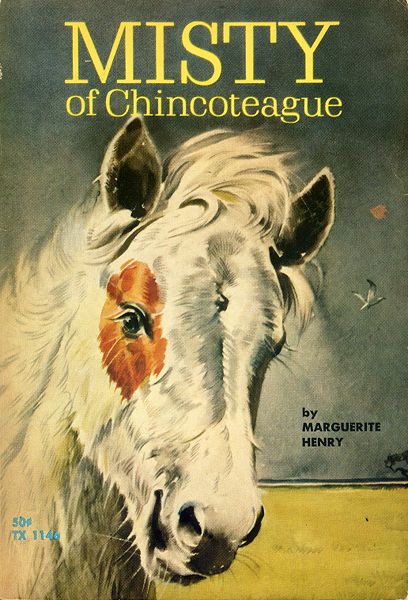
Reading this brought back so many memories that it's hard to review it objectively, though I don't remember it as a particular favorite amongst my collection of Marguerite Henry's books. The story is perfectly (and inextricably) linked with Dennis's illustrations in my mind, and I suspect this is true for many readers -- how many of you read Misty of Chincoteague and now see the pony on the cover in your head?
Dennis and Henry collaborated on over a dozen books over the twenty years that they were friends, and it's clear they really worked together closely. Supposedly, Dennis suggested the story of King of the Wind to Henry after he was commissioned to draw a portrait of the Godolphin Arabian.
Anyway, King of the Wind is many things. First and probably most importantly, it's the story of a boy and his horse, loyal and caring companions for decades. It's a story of fate, symbolized by the omens seen in Sham the horse's markings: the white spot, the symbol of speed, and the wheat ear, a whorl of hair that foretells misfortune. It's a rich look at some exotic cultures (in England as well as Morocco!) and different social classes in the mid-1700's. King of the Wind was the first time I read anything about (or indeed, even heard of) Islam - the story starts out with the fast of Ramadan, and it was amazing how familiar the opening lines of the book were, though it's been over thirty years since I read them:
In the northwestern slice of Africa known as Morocco, a horseboy stood, with broom in hand, in the vast courtyard of the royal stables of the Sultan. He was waiting for dusk to fall.Fasting all day for a month! Royal stables! Jujubes! Obviously this made a lasting impression on me.
All day long he had eaten nothing. He had not even tasted the jujubes tucked in his turban nor the enormous purple grapes that spilled over the palace wall into the stable yard. He had tried not to sniff the rich, warm fragrance of ripening pomegranates. For this was the sacred month of Ramadan when, day after day, all faithful Mohammedans neither eat nor drink from the dawn before sunrise until the moment after sunset.
The story of Agba (the groom) and Sham (the Godolphin Arabian) ranges from the royal stables of an all-powerful Sultan, to pre-revolutionary France and the streets of Paris, to the English countryside, from London's Newgate jail to the lonely fens near the estate of an English earl - the Earl of Godolphin, who ends up providing a home for Agba & Sham. KotW also touches on the many races won by Sham's offspring, with a prologue that starts with Man-o-War at his final race (Seabiscuit is also a descendant, by the way).
A bit of googling reveals that Grimalkin the cat actually existed, but how much of the rest of Henry's story is true is debatable. There may or may not have been a faithful groom that accompanied Sham to France, and many question whether Sham actually served as a carthorse in Paris before being brought to England. There are a lot of legends about the Godolphin Arabian, however, and I think Henry's book capitalizes on this brilliantly.
I think Henry's story of loyalty and redemption really holds up well sixty years after it was written. But I'm a sucker for good horse and dog stories. I suspect my daughter will enjoy this book in a few years (she already is begging for riding lessons), and I will definitely be getting the hardcover with Dennis's original cover - I was aghast to see other covers out there. My son, who is just the right age for KotW, is sadly uninterested, but I may see if I can tweak his interest by reading him a few passages.
Thursday, February 22, 2007
Some Newbery Trivia
I'm working (slowly!) on a post about The Story of Mankind, but meanwhile I thought I'd post about a related book that I got from inter-library loan today: Newbery and Caldecott Trivia and More for Every Day of the Year, by Claudette Hegel (2000). I've been busy sticking post-its in all the spots where there is something interesting about Hendrik Van Loon, like the entry for October 23:
Here's the entry for today, February 22:
Hendrik Van Loon (The Story of Mankind, 1922 Newbery Medal) was once seriously injured in a boat explosion.In addition to the daily trivia (three facts for every day of the year: one about a Caldecott winner, one about a Newbery winner, and one on some other famous piece of children's literature , and a "born on this day" author if there is one), the book has a very detailed name index, title index, references for all of the facts provided, and two appendices: one listing all the Newbery winners and Honor books (formerly known as "runners up"), and one listing all the Caldecott winners and Honor books. I just wish that the book was more recent and covered the books and authors from the last seven years. And that it was more widely available - my copy came from a university library on the other side of the state.
Here's the entry for today, February 22:
Illustrator Wesley Dennis was asked to alter his illustration of the Newgate Jail in King of the Wind (1949 Newbery Medal) because it looked too nice, "like a library." Dennis cheerfully revised the illustrations that he previously had been afraid to make too scary.I'll try and post some trivia in the comments for each book as long as I'm allowed to keep Hegel's book. Heck, I might have to buy it - I've been fascinated by the bits and pieces that I've just read today. And Wesley Dennis is one of my favorite illustrators ever - here's a post I did last year, gushing about him, with examples of his work. I actually remember reading King of the Wind (and most of the other Marguerite Henry books) as a child. I think I might pick that for my next read.
Author Arthur Yorinks used his profits from Hey, Al! (1987 Caldecott Medal) to buy property in rural Nova Scotia. Many birds inhabit the area.
J.M. Barrie sent the manuscript for Peter Pan to his publisher in an untidy brown-paper parcel without even a cover letter saying the work was for publication.
Subscribe to:
Posts (Atom)

 Posts
Posts