Showing posts with label The View from Saturday. Show all posts

Thursday, February 12, 2009

The View from Saturday

I was predisposed to like The View from Saturday, by E.L. Konigsburg, because From the Mixed-Up Files of Mrs. Basil E. Frankweiler was one of my favorite childhood books, and remains a favorite today. And I like reading about smart misfits, having been one myself, especially in junior high school.

But the four kids' stories in The View from Saturday didn't really grab my interest. The kids' voices didn't seem quite right to me, and as soon as I got used to one character - bam, a new point of view appeared.

There were a few passages that made me laugh, or nod my head in agreement, like the ones below - but in general, I just couldn't seem to connect to the characters or their situations. They never seemed real to me - except when Nadia gets mad at everyone and stays home watching daytime tv and decides that everyone is either pathetic or disgusting - that I could see myself doing when I was 11 or 12 year old.

Here are a few passages that I liked, anyway:

There were times in school when a person had to do things fast, cheap and without character (pp. 9-10).
Such public displays of affection can be embarrassing to a prepubescent girl like me who is not accustomed to being in the company of two married people who like each other (p. 27).

I read a book a few years ago called Ballyhoo, Buckaroo, and Spuds, by Michael Quinion (entitled Port Out, Starboard Home: And Other Language Myths in the U.K.), which includes a rather lengthy discussion of the origins of the word posh. And as much as I liked the Grandpa's song in his flying "laboratory" in Chitty Chitty Bang Bang:
"O the posh posh traveling life, the traveling life for me
First cabin and captain's table regal company
Pardon the dust of the upper crust - fetch us a cup of tea
Port out, starboard home, posh with a capital P-O-S-H, posh...

...my inner word nerd didn't really approve of Julian's use of this folk etymology to score points in an academic contest (see Quinion's essay on the origins of tip here). Then again, it wasn't as easy to fact-check stuff like this in the pre-Google era, and I certainly didn't know all of the "Fifteen Questions with Thirty-Six Answers" that Konigsburg adds to the end of the story.

Fact: Mrs. Konigsburg is pretty perceptive when it comes to describing people's reactions to physical disability and to subtle bullying amongst 6th graders.

Further Fact: The slightly mystical part of the story - Epiphany, The Souls, the choice of the teammates, Mr. Singh's statements to Mrs. Olinski, all the little synchronicities, and (most unreal of all) - the kids coming together and not fighting at all - didn't work so well for me.

And like Aunt Sara, the whole use of the noose as a team symbol bothered me - though its use as a racist threat wasn't as prevalent in the 90's as it is today (see an interesting article on "The History of the Noose"), it still made me uncomfortable. It didn't jibe well with what I saw as the other symbols in the story - the cups of tea, or the calligraphy and fountain pen, for instance. Then again, symbolism is not really my cup of tea.

I can't help agreeing that kindness is something that 6th graders and teachers really need. So even though many of the disparate pieces of The View from Saturday just didn't work for me (and why the title? I don't like it when the reason for the title isn't explicit in the book), I can see why many others - especially adults who like to speculate about the decline of Western civilization - like this book.

Thursday, March 20, 2008

The View from Saturday

The View from Saturday by E.L. Konigsburg

This book kinda sorta was about a team of young middle school kids who work together and go to the Academic Bowl.

If this was a linear world, and this book was a documentary, that’s what you’d say this book was about.

Instead, Konigsburg tells a circuitous story, of four misfits and their misfit teacher, who develop a friendship amid a hostile world. In the process, they not only create their own, kinder world, but they gentle the world around them.

Monday, November 12, 2007

The View from Saturday

Cross-posted at my blog.

I read The View from Saturday for the Newbery Challenge. I'm enjoying reading the Newbery books for this challenge so much that I just might set myself a personal challenge to read every Newbery Medal winner.

In this novel for kids from about 8 to 12 years old, four sixth graders form a trivia team. Their coach is their social studies teacher, who has been away from teaching for ten years due to a car accident which left her confined to a wheelchair. The four sixth graders are connected in other ways, mostly through their grandparents. Their strengths complement each other, and this, combined with dedicated practice, helps them become an unbeatable team.

I found the dialogue, especially that of the kids, stilted and not a very good reflection of how kids this age actually speak. Nadia, the only girl on the team, doesn't use contractions at all. In theory, I think this sounds like a good way to portray Nadia as a serious, intelligent girl, but in practice, it makes her sound pompous. I'm pretty sure that in real life, Nadia would be mercilessly picked on by the other kids, who would imitate and mock her odd speech patterns. Instead, Julian (my favorite character) is picked on because he wears shorts with knee socks (which I do think is realistic). None of the four kids care about what their peers think of them, though; in fact, they don't seem interested in any social interaction with anyone but each other.

Other than some problems with dialogue, though, this was an enjoyable story, and I particularly liked the sections taking place in Florida, where three of the kids' grandparents live.

My favorite character, Julian, is Indian, and he has grown up on cruise ships, where his father has worked. At the time the novel takes place, though, Julian's father has bought a bed and breakfast in the town where the others live, and Julian becomes friends with them by inviting them to a tea party via coded messages.

As I suspected, Konigsburg herself was a teacher. Children's books that take place mostly in schools so often seem to be written by school librarians or teachers. And why not? Who else could even try to write realistic scenes taking place in a classroom? It's funny when Snape verbally abuses the kids at Hogwarts, but kids know that Snape couldn't get away with that in a real, non-magical school.

Konigsburg has a new book being published this year, The Mysterious Edge of the Heroic World. I can't really say yet that I'm looking forward to reading it, but I am looking forward to seeing reviews about it that will help me decide whether to read it.

Saturday, July 14, 2007

Kids' Views of The View from Saturday

First-year teacher makes a bad choice.

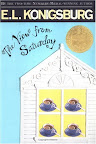
My 7th grade students actively hated Konigsburg’s, The View From Saturday (TVFS). From the cover, showing teacups and a Victorian architectural feature (“looks boring”), to the substance (the first major chapter focuses at length on the wedding of grandparents at a Florida retirement community), to the pedantic qualities (laboriously-constructed symbolism involving a heart-shaped-jigsaw, for instance, and vocabulary and history and natural science and trivia and morality lessons incorporated into the plot), to confusing use of repetition (some incidents are related from the point of view of more than one character).

In the manner of the recent Newbery controversy around the word “scrotum,” some of my students could not get over what seemed like a gratuitous reference to bra straps and (to them) titillating use of the word “puberty” on the second page.

After my class finished the book, I found comments inside the back cover where Konigsburg described using four separate short stories from her files to construct TVFS around a common theme. Although she wrote that readers have told her that, “fitting all the stories together is part of the adventure,” it was the disjointed origins of the stories that came across to me as I read the book.

One more thing. The main characters of TVFS form a team to compete in the middle school Academic Bowl. The principal of a competing school tells their teacher, “I told our coach that she could expect to be hung if she lets your sixth grade grunges beat us out.” The teacher replies, “I recommend that you start buying rope.” Apparently because of this conversation, the noose becomes the symbol for the team – their fans wear small nooses on their shirts, they hang a noose from a car antenna, and grandparents have custom-made t-shirts with nooses sold as a fundraiser. I did a double-take when the noose began to reappear as a symbol, and had to go back and comb through the book to figure out its origin and meaning. In what universe would thoughtful adults encourage the use of a noose as an inspiration for a school team of any kind?

The theme of building diverse communities through kindness to others is lovely, of course, and the one bright spot for the kids involved learning about sea turtles. For the most part, though, the book read like an out-of-touch adult’s idea of what a contemporary adolescent should care about, not what a young reader would actually want to read.

Newbery Committee makes a bad choice?