Saturday, March 13, 2010

2010 When You Reach Me

When You Reach Me by Rebecca Stead is a fascinating novel with a number of story lines. While I enjoyed the book (and stayed up until 12:30 in the morning to finish it, which speaks volumes), I wonder if the seconday story lines will be understood by young readers who might not have previous knowledge to support full interest. Certainly it appealed to the Newbery panel!

The novel takes place in 1979 and is narrated by twelve year old Miranda, who lives with her mother. Miranda experiences the pains of growing up while a mystery surrounds her. Miranda's mother is excited about being on the $20,000 Pyramid, a television game show which was popular in the 1970s. Along with her mother's boyfriend, the family helps the mother practice for the show. This story line might be an unknown for young people today.

Another story line, which is at the heart of the mystery, focuses on Madeline L'Engel's book A Wrinkle in Time and the idea of time travel. Marcus, who becomes a friend to Miranda, has theories on time and space. If one were unfamiliar with L'Engel's book, perhaps this story line might also have some gaps. Of course the simple answer to this problem is to read L'Engel's classic book and start over.

I liked this book. I didn't love it. The writing and tone were good and I wanted to get to the bottom of the mysterious notes. Overall, When You Reach Me should hold broad appeal for the age range Grade 5-8, which is where we have placed the book in our collection at the library.

TITLE: When You Reach Me
AUTHOR: Rebecca Stead
COPYRIGHT: 2009
PAGES: 197
TYPE: fiction
RECOMMEND: A slightly off-kilter book for middle school students - should spark good discussion

Monday, March 1, 2010

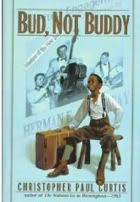
Bud, Not Buddy by Christopher Paul Curtis

Bud,Not Buddy,Christopher Paul Curtis,Herman E. Calloway

Bud, Not Buddy
by Christopher Paul Curtis

This book won the 2000 Newbery Medal for "the most distinguished contribution to American literature for children" and the award is well-deserved.

Set in Flint and Grand Rapids Michigan in 1936, the story covers three tumultuous days in the life of Bud Caldwell, orphan, age 10. Bud's single mom died when he was six and he has lived in the orphanage and various foster homes since. Bud's already wise to the system. So wise that he can feel sorry for the six-year-old who's being sent to a foster home in the most recent "deployment" from the orphange.
...Six is a real tough age to be at. Most folks think you start to be a real adult when you're fifteen or sixteen years old, but that's not true, it really starts when you're around six.

It's at six that grown folks don't think you're a cute little kid anymore, they talk to you and expect you to understand everything they mean. And you'd best understand too, if you aren't looking for some real trouble, 'cause it's around six that grown folks stop giving you little swats and taps and jump clean up to giving you slugs that'll knock you right down and have you seeing stars in the middle of the day. The first foster home I was in taught me that real quick.

(If that doesn't break your heart, what will?) To cope with his world in which children must be "too wise, too soon", and can't trust any adult, Bud has composed "Bud Caldwell's Rules and Things for Having a Funner Life and Making a Better Liar Out of Yourself". Sprinkled randomly throughout the book (#3, #63, #29, #16 etc), they're a melange of timeless childhood advice, hilarious reasoning, and poignant realizations.
Bud's busting out of the padlocked shed his newest foster parents have locked him in, and he's off to find his unknown father. When she died, his mother left a half-dozen small stones inscribed with letters and numbers, and five different flyers for the jazz band Herman E. Calloway and the Dusky Devastators. Bud is convinced that Herman E. Calloway is his father.

This is a young adult book that will be enjoyed by adults and adolescents alike. Bright and polite Bud narrates his own story and, although he relates the precarious position of an orphan during the Great Depression, he never sounds like he feels sorry for himself. Life is full of unpleasant situations but with his self-authored book of "Rules and Things...", he can find a way to deal with anything. You'll be uplifted by his story.

I rate Bud, Not Buddy 4.5 out of 5 stars.

Friday, February 26, 2010

2010 - When you Reach Me


I just finished reading When You Reach Me, by Rebecca Stead. It won the Newbery award this year, so I figured it would be worth reading.

I found the book rather disappointing. In the last few pages, all of the bizarre and confusing things that happened through the book are all explained, and everything falls in place but the fact is that until that moment, the book is hard work to get through. I think it's unlikely that my kids, anyway, would persist through to that Ahah! moment, and so would dismiss the book with their usual designation of "boring."

Added to that, the book relies heavily on the reader being familiar with "A Wrinkle in Time", a book which (yes, I know, it's heresy) I can't stand. So, if you're familiar with Wrinkle, and if you liked it, perhaps this will resonate with you. But it really didn't work much for me.

Here's a review that completely disagrees with me.

Thursday, February 11, 2010

Some Great Reviews and Links on Newbery Winners

are going up now in Elizabeth Bird's blogging on the "Top 100 Children's Novels". She's updating every day or two, and has done 24 books so far (starting at #100 and counting down), and some of my favorite Newbery winners have already been listed. The covers and video clips she finds are amazing.

Wednesday, February 3, 2010

Crispin: The Cross of Lead, by Avi, 2003


Recently I read Avi’s Newbery winning young adult novel, Crispin: The Cross of Lead. My initial opinion was that it was extremely well-written. I was especially enamored of Avi's descriptions of life in and around a tiny medieval English village. The death and burial of Crispin’s mother, Asta, set the scene for traumatizing upheavals in young Crispin’s life. Before long he was an outcast, his home burnt, his name dishonored. A false accusation sent him running into the woods for safety.

Crispin’s sole possession, a cross of lead, was a common one at that time. His mother wrote something on it but since he had no education, he couldn’t read it. At the age of thirteen, a rather young age for the main character in a young adult novel, Crispin set out as a fugitive to make a life of his own.

Though thirteen is young for the main character in a young adult novel, Crispin: The Cross of Lead should not be classified as middle grade, in my opinion, because of the subject matter, which includes violence. My library has it labeled 'young adult'. Perhaps Avi chose this young age for Crispin because this is intended to be the start of a trilogy, and during subsequent novels he will be growing older.

Toward the end of the novel there were a few events that I couldn’t believe Crispin could be capable of. My suspension of disbelief wavered. I was also distressed by his tendency to disobey -- something that normally would get a child in a lot of trouble! Instead Crispin managed to be a hero each time his disobedience surfaced. This annoyed me, yet I was happy that he wasn’t destroyed by the enemy and that he lived to disobey again.

Compared to other medieval age historical novels on the Newbery list, I thought this one to be one the best. Others I’ve read include The Door in the Wall, which bored me, and Adam of the Road, which is sweet but simplistic compared to today's standards.

Avi’s story-writing talents are well-developed and current. As I’m also a writer of middle grade and young adult novels I cannot help but spot anything that’s not on the current PC list for writers. Older Newbery Medal winners sometimes make me shake my head thinking, “If that book was written now it would never get published,” because it breaks the rules that I, as a modern writer, must live with. Avi’s books, of course are cream of the crop... a good source of novels we more modern writers can learn from.

Crispin: The Cross of Lead kept my interest and did not disappoint. I loved reading it! I also liked Avi's novel, The True Confessions of Charlotte Doyle, which was named a Newbery Honor Book in 1991.

My book review blog: Linda Jo Martin.
My children's literature blog: Literature For Kids.

Sunday, January 24, 2010

Young Fu of the Upper Yangtze

You know, a fair number of adults today seem to enjoy Young Fu of the Upper Yangtze, by Elizabeth Foreman Lewis. A couple of my friends have said positive things about it, and it's got an average rating of 3.56 on goodreads.com, which gives it more stars than 1/3 of the other Newbery prize winners. The Allen County Newbery Book Discussion Group even rated it relatively high (at 61 out of 88).

I can't figure them out. I liked Secret of the Andes more than Young Fu! Heck, I actually had more fun reading Dobry. And it's not that I don't like reading about historic China. I liked The Good Earth when I read it in high school, and I liked it even more when I read it again a couple of years ago (interestingly, Pearl S. Buck wrote an introduction to Young Fu of the Upper Yangtze for the 1973 edition that I checked out of the library).

Unfortunately, unlike the characters in The Good Earth (which won the Pulitzer Prize 1932, the year before Young Fu won the Newbery...hmmm, is there a connection?), I found the characters in Young Fu of the Upper Yangtze rather uninspired. Downright boring, in fact. I kept waiting for Young Fu to do something exciting, but even his minor transgressions were disappointing to me (unlike Johnny Tremain, for instance, another Newbery-winning apprentice whose flaws kept me reading).

I thought Scholar Wang was going to be an important character in his own right (especially as he appears in the first chapter), but he seems to exist mainly to embody "Classic Wisdom" (p. 10), to provide the means for Young Fu to learn to read and write, and for Young Fu to be able to show appreciation for the elderly and to display compassion when Scholar Wang is sick.

The women in Young Fu are even more disappointing. Fu Be Be, Young Fu's mother, is portrayed as rather stingy, short-sighted, and superstitious, and there really aren't any other important female characters in the book. The idea that men in Chungking (modern Chongqing) considered women to be foolish, emotional, and weak is often mentioned, and although it is clear (I hope!) that this is an historic cultural perspective, it is unfortunate that this idea is not countered by a single remotely sympathetic female character - with the possible exception of a blond foreign doctor (or possibly a nurse). I don't think it's true that girls don't enjoy boy's coming-of-age stories, but I don't think that too many girls today would enjoy this one. And it is just discouraging to keep reading about women's roles in this society without ever hearing their voices, like you do in The Good Earth.
Girls always cried during the tedious moons of foot binding. He had seen them often enough in the village, though a few of the farm women kept their daughters' feet of natural size that they might help in the fields. But this was not common. Everyone agreed that it was better to stand the agony of foot binding than the stigma of possessing large feet. And even though deformed feet permitted a woman to work only around the house, they were important in getting a husband.....He, Young Fu, was glad that his mother's feet were small; that she was not a coolie woman was plain for all to see (p. 39).
I didn't mind reading about the mechanics of making brass (although Young Fu is apprenticed to a coppersmith, the story revolves around brass), and of the selling of pots, kettles, braziers, and trays, but I thought Lewis was at her most interesting when she was describing the city of Chungking itself. The city streets, steaming paving stones, shops, the tenement in Chair-Makers' Way, and the soldiers, political activists in the tea shops, and the deadly flood - I thought that all of these things were much more interesting than hardworking, virtuous Fu Yuin-fah. But I really want more than a travelogue and history when I'm reading historic fiction; I want interesting characters and a compelling plot, too!

The chapters in Young Fu are rather disjointed - each chapter reads like a separate story, which works well for some books (like The Graveyard Book, for instance), but didn't help keep my flagging interest in Young Fu's story. Lewis' frequent use of proverbs annoyed me, too, even when I agreed with the sentiments. They just seemed a bit trite and forced to me:

Laziness never filled a rice bowl (p. 16).

At birth, men are by nature good of heart (p. 54).

Character is made by rising above one's misfortunes (p. 149...doesn't this contradict the previous one?).

He who rides on a tiger cannot dismount (p. 180).

Medicines are bitter in the mouth, but they cure sickness (p. 197).
The story (in my edition, anyway) concludes with ten pages of Notes by Alison R. Lanier, updating readers on some of the technological and political changes that have taken place between Young Fu's original publication in 1932 and the printing of the new edition in 1973. Since almost as long a timespan has passed since the Notes were written ("Planes reach almost any part of China the same day. Many of the planes are British turbo-jets; others are of Russian make", p. 259), with some pretty major changes occurring in China, I think it's time for an update of the update.

Wednesday, January 13, 2010

The 2010 Newbery Winner Will be Announced...


...next Monday, January 18.

I've read some of the contenders already:

When You Reach Me, by Rebecca Stead
The Evolution of Calpurnia Tate, by Jacqueline Kelly
The Dunderheads, by Paul Fleischman
Charles and Emma: The Darwins' Leap of Faith, by Deborah Heiligman
Anything But Typical, by Nora Raleigh Baskin
Written in Bone, by Sally Walker
Catching Fire, by Suzanne Collins
Season of Gifts, by Richard Peck

and I'm on the library wait list for Where the Mountain Meets the Moon, by Grace Lin, and Claudette Colvin, by Phillip Hoose. From reading at the School Library Journal's Heavy Medal blog, I think that Stead, Lin, and Hoose are the front runners. But I know that the both the critics' and popular favorites are quite often not chosen. Tune in next week for the results.

Dobry

Well, I didn't really hate Dobry, by Monica Shannon, but then again I didn't have very high expectations for this 1935 winner.

I liked reading about the round of seasonal chores in a Bulgarian village. A lot of the story reminded me of an old-fashioned ethnography, with its dispassionate depictions of the peasants plowing, planting, hoping for rain, taking their cows to mountain pastures, harvesting tomatoes and peppers, winnowing wheat, and making bread (note the hanging peppers and the bread and oven on the cover). There were some mildly interesting and exotic words to ponder, and a few nice descriptions of food:
Roda served cherry sladco to all her guests. They sat on three-legged stools around the jamal fire which had only new air to warm up because the windows looking onto the village street were open to let the music of rain and the smell of rain come into the room. Grandfather brought in a tubful of red peppers at a time and got out a jug of sauerkraut juice from a cubby-hole back of the jamal. Peppers went on strings so fast that he could do nothing at all except serve his guests and refill the pepper tub (p. 35).
I think sladco is some kind of sweet, but it's not listed in my food dictionary or the Oxford English Dictionary, and when I Google sladco I get a thousand hits for a Russian candy company. A jamal is apparently some kind of clay fireplace stove (again, too many hits, given its popularity as a first name). I also liked the spelling of "bowlder" for boulder, the Wickerwockoffs, the descriptions of the tunnels through the snow in the village in the winter, and some of the Christmas and New Year's traditions that Shannon describes, although at times it seems like she's trying to load as many extraneous facts about Bulgarian culture as she can onto poor Dobry's shoulders.

The "massaging Gypsy bear" - first mentioned on the second page, and then appearing periodically - is just bizarre. Did such a thing really exist? Did this bear not have claws? Was it really that exciting to have a bear walk on your back? It's a little hard to believe that this gave "every peasant man in the village" something that "wiped out all thought of his summer toil and gave him the feeling that a long vacation gives to other men (p. 93)".

I don't know if the gypsy bear was stranger than when Dobry envies the older men in the village who have icicles on their chest hair in the winter. When Dobry says "I'll be proud the day I can stride in here, clinking at the chest. It's a noise I love even better than the noise of sledge bells on our oxen (p. 131)", all I could do was goggle at the page in disbelief. And then there's the idea that if you sneak a piece of pig's skin to munch on at night from the slaughtered animal hanging in your house, the ghost of the pig will ride on your back. But these passages did keep me from being bored, as I was with some of the other Newbery winning exaltations of "simple" cultures (see Secret of the Andes and ...And Now, Miguel, for instance).

But what happened to Dobry's father? He must have died sometime after Dobry was born (there's a story about him on the day of Dobry's birth), but no one seems to mourn him, not even Dobry's mother, Roda. Then again, it was hard to care much about any of the characters in the book, given the way they are portrayed. Dobry is interested in art instead of farming, but this big conflict in his life isn't even mentioned until page 80 (of a 176 page book). He's really just a generic happy Bulgarian peasant boy and his mother is a hardworking farm wife. Dobry's grandfather is a hearty man who is most notable for the number of things he is able to keep in the sash belted around his waist (on page 46, this includes "two loaves of bread, a goat cheese, garlic, and his tall wooden salt-and-paprika box," along with six tomatoes!), and of course his ability to melt snow with his body heat.

I really didn't like the illustrations by Atanas Katchamakoff (including the original cover), and agreed with Alicia's comments on them. I didn't like the stories that Grandfather told in the book, either - I think my least favorite was the story of Hadutzi-Dare and the Black Arab. I did wonder why the illustration for this story was listed in the front of the book as "Heidout-Sider Pulling the Water Buffalo with a Chain" (are Hadutzi-Dare and Heidout-Sider different translations of the same hero?), but not enough to research it after a cursory Google didn't enlighten me. I also didn't like the fact that the chapters are neither titled nor numbered, and that the only way you can tell it's a new chapter is by the fact that there's an illustration on the upper third of the page.

I didn't much care for Shannon's descriptions of Dobry's art, either:
Only youth could have brought the freshness Dobry brought to his Nativity, and only a primitive genius, Indian or a peasant like Dobry, could have modeled these figures with strength, assurance, sincerity - untaught in any school (p. 146).
I would be very surprised to hear that any kids today care for this book.

Friday, October 30, 2009

Johnny Tremain

Here are some of the things I liked about Esther Forbes' 1944 Newbery winner, Johnny Tremain. The historical characters - stocky, practical Paul Revere, proud businessman John Hancock, and Samuel Adams with his shabby house - are all portrayed in an interesting and not overly simplistic way. They're real, complicated characters, not icons of the Revolution.

The colonial setting is also very well drawn, and Forbes has included many details about life in the late 18th century - especially food (syllabub! salt alewives, apple, mince, pumpkin and plum tarts, squabs, "a wreath of jellied eels" and "tipsy parson - white bread tied into little knots, buttered and baked", p. 58-59), and the apprentices' work, and a bit about the Puritans' religious strictures, and the general feel of the busy wharves of Boston. In addition to the silversmiths (Johnny starts out as an apprentice silversmith), there are also clockmakers, wool weavers, barbers, butchers, tailors, bookbinders, instrument-makers, printers, delivery boys (or "horse boys", which Johnny becomes, with some wonderful descriptions of his horse, Goblin), as well as chimney sweeps, oystermen, and knife-grinders. Boston and its hinterland of smaller towns and farms really is shown in a historically accurate (as far as I can tell) and colorful manner.

I did not like the cover. Peter D. Sieruta blogged about the different Johnny Tremain covers (some with Johnny in a tricornered hat and some without), but I have to say that this is one of the few Newbery winners where I think that recent covers are actually an improvement over the original. Seriously, Johnny's pale, ghostly face and the lines of redcoats and huddled houses made it harder for me to pick the book up and start reading it than it should have been. I did like the black & white illustrations every few chapters, though they weren't especially memorable.

Johnny himself is an interesting but often not very likable character, starting out with his thoughtless name-calling ("pig-of-a-louse"!), and his bullying of the "whitish, flaccid, parasitic Dove" (p. 3). He doesn't treat the women in his life very well, either, taking them for granted, pulling away from Cilla when she needs him, and then only getting interested in her when it appears she might be involved with his friend Rab.

Johnny does carry the story, though, and this is true partially because of his flaws. He does mature, and I liked how he thought better of his dead mother and the sacrifices she made as the story developed. His understanding of his own personal shortcomings and his increasing knowledge of politics and subsequent patriotism are also heartening to read about.

Paragraphs like the following infodump, however, reminded me a bit too much of the history I didn't like reading in high school (it wasn't until I got to college that I realized that I really loved history, and that it is full of the most bizarre and amazing stories that you couldn't make up):
The tension in Boston grew. Everyone knew that with the coming of spring General Gage would leave the safety of Boston, strike out into the country as commanded by his King, and this time in considerable force. He would never dare send out a mere handful. He knew how well the provincials were arming, preparing to welcome him. King George was in a fury over the dilatory, cautious behavior of his general. Rebellion had not been put down as he had ordered and every day it was growing stronger.....Word came to Boston that three generals, more ferocious than mild General Gage, were already on the way over to take command - Generals Howe, Clinton, and Burgoyne. Doubtless, perhaps against his better judgment, Gage would make his big sortie before the Cerebus arrived with the three new generals (p. 197-198).
Luckily, paragraphs like this didn't constitute the majority of Johnny Tremain's story, but they were frequent enough to make me sigh and wish for a little more showing and less telling. This is probably why a lot of kids today also dismiss Johnny Tremain as boring and old-fashioned. Which is a shame, since the story is really rather compelling, and I can think of loads of good discussion questions for kids (or adults!). You could look at how Johnny deals with his disability, what it means "that a man can stand up", and how different things were for 14-16 year old boys in the late 18th century, for instance. And why did Johnny became a Whig, and whatever happened to Dove? And Cilla and Isannah?

Friday, October 2, 2009

Secret of the Andes


Secret of the Andes, by Ann Nolan Clark, is a short and rather heavy-handedly poetic story about a boy named Cusi, who lives in an isolated mountain valley, tending a flock of llamas with an older man. The story follows Cusi as he learns about life outside the valley and subsequently discovers why he lives there alone with Chuto.

So - a few things I liked about Secret of the Andes. It's relatively short, and I did like Clark's language sometimes, especially when she describes sunrise and spirituality in the mountains:
The morning was cold with the coldness of before dawn. It was gray with the grayness of before dawn. It felt unfriendly because the world had not yet wakened to make it happy with living things.

Chuto was a dark shadow moving the gray shadows. Cusi followed him swiftly lest he become lost in the earth clouds that billowed around them (p. 19).
Earth clouds! What a great description of fog.
Then the sun came. Chuto's voice rose to meet the sun, and Cusi knew forever the joy of welcoming the coming of the Great Father who lightened and warmed the world.

After the call was finished Chuto stood for a minute with head bowed, lost in thinking. For a brief time he had touched the Spirit World, and he hated to return to the realness of living. But it was only for a moment. With a sigh the old man raised his head, straightened his thin shoulders, and turned to the homeward trail (p. 36).
Furthermore, I have a fondness for descriptions of food in books (what can I say? I studied ethnobotany for several years), and I really enjoyed the parts about traditional Andean coca use, the frozen (actually freeze-dried) potatoes that Cusi grinds up, chicha (Clark missed a wonderful chance to describe how it's made with saliva), and the obscure grains - canihua (which is related to the better known quinoa) and "pigweed" (which may be amaranth [kawicha], or canihua or quinoa) - and of course the "guinea pigs and sweet potatoes" that Cusi eats a couple of times.

I didn't like the rather plodding plot of Secret of the Andes as much. I didn't care much about the heavily foreshadowed secret, and the emphasis on pure, royal Inca blood annoyed me - not to mention that these elements precluded any kind of normal family life for Cusi (one of the major sources of conflict in the story). The characters were all rather stoic and flat, and I didn't appreciate the pseudo-profound statements about following your heart, not grieving if your searching circles (no, I didn't mean you're, it's about searching in circles), and the like. I did rather enjoy Cusi's quasi-mystical relationship with the llamas, though I got a little tired of hearing how haughty and graceful they were.

In a lot of ways, Cusi's story reminded me of ...And Now, Miguel, which won the Newbery the following year (1954) - both are slow (if not ponderous), thoughtful stories about a boy's coming of age, with a lot of ethnographic detail. Is it possible that a lot of the same committee members were still there a year later?

When I went looking for the cover of the 1963 edition that I have checked out of my library, I couldn't find it online. So above you see a photo that I took (hopefully my local librarians won't hunt me down for putting the open book face down to get a shot of the wrap-around effect of the dust jacket).

Although I'm not a huge fan of illustrator Jean Charlot (and he illustrated ....And Now, Miguel, too! how interesting), I think his cover and the endpapers (seen here in a photo taken from Peter D. Sieruta's wonderful post on Secret of the Andes) fit the book very well. Much better than the modern adaptations. Why the heck do publishers keep slapping new cover illustrations on these classics?


Peter D. Sieruta's post also led me to an absorbing online discussion of The Secret of the Andes at the Heavy Medal blog, and how Secret compares to the Newbery Honors books of 1953 - especially Charlotte's Web, by E.B. White. I don't think anyone can deny that Charlotte's Web is the more widely read and loved book today. But is Secret of the Andes actually a better book? Be sure and read the comments, they're quite enlightening.


Wednesday, September 30, 2009

Sounder (1970)


My rating 3/5 stars.

I got Sounder from the library, and put off reading it. I could tell just from the dust jacket that it was bound to be a Dead Dog Book, and I tend to avoid those. I was right, but it was far more and far less than that.

First of all, Sounder is the only character in the entire book who is given a name. The rest are referred to as "the boy" or "his father" or "the red-cheeked man." This would make you think that Sounder is the most important character in the book, and yet he isn't. The boy is. I still can't quite figure out why the author chose to give the dog a name and no one else. Well, that's not true. I can tell why the people don't have names; it is meant to be a story that could apply to the experiences of many in the sharecropping days of the South.

So why is the dog special? I'm still not quite sure. He is loyal, of course, and waits for his master - the boy's father - to return from his sentence of hard labor for years on end. And he is symbolic of...something. Perhaps I just missed the point of the dog. Maybe it is that the book didn't really do it for me so I not only put off reading it for a while, but then I put off writing this review for even longer and now I have forgotten what I thought the author's intent was.

So it is more than a Dead Dog Book because it is about a human experience of waiting, longing, unfairness, love, learning, hope. It is less because unlike books like Where the Red Fern Grows, you aren't as attached to the dog and therefore it isn't as heartbreaking when he dies. That's as much of the ending I will give away, and only because the summary of the book reveals it as well.

Even so, I found that I read it quickly (a sure sign of a plot with good movement), and there were a few memorable parts of the book that I can share with you.

Favorite quotes:
"...a human animal, like Sounder..." (p. 30) I love this. Anyone who has had a cat or dog (or perhaps other pets, I wouldn't know) can relate to this idea that those animals have a human quality.

"The boy liked the woods when they were quiet. He understood quiet. He could hear things in the quiet. But quiet was better in the woods than it was in the cabin. He didn't hear things in cabin quiet. Cabin quiet was long and sad." (p. 51) I like this way of thinking about different types of silence.

"'Go, child. The Lord has come to you.'" (p. 101). This line comes from the mother to the boy after he has told her about meeting a teacher in his journeys who has offered to let the boy live with him while he goes to school. The boy is asking his mom if he may go. What speaks to me about what she says to him is the idea that God can work in our lives through other people.

The boy would not tell her that the teacher had told him that dog days got their name from the Dog Star because it rose and set with the sun during that period." (p. 103) I didn't know this! The dog star, I learned from J.K. Rowling, is Sirius. Yes, you can get smarter from reading children's books! :-)

"Everything don't change much, the boy thought. There's eatin' and sleepin' and talkin' and settin' that goes on. One day might be different from another, but there ain't much difference when they're put together." (p. 109) An interesting way to look at one's life. Reminds me of a quote I found on The Happiness Project: "The days are long, but the years are short." Any particular day has its differences, but the years go by fast because there is a similarity about the days when they are thought of together.

"'Only the unwise think that what has changed is dead.'" (p. 114) The boy reads this in a book he finds at the teacher's house. He doesn't understand it at first, but he does by the end of the story, for reasons I can't say without giving away the ending.


A Gathering of Days (1980)

My rating: 3.5/5 stars

A Gathering of Days was a very quick read, being only about 145 pages and written in the form of a teenage girl's diary with frequent breaks. This would be a great book to read with elementary students who are learning about 19th century New England because it chronicles a year of a girl's life in Connecticut from 1830-1831 and deals with many relevant issues of the time. The main historical one is about fugitive slaves as Catherine and her friends come across one who needs help on his way to freedom in Canada.

Catherine deals with a number of other issues in this year in which she keeps the journal, and because it begins with a letter from her to her great-granddaughter, we get a preview of what's going to happen. I found that I didn't like this because it kept me wondering the entire time when her best friend Cassie was going to die (which is given away in the first page by the aforementioned letter). It made me feel unattached to that character throughout the book because I knew she wasn't going to make it.

One thing that I think is well-done about the book is the voice of Catherine as she tells what's happening to her. Not having researched how children thought, talked, or behaved in the 19th century very deeply, I can't attest too much to its accuracy. However, it felt accurate as I was reading it. I also liked how she makes it clear how she is feeling in very few words or sentences. It would be great for teaching skills on inferring from texts. (Once a teacher, always a teacher, I guess).

I didn't give it a higher rating only because it didn't grab me quite as much as some of the other Newbery books have. I still zipped through it and enjoyed it.

Great vocabulary:

abcedarian (p. 63): noun. dictionary.com suggests that the current spelling of this is "abecedarian" who is someone just beginning to learn the alphabet. Great word!

dimity (p. 118): noun. "a thin cotton fabric, white, dyed, or printed, woven with a stripe or check of heavier yarn."

loquacious (p. 129): adjective. "talking or tending to talk much or freely; talkative; chattering; babbling; garrulous: a loquacious dinner guest"

Favorite quotes:

"Trust, and not submission, defines obedience." p. 139.
I like this one because it speaks to me as a teacher and as a parent. Sometimes I need the children to obey what I tell them or ask them to do, and it is clear that children follow more readily out of trust than fear of negative consequence.

"I wonder if it common to feel that never is a place so loved as when one has to leave it?" p. 142
I think this is entirely common, so I'm not sure why I liked this quote so much. Perhaps because I feel this way about Michigan every time I have to come back to Washington, which happens regularly these days.


The Witch of Blackbird Pond (1959)

My rating: 4/5 stars

I am fairly certain that I originally read The Witch of Blackbird Pond when I was in elementary school. As it's historical fiction, it seems likely that it was assigned to me to learn about colonial history. In any case, I remembered none of it, so I figured it was time to reread it.

It turned out to be the perfect chore book, which for me is a book that has chapters of just the right length with which to reward myself after completing some task. It feels like just the right length a break from housework should be: 10-15 minutes. It also kept me wondering what would happen just enough to encourage me to complete another task so I could get back to it.

My quick summary is that Kit comes on her own from Barbados to New England to live with her aunt and uncle, who don't know she's coming. She tries to fit in with the Puritan town, but is an outsider before she even arrives, due to her outlandish behavior and ideas, like knowing how to swim. (!) Of course she makes friends with those who are also outsiders, including Hannah who is the "witch" mentioned in the title. She isn't a witch but rather a Quaker and she helps make the year bearable for Kit, though a bit dangerous as well. There is also a bit of (historically accurate) colonial politics thrown in as Kit's Uncle Matthew and the other townsmen debate the potential dismantling of the Connecticut charter.

I decided to forgive the book its easy resolution of the difficulties Kit faces because a) I like happy endings, b) I liked the characters and c) it's a children's book and not required to delve quite so deeply into what would have actually happened to someone accused of being a witch in 17th century New England. Just seemed like a lot of characters did faster about-faces than they would have, but perhaps I am selling the Puritans short.

My favorite character in the book was Nat, but I suppose the best one in real life would have been Hannah.

All in all a good read, but I don't think I'll be assigning it to my fourth graders any time soon.

Great vocabulary word:

obstreperous: adjective. "noisy, clamorous, or boisterous: obstreperous children"

Rifles for Watie (1958)

My rating: 4/5 stars

Finished reading Rifles for Watie a couple days ago. It is about a boy from Kansas who joins up with the Union army because he and his family want the Kansas territory's slavery status to be determined by the settlers, not by people crossing over from Missouri to stuff the ballots. He begins by being very excited about the prospect of fighting in battle and is dismayed when his own involvement is delayed. Of course he comes to be in many battles, fighting on both sides (one side undercover), before the war is over and sees they are nothing to be excited about after all.

I enjoyed the book, and was especially hooked when he was undercover with the rebel forces. What I liked best was that it was about a faction of the war that I never really learned about before, namely the Cherokee nation's split loyalties to the North and South, depending on which side had offered them what they considered the best treaty. Their people were just as split as the white settlers throughout the nation. The author did considerable research for the book, which made me wonder what the Cherokee perspective is on the war and the book today.

I also liked that Jeff, the main character, maintains his honor and treats everyone with respect, regardless of which side they are on. I particularly like that he is able to see the good and bad that exist no matter where he is.

What I did not like is that in the end, though the author seems to be starting off by showing Jeff (and the reader) that war is awful, ends up glorifying it anyway. There is even a line about how Jeff "lived life more fully" than most people throughout his three years in the army. I suppose if one person had indeed done all of that, it would be true. However, I felt like there should have been more acknowledgment that war is ugly and brutal.

Overall likeable characters, great use of dialect, and important messages about what it means to be human in the middle of difficult times. The Yankee soldier, Rebel girl love story didn't hurt, either.

Sunday, September 27, 2009

The Trumpeter of Krakow

Everyone seems to love The Trumpeter of Krakow, by Eric P. Kelly. Amazon.com has mostly four and five star reviews, and the few one and two star reviews on goodreads.com say non-specific things like "I couldn't finish it" or "really boring" - things that I think kids say about a lot of assigned books that they have no real interest in reading.

So I expected that I would like The Trumpeter of Krakow. I was looking forward to reading about medieval (or mid-evil, as one kid wrote in his review) Poland, as I like historical fiction, and have especially liked most of the other Newbery winners set in the Middle Ages.

Sadly, I really didn't enjoy The Trumpeter much. Maybe I'm becoming curmudgeonly, because the only medalist I've really liked out of the fourteen I've read in the last year is Criss Cross. Or maybe I picked all the best ones first, and now that I'm near the end of all of the Newbery winners, I'm scraping the bottom of the barrel. But I thought I was going like The Trumpeter of Krakow!

My problem with the story started right away in the first chapter - "The Man Who Wouldn't Sell His Pumpkins". The first sentence of the chapter states that "It was in late July of the year 1461 that the sun rose one morning red and fiery as if ushering in the midsummer's hottest day" (p. 7). Some interesting descriptions of wagons and people on the road to Krakow follow, and we meet the villain, whom you can tell is really bad because he's so ugly:
"It was the face, however, that betrayed the soul beneath. It was a dark, oval, wicked face - the eyes were greenish and narrow and the eyebrow line above them ran straight across the bridge of the nose, giving the effect of a monkey rather than a man. One cheek was marked with a buttonlike scar, the scar of the button plague that is so common in the lands east of the Volga, or even the Dnieper, and marks the bearer as a Tartar or a Cossack or a Mongol. The ears were low set and ugly. The mouth looked like the slit that boys make in the pumpkins they carry on the eve of Allhallows" (p. 12).

Now hold it right there. In 1461, boys in Poland did not make jack-o-lanterns out of pumpkins. Squash and pumpkins were domesticated by the American Indians in prehistoric North America, and before 1492, there wasn't much of chance for Europeans to grow pumpkins (or tomatoes, chili peppers, kidney/pinto/Lima beans, tobacco, maize, potatoes, zinnias or petunias, either). Well, maybe this wasn't widely known in 1928, and anyway, it's only a descriptive passage.

But wait a minute. A few pages later, we learn that a man, a woman, and their son have a huge yellow pumpkin in their wagon - and the man (Pan Andrew, or Mr. Andrew) refuses to sell it to the villain, even for its weight in gold. Well, that's where the name of the chapter comes from, obviously, but this late-season pumpkin from the steppes just bothered me. It made me suspicious of all of the other historical descriptions in the book.

I never really felt close to any of the main characters - Joseph (Andrew's son), his mother, Andrew the trumpeter, the alchemist Kreutz, or Kreutz's niece, Elzbietka. The mystery and the suspense that others applaud felt mechanical and forced to me. Although I enjoyed the rather lengthy descriptions of medieval Krakow, with its pillories, university students, cloth traders, night watchmen, and priests, I suspect my 12 year old son wouldn't find it as interesting as I did, especially in the absence of more engaging characters.

I guess I'm glad that so many other people still enjoy this story, but (as with Shen of the Sea), I'm at a loss as to why I don't like it more when so many others do. The whole alchemy and hypnotism story line didn't do much for me, either. But maybe I would have liked it a lot more if not for the pumpkins.

Wednesday, September 23, 2009

Shen of the Sea

It's interesting that all of the Newbery winners from the 1920's are set in exotic locations, isn't it? And it's a little strange that Shen of the Sea, by Arthur Bowie Chrisman, won the Newbery just a year after Tales from Silver Lands (a collection of South American stories) did. Were ethnic (or faux ethnic) folk tales really popular in the 20's, or were they seen as new and exciting? Maybe all the other children's books published in 1925 seemed like the same old stuff to Newbery committee?

I can't help wondering why it won, you see, because I really didn't like Shen of the Sea at all. And by the way, what were those teachers and librarians in Allen County smoking, to rank Shen at 48 out of 88? It's better than Hitty, Her First Hundred Years? Better than Criss Cross and Miracles on Maple Hill? Better than The Graveyard Book??!!

No way. I put it down in the 80's in my personal rating, close to Tales from Silvers Lands and The White Stag, if not quite as terrible as Amos Fortune or Daniel Boone.

Some passages in Shen of the Sea were enjoyable for the images they engendered, or for their poetry. Here's a short one that I liked, from the story that gave its title to the book:
And the water demons danced in the dew. Jubilant were they, flinging their toes high, spattering dew drops upon the palace roof, and singing the terrible song of the ocean (p. 34).
And here's a passage I didn't like, describing the perfect girl. It starts out well enough (and "the depraved and shameless" dances of today made me laugh), but then you see the importance of not outshining men:
If she was not so tall, she seemed equally strong and daring. She played ball with the prince. She climbed trees and rode donkeys. She could place her arrow in the target's eye, and she could swim where few would venture. More, the princess could broider, and sew, and dance most gracefully - not in the depraved and shameless manner of today; she danced the olden dances. And Chai Mi was a discreet maiden. She took good care not to excel Prince Tou Meng. If the prince's arrow struck the second ring, then her arrow came no inch closer to the mark. When swimming, the prince always won his races by the slightest margin (p. 103).
I can't help thinking that this is Chrisman's perfect girl. Though maybe that's Radiant Blossom, whose face "was shaped like a seed of the melon", whose eyebrows "were like the leaf of the willow", whose "eyes resembled the heart of an apricot" and whose feet "were three-inch golden lilies. And when she walked, she swayed as a poplar sways in summer zephyrs" (p. 112). Too bad that dishonest court painter portrays her as "a gruesome crone, a witch, a slattern" (p. 116), but this did save her from being one of the emperor's "Many Wives" (that's the name of this story). It's amazing Radiant Blossom was able to escape when the emperor sent her to marry Wolf Heart, the Barbarian, though, with the bound feet and unsteady walk.

Anyway, I didn't find the tales particularly "amusing and appealing in themselves", as promised on the dust jacket, and even without reading Amanda's review, I would be suspicious about the dustjacket's further claim that "hidden beneath their surface is the wise and practical philosophy that has influenced Chinese life for thousands of years".

The cutesy names (like Ah Mee and Ah Fun) annoyed me, and the sexism annoyed me, and it's all just sanctimonious and pretentious somehow, without the disturbing and yet compelling qualities in real folk tales (or even Tales from Silver Lands). Shen of the Sea made Smoky the Cowhorse (which won the following year) seem positively genuine - and much less annoying - in comparison.

Friday, September 11, 2009

The Dark Frigate, 1924

There will be no piracy here. Curb your Arrrs and your mateys. Remove your daggers and hooks, your parrots and eye-patches. Stop prancing around on that wooden leg. The Dark Frigate reveals the sordid side of piracy: selfishness reigns, boastfulness passes for courage, and the gallows awaits.

Philip Marsham is raised at sea and set for a sailor’s life. But pirates overcome The Rose of Devon, and Phil finds himself forced into an outlaw existence. Should he serve the pirate captain, the shrewd man they call the Old One? In so doing, he would betray his country and risk death in a hundred ignominious ways. Should he seek help? By escaping and turning himself in to the authorities, he may be hanged. In fact, Philip cannot escape; on the open sea there are few choices. Life on the “dark frigate” is dark indeed.

At first, The Dark Frigate was a hard slog. After the sweet candidness of The Voyages of Doctor Dolittle and the lively forthrightness of The Higher Power of Lucky, I was lost in the foreign world of England under King Charles I. And, in truth, the book is a slow starter. But once those pirates crept on board, I was drawn in as helplessly as Phil Marsham.

Mama, don’t let your babies grow up to be pirates.

In this day and age, we play with the notion of pirates. And why not? They have been romanticized into free-spirited heroes—wild enough to bring fear to the hearts of stuffy old men and stuffy old countries, but essentially loyal, relatively benign, and even honorable in their way. Besides, they just dress so well.

But piracy is a dreadful thing, and I appreciate that The Dark Frigate does not cast a glowing eye on such a career. Though some of the pirate crew are wise and loyal—and the Old One could match the bravery of any man—for the most part we find a host of dull-witted, strutting cowards. These men are gluttons and drunkards, egged on by promises of gold, wine, women, and palaces in the tropics. Rash in their actions and quick to complain, their own lack of discipline bungles many of their efforts.

Yet the author wisely does not paint all pirates in this color. The Old One, fearsome as he is, possesses a wit and courage that give Philip Marsham (and the reader) pause. Harry Malcolm is sea-wise and loyal. Jacob (one of the book’s most intriguing characters) owns an intelligence that could have been shaped to a much better purpose.

I also appreciate that the author paints clearly the choices of those in the grip of piracy. When The Rose of Devon is taken, the remaining crew have two choices: serve or die. Life at sea is as much a prison as it is a place of freedom.

What, this a Newbery?

Forget one little word in The Higher Power of Lucky. What’s “scrotum” on the first page of Lucky compared to the first chapter of The Dark Frigate, where our hero accidentally fires a gun, injures a “fat man,” breaks open a barrel of wine, and gets run out of town? In the third chapter, two drunken sailors brawl until one pulls a knife on the other. And then there are the pirates, who kill their victims and each other. This book wins an award for young adult literature? Bad Newbery book! Bad!

Yet just as the word scrotum can teach us to be inquisitive, guns and drink and all manner of shady characters with knives can teach us about honor, strength, and wisdom. In The Dark Frigate, what prevails is principle. The pirates’ lawless self-interest falls at the feet of a disciplined, law-abiding crew. The protagonist, young Philip, has to tread the line of right and wrong and find his own way. And choosing the right may cost him his life.

“A lobock?” “A lapwing?” “Thou puddling quacksalver—”

What did you just call me? One initial obstacle to my reading was the language. On land, I wandered through antiquated vocabulary and (to my sense) pompously contrived constructions. At sea, I floated helplessly in nautical terminology: “Cast off the topsail sheets, clew garnets, leechlines and buntlines!” (page 86) Anyone reading this book today has to wade through a slough of words—and in the beginning it is very hard going! I had to persist, let a lot of sentences slip through my grasp, in the interest of adhering to the plot. The writing style is a barrier, but the story is rewarding.

And the writing does win its share of triumphs. I even have some favorite quotes:

“Our ship is the Porcupine ketch and our quills are set.” (p 133)

“We know what we know; there be those who come toward us with their feet, but go from us with their hearts.” (p 138)

“But although he changed his manner as fast and often as light flickers on running water, under the surface there flowed a strong, even current of liking or ill will, as sooner or later all men that had dealings with him must learn, some to their wonder and some to their sorrow.” (p 124)

In conclusion

The Dark Frigate is a great adventure and a worthy, if unexpected, Newbery winner. To my surprise, I was reluctant to return the book to the library. I would like to read it again and feel again that sense of adventure.

. . .

Boardman Hawes, Charles. (1971) The Dark Frigate, decorations by Warren Chappell. An Atlantic Monthly Press Book; Little, Brown and Company, Boston. Library of Congress Catalog Card No. 77-117023.

[Also posted at Karen edits.]

Wednesday, September 9, 2009

2010 Mock Newbery Awards

Want to get started reading some the potential winners for next year's award?

Mock Newbery Award

and the ACPL's Mock Newbery Blog

The Most and Least Reviewed Books Here

People can pick any of the Newbery winners they want to review here. Initially, we tried to get people to commit to reading all 88 of the books, but life gets in the way, even without a deadline, and people have dropped out and new people have joined and no one's managed to read and review all of the books yet.

But how many reviews there are for a given title is somewhat of a measure of popularity, or at least a measure of how controversial and easy it is to talk about a given book.

Over the past few years, the most reviewed winners here have been:

The Tale of Despereaux (10)
The Giver (10)
A Wrinkle in Time (7)

Books that have only been reviewed once include:

The Westing Game
Rifles for Watie
Ginger Pye
Call It Courage
Invincible Louisa

I'm surprised no one else has reviewed The Westing Game! I thought it was a beloved favorite. Someone else really needs to write about it. I'm also really curious to hear what you think of Call It Courage and Miss Hickory.

Tuesday, September 8, 2009

Smoky the Cowhorse


I like horses a lot. I was one of those girls that constantly drew horses, grabbed every opportunity to go riding, and read all of Marguerite Henry's books (including King of the Wind) before I was 12. My daughter is taking riding lessons right now, and it makes me want to go again, too. I love feeding the horses treats and the smell of the stable, and when I saw The Hearts of Horses by Molly Gloss recommended at my local Border's, I checked it out of the library and enjoyed every minute of the story of a horse breaker in pre-World War I Montana.

So I had high hopes for Smoky, especially after reading Will James' preface:
To my way of thinking there's something wrong, or missing, with any person who hasn't got a soft spot in their heart for an animal of some kind. With most folks the dog stands highest as man's friend, then comes the horse, with others the cat is liked best as a pet, or a monkey is fussed over; but whatever kind of animal it is a person likes, it's all hunkydory so long as there's a place in the heart for one or a few of them (pg. v).
I have a pretty high tolerance for old fashioned writing styles, including lots of slang and dialog (one of the things I liked most in The Dark Frigate). Despite this, I had a really hard time getting through Smoky, the Cow Horse. It seemed so long, and although experiencing the story from the horse's point of view was interesting at first, very little happened for much of the book.

One of the things that did strike me was that soon after Smoky's first experience with humans, when he is branded, he is thereafter referred to "the mouse colored gelding". (Field mouse? House mouse? Turns out it must be a house mouse, because the color illustrations - which are pretty nice in my library's 1929 edition, anyway, as shown above - portray him as dark gray). Smoky must have been gelded when he was branded, but it wasn't mentioned, and the omission bothered me a bit. I guess that castration wasn't an appropriate topic for a children's book in 1926.

Will James' language did start to wear on me as the story plodded along, too. Crethure (creature) and eddication (education) particularly got on my nerves, and they appear repeatedly. I didn't mind the cayotes so much, and I enjoyed the use of kinky as a synonym for wild (just as gay was different when Gay-Neck was written). Those kinky calves sure ran wild on the range.

I loved a few of the old terms that James pulls out: gazabo (just some guy), "ganted up" (not sure about this, but it happens after a horse has been ridden too hard and not watered), and beezer (nose) were my favorites.

But why do half the chapters have quotation marks around them? There's "The Squeak of Leather" and the next chapter is Smokey Shows His Feelings. Weird.

The racism that I'd heard about didn't pop up until the last half of the book, and it is pretty notable that every bad man in the book is dark "complected". I didn't realize that "the vegetable man" in the last chapter was not fair-skinned until I read this shocking remark from the sheriff to Clint, the cowboy who breaks Smoky and then rescues him from an abusive owner:
"Say, cowboy," he finally says, "don't scatter that hombre's remains too much; you know we got to keep record of that kind the same as if it was a white man, and I don't want to be looking all over the streets to find out who he was (p. 257)."
Anyway, I'm glad I read Smoky - although I think much of that is because reading about Will James is utterly fascinating. You should see Amanda's review for more about him, and then you might want to check out a couple of recent museum exhibitions and articles on his work:

Cattle-Rustler Turned Author-Artist Featured at University

Plains-Panhandle Historical Museum exhibit

Canadian Cowboy Country magazine

Even as a horse lover, though, I don't recommend Smoky the Cowhorse. Those first one hundred pages were just too long.