Showing posts with label Dewey's posts. Show all posts

Wednesday, April 2, 2008

Criss-Cross by Lynne Rae Perkins

I decided to try listening to an audiobook while knitting, and I chose Criss Cross (a Newbery winner) because I thought it'd be shorter than an adult novel, just in case the whole audiobook thing didn't go well.

I discovered two reasons I vastly prefer reading to listening. First, the voice of the reader for this book was hideous. When I finished Criss Cross and started listening to Purple Hibiscus while knitting, it was such a relief just to have a pleasant voice to listen to. Aside from that, this book used a lot of poem and song snippets. The reader's awful voice was not improved by singing. And when she launched into a poem, I usually didn't know it was a poem right away, because I couldn't see the form on the page.

I really didn't particularly care for this book in general, though. The characters seemed interchangeable. I could not tell the two main girl characters apart. There were several times when there was dialogue between them that I just had no clue which girl was supposed to be speaking. The boys were more unique, but not by much. It seemed that although they had different interests, they all had the same personality.

It also didn't seem a special enough book to win the Newbery award. It was a story of middle school kids learning a little bit about themselves. Nothing out of the ordinary. The Wikipedia article calls it postmodern, but if that's true, it didn't come through on the audiobook. Maybe it's visually innovative? Powell's says, "Illustrated throughout with black–and–white pictures, comics, and photographs by the author." Maybe I just chose an audiobook version of something that should always be read. I can't even imagine trying to listen to The Invention of Hugo Cabret on CD, for example.

My favorite scene was the one in which two of the kids are helping an elderly woman, who becomes ill and has to be driven to the hospital by one of the twelve year olds.

What I did find special in this book were the kids' observations. The kids talk or think about life a lot, and their observations are quirky and amusing while at the same time very insightful. But perhaps a bit too insightful? Even gifted kids are not generally very emotionally precocious. These are tweens with the vocabularies of college graduates and the wisdom of grandparents. I'm not sure how actual tweens would react to that. Would they simply accept the insights and gain some understanding of their own? Would they feel inadequate because they don't think such things? Would they just think, "Huh?"

Cross-posted in my blog.

Monday, November 12, 2007

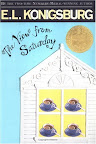
The View from Saturday

Cross-posted at my blog.

I read The View from Saturday for the Newbery Challenge. I'm enjoying reading the Newbery books for this challenge so much that I just might set myself a personal challenge to read every Newbery Medal winner.

In this novel for kids from about 8 to 12 years old, four sixth graders form a trivia team. Their coach is their social studies teacher, who has been away from teaching for ten years due to a car accident which left her confined to a wheelchair. The four sixth graders are connected in other ways, mostly through their grandparents. Their strengths complement each other, and this, combined with dedicated practice, helps them become an unbeatable team.

I found the dialogue, especially that of the kids, stilted and not a very good reflection of how kids this age actually speak. Nadia, the only girl on the team, doesn't use contractions at all. In theory, I think this sounds like a good way to portray Nadia as a serious, intelligent girl, but in practice, it makes her sound pompous. I'm pretty sure that in real life, Nadia would be mercilessly picked on by the other kids, who would imitate and mock her odd speech patterns. Instead, Julian (my favorite character) is picked on because he wears shorts with knee socks (which I do think is realistic). None of the four kids care about what their peers think of them, though; in fact, they don't seem interested in any social interaction with anyone but each other.

Other than some problems with dialogue, though, this was an enjoyable story, and I particularly liked the sections taking place in Florida, where three of the kids' grandparents live.

My favorite character, Julian, is Indian, and he has grown up on cruise ships, where his father has worked. At the time the novel takes place, though, Julian's father has bought a bed and breakfast in the town where the others live, and Julian becomes friends with them by inviting them to a tea party via coded messages.

As I suspected, Konigsburg herself was a teacher. Children's books that take place mostly in schools so often seem to be written by school librarians or teachers. And why not? Who else could even try to write realistic scenes taking place in a classroom? It's funny when Snape verbally abuses the kids at Hogwarts, but kids know that Snape couldn't get away with that in a real, non-magical school.

Konigsburg has a new book being published this year, The Mysterious Edge of the Heroic World. I can't really say yet that I'm looking forward to reading it, but I am looking forward to seeing reviews about it that will help me decide whether to read it.

The Witch of Blackbird Pond

at my blog.

Title and author of book? The Witch of Blackbird Pond by Elizabeth George Speare

Fiction or non-fiction? Genre? Young adult historical fiction, Newbery winner.

What led you to pick up this book? It was one of my chttp://www.blogger.com/img/gl.link.gifhoices for the Newbery challenge. I actually thought I had read it and this would be a re-read, but it turns out it wasn't familiar at all.

Summarize the plot, but no spoilers! It's the late 1600s, and Kit, who is a teen from Barbados, is left without any family or money after her wealthy grandfather dies. She takes a ship to Puritan New England to live with an aunt she's never met. The way of life there is very different from what she was used to. Not only does she work hard from dawn until bedtime, but even her clothes are shockingly bright and colorful compared to the dark clothes the Puritans wear. Somehow, in spite of her status as an odd outsider, a wealthy young man in the village takes an interest in her and starts to court her. Meanwhile, one of her two girl cousins is also being courted. Kit and the other cousin, Mercy, run a school for very young children. Eventually, Kit meets an older woman, a Quaker the town is suspicious of. Eventually, there are accusations of witchcraft.

What did you like most about the book? I liked the historical aspect best, but I also liked the characters, especially Kit and Hannah, the Quaker woman.

What did you like least? I found it implausible that the wealthiest bachelor in town would set his sights on Kit when she seemed so strange to the townspeople. I also found that, like in many historical novels, there were attitudes and behavior attributed to the main characters that are more in line with how people today think and act.

Share a quote from the book:This is Hannah, the Quaker woman: "'The answer is in thy heart,' she said softly. 'Thee can always hear it if thee listens for it.'" I liked that partly because it's sensible advice, partly because it seems in character for a Quaker, and partly because Kit does listen to her heart later, and finds an answer to something that is not what she and Hannah were discussing when Hannah gave her that advice.

What did you think of the ending? It ended just as I expected it to, but a younger reader may not have found it as predictable.

Friday, October 5, 2007

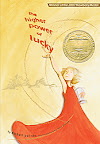
The Higher Power of Lucky: Dewey's Review

Cross-posted at my blog.

I read The Higher Power of Lucky by Susan Patron and Matt Phelan for the Newbery Challenge and the Book Awards Reading Challenge. I really enjoyed this novel, which is intended for an audience of children from ages nine to eleven.

Lucky is a spirited ten year old girl who lives in an impoverished small town in the Mojave desert. The conflict she faces was a bit simplistic for me; like a bad TV sitcom conflict, it arises out of a misunderstanding that could easily be cleared up with some simple communication. But I'm not ten years old, and maybe kids of this age could use a book that teaches them to just ask when they're confused.

SPOILER WARNING: Lucky's dad has never been a part of her life, and her mother died two years ago. When that happened, her dad, whom she didn't even recognize, convinced his ex-wife from before his marriage to Lucky's mom to come and take care of Lucky. Lucky believes that this is a temporary arrangement until she can be put in a foster home, but she's grown attached to her guardian, Brigitte, and understandably isn't ready to face losing another adult she cares about. She sees Brigitte's passport out and assumes Brigitte is going home to France without her. So Lucky runs away from home, hoping that Brigitte will miss her so much that she realizes she should stay with Lucky. As it turns out, Brigitte only has her passport out as a form of ID for a hearing to adopt Lucky permanently.

Many children's books present a false view of the world in which children have no contact with difficult situations, or with the adult world. I think that this sort of approach in children's literature gives children a strange sense that the rest of the world is safer and saner and simpler, more ethical and straightforward than their own life experiences. This gives them a feeling that there's something wrong with them and the people they know in real life.

In this book, however, Lucky eavesdrops on AA meetings and hears a lot of confusing things she doesn't understand. She has to try to come to terms with the fact that her father has simply never wanted kids and isn't about to start wanting kids now just because she has no other parent to take care of her. She wrestles with the cultural differences between her and her French guardian. She's also entirely aware that everyone in her town is poor, and that the free government food they get is of a low quality.

I think that many children reading this book will feel relief to know that even kids in books face challenges they don't really understand. I also think many children will miss some of the references to adult situations (such as twelve step programs) but they will recognize that Lucky doesn't understand either, and that will reassure them that it's natural for kids to encounter aspects of the adult world they can't make sense of.

The fact that Lucky's mother has died will be especially reassuring to kids who have had enormous losses in their own lives and are tired of reading about kids in perfect little worlds where everything is always just fine.

There was a big hullabaloo about the fact that this book contains the word "scrotum." This word, which Lucky overhears but doesn't know the meaning of, is just one more thing Lucky doesn't understand. Personally, I'm surprised that people could worry that the word scrotum might traumatize children while it's more likely a child reading this book would be shocked by the idea that hey, their mom could die in an electrocution accident, too, just any old time, right out of the blue.

One prude objector said: “You won’t find men’s genitalia in quality literature.”

Um, it's a dog's genitals mentioned in the book this objector so obviously didn't read. Every kid who has a dog sees their dog's scrotum all the time. Maybe we should start requiring dogs to wear pants in public. And they should keep their tails tucked into their dogpants, because tails are also a dog body part mentioned in this book.

But as for men's genitalia, half the kids reading this book carry around scrota attached to their bodies every day. They've probably noticed such things exist by now. As for the girls, maybe this book will initiate a birds-and-bees discussion with their parents when they go ask what "scrotum" means like Lucky did. They are theoretically nine to eleven, definitely of an age to wonder how babies are made. Or even be menstruating themselves. I would prefer that menstruating pre-teen girls know what scrota are for, so they can avoid them, but maybe that's just me.

All in all, I highly recommend this book, but don't take my word for it; take the American Library Association's recommendation. They awarded the 2007 Newbery Medal to this book.