Showing posts with label Semicolon's Post. Show all posts

Tuesday, May 29, 2007

Serious Books Win the Newbery

Just after the 2007 Newbery award announcement, J.L. Bell wrote in this post about the undeniable fact that Newbery committees tend to favor "serious" books.
For the Newbery Medal for children's literature, that means contemporary and historical fiction about Overcoming Hardships, societal or familial, almost always prevail over humor, adventure, and fantasy or science fiction. Stories that bring us into Other Cultures also have an edge, as long as those cultures are real. Of course, there are exceptions, like 2004's Tale of Desperaux, but the pattern holds up generally over several decades of winners. It's just the way our culture tends to think.


I looked back over the list of Newbery Award books (just the winners, not the honor books), and I found:

54 fairly serious books of contemporary and historical fiction about overcoming hardships.

19 books set in foreign countries, other than Britain.

14 books that could, very loosely, be classified as somewhat humorous, although most of those still dealt with serious themes, too. Example: Caddie Woodlawn is historical fiction about a girl growing up in a frontier town. It has humor, but it's also about being brave and facing the hardships of frontier life.

12 sort of fantasy-ish/science fiction books. Almost all of the fantasy and science fiction books were, again, serious books with grand philosophical themes. Except for The Voyages of Doctor Doolittle and maybe The Tale of Despereaux, the latter of which I haven't read yet.

Pure adventure? Roller Skates? The Westing Game?

So, are the books that really last, the classics, really all serious? I can name some classics that are certainly not serious: The Three Musketeers, all of Wodehouse's books, Anne of Green Gables, The Adventures of Tom Sawyer. Are these the exceptions that prove the rule?

Rule: Award-winning books must be Serious Books that deal with a Serious Theme ---mostly.

Friday, May 11, 2007

Crispin: The Cross of Lead by Avi

According to the endnotes, Crispin: The Cross of Lead was Avi's fiftieth published book. I've read a couple of other books by Avi and enjoyed them. This one, however, deserved the Newbery award, I think. And it was set in the Middle Ages, my favorite historical period to read about.

Asta's son, a thirteen year old peasant boy, without a name, accused of a crime he didn't commit, meets Bear, a huge and possibly mad, man, who becomes Asta's son's master and mentor. The boy is given the name of Crispin and a cross of lead that belonged to his mother by the priest in his home village, but he must flee the village and the enemies who are determined to capture and even kill him. So, Crispin: The Cross of Lead is a journey/quest story. Crispin must escape his pursuers and find out who he really is and what his purpose in life is to be.

The story takes place in fourteenth century England, and at least one of the minor characters in the book is a historical figure. John Ball was "an English Lollard priest who took a prominent part in the Peasants' Revolt of 1381." Not a great deal is known of Mr. Ball's antecedents, but he was "hanged, drawn and quartered in the presence of Richard II on July 15, 1381." Luckily for the reader, Crispin ends before this untimely and violent end of John Ball the priest. The book does paint a rather dark picture of life in medieval England, probably a rather accurate picture. I want to re-read another Newbery award book, Adam of the Road by Elizabeth Janet Gray (1943) to compare the two. Adam of the Road is set about a century earlier than Crispin in England, and as I remember it, Adam of the Road depicts a much brighter, more idyllic, picture of medieval life than Crispin does. Another good book for comparison would be The Door in the Wall by Marguerite deAngeli, another Newbery book. All three books would be good read aloud books for a classroom or homeschool study of the Middle Ages.

There's a sequel to Crispin: The Cross of Lead called Crispin: At the Edge of the World, also by Avi.

Friday, April 27, 2007

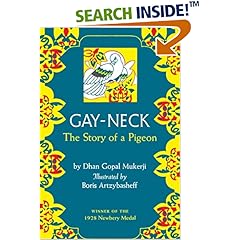
Gay-Neck: The Story of a Pigeon by Dhan Gopal Mukerji

If you're interested in carrier pigeons, or pet birds, or India, or birds used in war, this Newbery award book from 1928 might just fit the bill. Yes, it's somewhat dated in style and content. Yes, the first half of the book is a nature story reminiscent of Jean Craighead George's books such as The Other Side of the Mountain, and the second half changes focus and deals with themes of fear, war, and religion. Yes, the narration jumps back and forth from the boy who owns and trains the pigeon to Gay-Neck himself telling his own story by means of "the grammar of fancy and the dictionary of imagination." Yes, its audience would probably be limited, but I think there are some children and adults, especially nature lovers and bird lovers, who would really like this book.

Dhan Gopal Mukerji was born near Calcutta in 1890 and came to the United States at the age of nineteen. So, I'm fairly sure he gets the atmosphere of life for a boy in early twentieth century India. Mukerji wrote other nature stories, including Kari the Elephant and Hari the Jungle Lad. In Gay-Neck, Mukerji gives a lot of information about pigeons and about training pigeons, and he imparts that information by means of a fascinating story of the adventures of one particular pigeon, Gay-Neck or Chitra-griva.

The descriptions of the pigeons' defense against their enemies, eagles and hawks, and of their capacity to deliver messages even in the midst of battle are detailed enough to make the reader feel as if he could go out, purchase a pigeon, and begin training tomorrow. And it sounds like fun. As an adult and a non-animal lover, I'm sure it's not that simple, but don't be surprised if a child, after reading this book, wants his own bird to train and watch and admire.

Gay-neck is admirable. Even when he gives in to fear after a deadly encounter with a predatory hawk, and again after his war experiences, Gay-Neck is able to make a comeback. "Love for his mate and the change of place and climate healed him of fear, that most fell disease."

The story does take place in India, and it's filled with lamas and monks and Hindu or Buddhist prayer and meditation. If that's going to bother you or confuse your child, but you still want a book about training pigeons or about India, try something else. However, if you can appreciate the story as a picture of another place and another time, a vivid portrait of a boy and his pet bird, and a good imaginary tale of India and its culture and a childhood in the Indian countryside, you should enjoy this book

Gay-Neck would make a fun read aloud for children who haven't been spoiled by too much action in TV and movies. Gay-Neck has lots of action, war and predators and natural disasters, but the reader or listener must have an imagination to appreciate the story. Gay-Neck would be good to read during a science study of birds or ecosystems, or as we're doing, during a study of India and its culture. The boy in the story spends most of his time with his pigeons, caring for them and training them, and he learns a great deal about birds and about communication and about fear and courage. I can see a child making the raising of pigeons a cross-curricular project and learning more than just how to train birds, too.

Finally, I leave you with a sample of Mukerji's observations on nature, especially animal life:
I thought, "The buffalo that in nature looks healthy and silken, in a zoo is a mangy creature with matted mane and dirty skin. Can those who see buffalo in captivity ever conceive how beautiful they can be? What a pity that most young people instead of seeing one animal in nature--which is worth a hundred in any zoo--must derive their knowledge of God's creatures from their appearance in prisons! If we cannot perceive any right proportion of man's moral nature by looking at prisoners in a jail, how do we manage to think that we know all about an animal by gazing at him penned in a cage?"

Friday, April 20, 2007

The Dark Frigate by Charles Hawes

Hi all! I started my own Newbery Project back in January, and then Sandy found me and invited me to join in here. I'm enjoying my reading of the books that I haven't already read, which is quite of few of them.

Philip Marsham was bred to the sea as far back as the days when he was cutting his milk teeth, and he never thought he should leave it; but leave it he did, once and again, as I shall tell you.


The 1923 Newbery Award winner is Charles Hawes' tale of adventure and piracy in a seventeenth century sailing frigate, The Rose of Devon. It's a "dark frigate" because of the dark deeds that take place in and around it as the ship is captured by pirates, and the hero of the story, young Philip Marsham, is forced to join the pirates against his will ---or lose his life.

In an introductory note on back of the dedication page, Hawaes writes, "From curious old books, many of them forgotten save by students of archaic days at sea, I have taken words and phrases and incidents. The words and phrases I have put into the talk of the men of the Rose of Devon; the incidents I have shaped and fitted anew to serve my purpose."

Lots of sailor talk and sea-going jargon in this book: mainmast, mizzenmast, scupper-holes, lee, maintop, lanthorn, forecastle, capstan, windlass, sheet anchor, ship's liar, boatswain, bullies, whip-staff, breeching, sheet, brace, halyards, clew garnets, leechlines, buntlines, aft, amain, downhaul, traverse, gall, belay, spritsail-yard. Those are just a few of the words for which I had to guess at the meanings from only one chapter. It might be well to do a short lesson on nautical terms before reading this book aloud to a class or at home.

There were also some delightful insults that I'm sure any red-blooded child would love to write down and save for later use: lobcock, lapwing, puddling quacksalver, vagabond cockerel, old cozzener, rakehell muckworm, base stinkard, bawcock. (I'm rather attached to "puddling quacksalver" myself.) Of course, I would never allow a child of mine to use such terms in polite company, but then again, no one would know what they meant anyway. so . . .

I think with a bit of preparation and a bit of explanation along the way, The Dark Frigate could be a great read aloud, especially for boys. I can envision hours of pretend play following the reading of this book. And the book doesn't idealize pirates, either; these pirates are real villains, bloodthristy and greedy and cruel with hardly any redeeming qualities. There's a moral to the story: be careful whom you trust, and don't get involved with bad company if you can help it. Or get away from bad company as quickly as possible before you get tarred with the same brush as they are. But the moral is something to be derived from the narrative; not once is the story preachy or unrealistic.

This Newbery Medal book (1923) holds up well. The introduction to the copy I got from the library was written by Lloyd Alexander, and he says much the same thing, "Though it lies beyond our power to sail with him again, we have had the good fortune to sail with him at least once in The Dark Frigate, and we could ask for no more fascinating voyage."