Wednesday, August 15, 2007

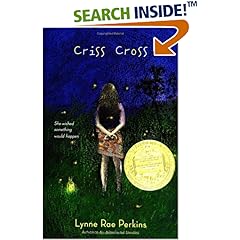
Criss-Cross

Here's my 12 year old daughter's opinion of Criss-Cross by Lynne Rae Perkins:

I started this book, didn't think I'd like it, and put it down. Then, in about a month, I started it again. And, of course, I liked it. Because my first impressions of books are usually completely wrong.

I suppose you might say there are two main characters in this story. First, there's Debra (Debbie), an imaginative, wishful and thoughtful girl. Some of her favorite pastimes are helping elderly Mrs. Bruning around the house (and consequently meeting and falling for Mrs. Bruning's handsome grandson, Peter Bruning, later in the book), hanging out with her neighbourhood friends, and speculating over things (usually nothing at all).

Then, there's Hector, a slightly pudgy adolescent boy who sees a guitarist and is inspired to learn how to play. Taking lessons from a Presbyterian minister with a few others is how he meets a young girl named Meadow and develops a hopeless crush on her, hopeless because the striking, football-playing Dan Persik is interested in her as well.

Debbie loses her necklace, which is found by a few different people, all of whom make an effort to get it back to her, but in the end of the story...

Well, now you'll have to read it.

I really enjoyed this because of the different perspectives of all the different characters. The author didn't just stick to following Debbie and Hector around, but decided to bring their friends more into the story. Just the way the book was written was intriguing.

I liked this book, and I hope anyone who reads this review will want to read it as well.

Saturday, August 11, 2007

Maniac Magee

Maniac Magee, by Jerry Spinelli won the Newbery award in 1991. This book is really timeless, though - it could have taken place anytime from WW II to the present. Spinelli's writing is just fantastic (in several senses of the word!); I'm so happy that this project introduced it to me.

In Maniac Magee, Spinelli writes in a "playground folklore" style that is very appealing. Even when reading about something I don't care much about (like baseball), the magical realism made the story interesting and entertaining. I think this would be true for most kids, too (and I'm thinking of the "child appeal" of the different Newbery books here).

The setting and sense of place is very important in Maniac Magee (and hasn't that been very true for many of these winners?) - urban southeastern Pennsylvania is not someplace that I know, but it (and its inhabitants) are portrayed in both a loving and rather brutal manner. It makes me want to go to Norristown (Spinelli's hometown, said to be the model for Two Mills in the story) and look for a corner store and buy Tastykake butterscotch krimpets.

There is a lot for both kids and adults to ponder in this book: the importance of family, homelessness, reading, and race, but what really kept me hooked were the characters and Spinelli's incredible gift for spinning a story and description. Take the McNab house, delightful in its disgusting-ness:
Maniac had seen some amazing things in his life-time, but nothing as amazing as that house. From the smell of it, he knew this wasn't the first time an animal had relieved itself on the rugless floor.

Cans and bottles lay all over, along with crusts, peelings, cores, scraps, rinds, wrappers - everything you would normally find in a garbage can. And everywhere there were raisins.

Nothing could be worse than the living and dining rooms, yet the kitchen was. A jar of peanut butter had crashed to the floor; someone had gotten a running start, jumped into it, and skied a brown, one-footed track to the stove. On the table were what appeared to be the remains of an autopsy performed upon a large bird, possibly a crow. The refrigerator contained two food groups: mustard and beer. The raisins here were even more abundant. He spotted several of them moving. They weren't raisins; they were roaches. (p. 131-132)*
This book was among my favorite Newbery winners so far, and one that I think would appeal to boys more than many that we've already read. Incidentally, it is also one that I didn't think I'd like in the least - so much for judging a book on its cover and dustjacket blurb.

*Suggested musical accompaniment: Warren Zevon's (2003) "Disorder in the House".

Friday, August 10, 2007

Bridge to Terabithia

Bridge to Terabithia is one of those books that gets into your soul and sticks there for a while. It's also one of those books that means different things as you grow older, and as you grow into the lessons that it has to teach.

It's about friendship, and family, and the death of loved ones, and the ongoing death of being unseen by the people that you need most to see you. Paterson manages to capture all of these things both at the depth of adult commentary and at the depth of childlike experience, resulting in a book that is wonderful no matter how old you are.

The recent movie was both wonderful and disappointing. Imagination and the escape to a fantasy place is a major part of the book, but by making it so explicit in the movie, much of the power of imagination is stolen from the viewer. If you see the movie before you read the book, you're dong yourself a great disservice. Of course, that's true of any book. :-)

As usual, I have a word of advice for parents. This book is very, very sad, but it's also all about redemption. Read it before you read it to your kids, but do read it to your kids. It's worth the effort, and it deals with the issue of death of a friend in a very redemptive way.

Wednesday, August 1, 2007

About the Award

The other day, when it was too hot to go outside with the kids, I decided to read up a little on the Newbery Award - how exactly is it selected? The winners are so diverse. Anyway, I found this article in Open Spaces Quarterly online by Elizabeth Cosgriff, and pulled a few interesting bits out of it:
The award brings fortune (or what passes for it in the children's book world) as well as fame. Although the award itself does not include a monetary payment, it can double the sales of the book, as well as increase sales of the author's other books. It will also keep the book alive. The average shelf life (time in print) of a children's book today is eighteen months. But of the seventy-seven Newbery medal books, seventy-two are still in print today, including the second recipient, The Voyages of Doctor Dolittle, published in 1922.

The Newbery winner is selected by a committee of fifteen members of the Association for Library Service to Children. Competition to get onto the committee is fierce. Seven members and the committee chair are elected from a ballot of twice that many candidates, and the President of the Association appoints the remaining seven, with an eye to achieving ethnic, gender, professional and geographic balance. Although the ALSC is itself a division of the American Library Association, membership is not restricted to librarians. Parents, authors, booksellers and publishers are members and have participated on the awards committees, barring conflict of interest.

E.L. Konigsburg, Joseph Krumgold, Lois Lowry, Katherine Paterson, and Elizabeth George Speare have all received the medal twice.

What does it take for a book to win? The official criteria state that it must have "conspicuous excellence" and be "individually distinct." It must be age appropriate as well. A good book for a fourth grader dealing with, say, racial prejudice, will be very different in style and presentation from a book on the same subject intended for eighth graders. The majority of winners have been novels, but other genres have been represented as well.

The award criteria declare that the award "is not for didactic intent." But to receive a Newbery, it helps to have a serious theme. Death, loss, injustice, and hard decisions have figured in winners throughout the history of the awards. There have been lighter books, including a recent winner, The Whipping Boy, a romp in which an appropriately nicknamed Prince Brat, accompanied by his whipping boy, discovers what life is like outside the castle. But, although it is difficult to generalize among so many books, it seems that many of the more recent winners display a decidedly more serious tone than the majority of the earlier books.

The award criteria also state that the award is not for popularity, and Ellen Fader acknowledges that a well-written book could be a serious contender for the award even if it didn't have a lot of "child appeal."....Which raises the question of the role of children in the Newbery awards, and in the world of children's books generally. Children's books are an anomaly -- they are for children, but they are written by adults, purchased (generally) by adults, and judged by adults.
What do you think?

Between this article and Flusi's recent post, I'm picking up The Whipping Boy soon!

Tuesday, July 31, 2007

Missing May -1993 Winner

I finished reading this book quite some time ago - ummm, about two months ago. At the time, I was reading Torey Hayden's book One Child as well. Strangely, the books both revolve around a child who for one reason or another had been moved from one home to another after the loss of their mother. In Hayden's book, which is a true story, the young six year old girl was abused by her family and showed her distaste for the world by setting a neighborhood toddler on fire. The story told by Hayden, the little girl's teacher, is heartbreaking and uplifting at the same time. Slowly, Hayden was able to break through the barriers the little girl had surrounding herself to protect from all the horribleness in the world. She did not know love until she met this teacher.

Missing May by Cynthia Rylant is nothing like One Child because the young child in this story was able to pull from the inner love she remembered from her own mother (who died) while she was passed from family to family. Then, a miracle happened, and Summer went to live with May and Ob. The story unfolds after May has died and both Summer and Ob are trying to come to terms with May's absence. Like so many children in stressful situations, young Summer is worried that she has to put her grief on hold to help Ob cope with his. With the assitance Summer's quirky classmate Cletus, Summer and Ob find peace without May - knowing that she remains a part of their lives. Seen through the eyes of the young girl, the author helps us to realize that love does not have to come in shiny big boxes or cost any money - it can be in the form of an old trailer filled with whirlygigs and whatnots!

After finishing both books, I wondered what in the world made me think they were related at all. So I reread Missing May and found myself weeping at the fictional comments of young Summer, who had everything that Hayden's real-life child did not. Here are two paragraphs that show you what I mean:

I know I must have been loved like that, even if I can't remember it. I must have; otherwise, how could I even recognize love when I saw it that night between Ob and May? Before she dies, I know my mother must have loved to comb my shiny hair and rub that Johnson's baby lotion up and down my arms and wrap me up and hold me all night long. She must have know she wasn't going to live and she must have held me longer than any other mother might, so I'd have enough love in me to know what love was when I saw it or felt it again.
When she died and all her brothers and sisters passed me from house to house, nobody ever wanting to take care of me for long, I still had that lesson in love deep inside me and I didn't grow mean or hateful when nobody cared enough to make me their own little girl. My poor mother had left me enough love to go on until somebody did come along who'd want me. (p. 4)

Torey Hayden's child must not have had that reserve - or maybe when awful, awful things happen to you it is difficult to remember the good. At any rate, these books made me want to thank everyone who loves and cares for children who might not otherwise have love in their lives.

Also, just to set this post straight - this book was not depressing in the least - it was really very uplifting and funny.

Flusi Cat

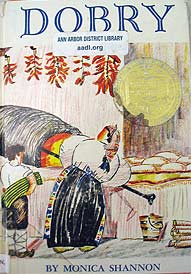
Dobry (1935 Winner)

When I issued the July challenge, I was already several tens of pages into this book. I did not know I would be cutting it so close (July 31) in trying to finish before the end of the month. I read the final words this morning on the bus heading in to work.

I chose this book more or less randomly. When one is planning to read all Newbery books sooner or later, there is no wrong selection. They all "count" toward the end goal (and I am nothing if not goal oriented).

Yet the two things that drew me to the book once it was in my hands were the title and the cover illustration. The book had no jacket-cover preview. I was left to discern what I could from its appearance.

To this former student of the Russian Language, Dobry meant "Good." That word, above the amateurishly drawn domestic scene promised a sweet tale about what is good in peasant life. In that regard, the book did not disappoint. It was, in fact, about the simple yet satisfying work and rites of the people in a Bulgarian village.

[spoilers below]

Surprisingly, Dobry turns out to be the protagonist's name. I don't know Bulgarian to know if it is also the word for "good," or if it is simply a name. The book gives us two years in Dobry's life. The first is when he's a boy of maybe 7-10 years. He helps around the house, relishes the outdoors, and displays a talent for art.

The second section of the book takes place when Dobry is an adolescent. His artistic skills have blossomed into a rare gift the whole village recognizes.

What I found rewarding about the book were its accounts of everyday life in a mountain village before electricity or modern culture. Each chapter revealed something about how seasons were celebrated, traditions observed and relationships maintained.

Beyond that charming and no doubt rosified view, the book was not very good. It reminded me of the one Lois Lensky book I read, where very little happens and one is not given a reason to care about the characters. And ironically, the illustrations in this story about a budding artist, are bad. I can only guess they were supposed to look like folk art and have that unpolished composition. On more than one occasion, however, I could not tell what was happening in a photo until after I finished the chapter to which it corresponded.

Reading this book was like looking through a viewmaster. Each chapter was a different snapshot, and it didn't really matter where one began.

Hitty: Her First Hundred Years

This is a charming story in which a doll shares her adventures, which over the span of a hundred years have taken her around the globe. She starts life as a small, carved gift from a snowed-in peddler in Maine to the daughter of a whaler. Through circumstance, the family ends up on a whaling ship together and quite a long time passes before Hitty returns to America.

While the story is certainly dated by certain expressions and references to world religions and ethnicities, the point is very strongly made that worth cannot be gauged merely through appearances. Young and old, rich and poor alike are united in the desire to love and nurture little Hitty.

The Whipping Boy

The Whipping Boy by Sid Fleischman was illustrated by Peter Sis. This was a very quick read and full of mini-adventures that would probably entertain most children. The illustrations were in black and white and quite the match to the story. We have all probably heard the phrase "whipping boy" and while we knew what was meant by the words, I know I was not really sure how the terms came into use. The Phrase Finder provides some history of the term and traces it to the 15th and 16th centuries in England. It is interesting to note that the practice was NOT to use street urchins, but to select one of near-noble birth...this is contradicted by the story by Fleishhman.

So, on to the story: Jemmy was the orphaned son of a rat-catcher who lived in the sewers of the city before he was brought to the castle to serve as the whipping boy for Prince Brat, as he was not so lovingly referred to by his subjects. Each time the Prince did something wrong, Jemmy was whipped. Because the Prince was bored, he decided to run away and Jemmy was to go with him to serve as his man-servant. The two soon run into trouble and many fabulous characters as they navigate around the city hiding from the king's men who were searching for the Prince. As the two boys overcome many obstacles, they slowly become friends. They eventually make their way back to the palace where all is forgiven and the two boys remain friends and companions - with no more whippings!

In the author's note at the end of the book, Fleishman says, "History is alive with lunacies and injustices." I suppose that is why I spent six years of my life studying history with all of its insanity!

Flusi

PS. If you are a librarian (or even if you aren't I suppose), check out the YouTube post at my work related blog, LibrarysCat. It is a wonderful affirmation of what we, as librarians, should be doing to move the field into the 21st century! Also, this book post will be posted at my book blog Now that my required work blogging is done, I can concentrate more on reading!

Monday, July 30, 2007

A Visit to William Blake's Inn

is subtitled Poems for Innocent and Experienced Travelers, was written by Nancy Willard, illustrated by Alice and Martin Provensen, and won the Newbery Medal in 1982.

I felt like I was on a roll with children's poetry - I absolutely loved Out of the Dust, and I liked Joyful Noise very much. Last week I picked up my son's copy of A Pizza the Size of the Sun (by Jack Prelutsky) and read it without even meaning to do so before re-shelving it. And I have always liked "Tyger, Tyger, burning bright, In the forests of the night" (the only William Blake poem I can remember), so I thought that A Visit to William Blake's Inn was a good bet for my next read.

I was a little disappointed. It's a short book, shelved with the younger kids' picture books in our library (it won Caldecott honors in addition to the Newbery award), and I just didn't find the the sixteen poems and the accompanying illustrations about an imaginary inn run by William Blake terribly compelling. I like reading about (and watching video re-creations of) Regency period England, too. I just moved Pride & Prejudice (both recent versions) up on my Netflix queue. Again. Not just so I can see Colin Firth swimming, either.

The poems and the illustrations do have a certain charm reminiscent of old nursery rhymes, and they suit each other very well. But I would be very surprised if this were a favorite of many kids. I can see that some adults would enjoy it (especially if you have a fondness for early 19th century England) - but this is supposed to be an award for children's literature, not children's literature written for adults, and that's how this book struck me.

The Wise Cow Enjoys a Cloud

"Where did you sleep last night, Wise Cow?
Where did you lay your head?"

"I caught my horns on a rolling cloud
and made myself a bed,

and in the morning ate it raw
on freshly buttered bread." (p. 26)

Saturday, July 28, 2007

Feeling Pensieve about The Giver

In her blog, Bookworm recently posed a question about how one might differentiate between a literary homage and a literary rip-off. As I read The Giver (published in 1993), I was fascinated to see myself staring into Dumbledore’s pensieve (first revealed in Harry Potter and the Goblet of Fire, published in 2000) as the bearded, elderly mentor chose memories (magically presented from an omniscient point of view) to share with his youthful pupil. Receipt of the memories is a bittersweet experience for the student. In Harry Potter, the pensieve is a useful tool for a privileged few to access. In The Giver, memories are forbidden for most people. In each case, the pupil had been pre-ordained to bear a great burden on behalf of the community, and needed to be fortified with knowledge from the past in order to free loved ones from unpleasantness that would otherwise befall them.

In her June post about The Giver, Alicia asked: Is it possible to create a compelling story (about regimented eu/dys-topias) in which the protagonist is persuaded by the merits of and chooses to remain and support the society despite knowledge of its shortfalls? The wizarding world doesn’t nearly reach the level of regimentation of the society described by Lois Lowry (others have pointed out The Giver’s similarities to the planet in A Wrinkle in Time, and I also recall a Star Trek: Next Generation episode, in which Wesley Crusher had a close call after falling into a flowerbed). Taking gifted children away from their families to be schooled at Hogwarts, a sorting hat and a room full of prophecies are the main things I can think of where Rowling approaches regimentation.

Homage? I loved both books, but it is interesting to see how one author (perhaps) draws inspiration from another and uses it in a new way. J.K. Rowling and Lois Lowry both explore memory, using similar devices, and reach somewhat similar conclusions about the value of love, loyalty and innocence. I’ve got no problem with reinforcing those lessons. I’ll vote for homage.

Tuesday, July 24, 2007

More Love for the Hero and the Crown

Like Melissa, I read The Hero and The Crown a long time ago. I was an adult, but I've always liked fantasy, and when this was publicized as award-winning YA fantasy, I eagerly picked it up and wasn't disappointed. I went on to read everything that Robin McKinley published (which has not been nearly enough over the years!), most recently Sunshine - a post-apocalyptic vampire story - and I've loved them all. So I'm hardly an objective reviewer either.

I never re-read The Hero and the Crown after I discovered it in the late 80's, though, so when I picked it up last week I really couldn't remember why I loved it so much, nor many of the details of the story.

It didn't take me long to realize that (again, like Melissa) it was the writing and the characters - especially Aerin, the main character - that really got to me. Like J.R.R. Tolkien (sorry, but that's what got me hooked so hard on fantasy as a child), McKinley combines the mythical and the down-to-earth perfectly. And furthermore, she writes about a young girl, the rescue of a beautiful and intelligent horse, dragons, and secret powers - I would have read this and re-read it countless times if it had been out when I was an adolescent. Now, I noticed how cleverly that McKinley portrayed Aerin as a likable, irreverant, smart outsider - much like Rae in Sunshine, come to think of it.

There are a few things that bothered me a bit this time around. McKinley does an incredible job of world-building, but the Damarian names for things jarred sometimes. I didn't mind sol and sola (princes and princesses) so much, but hafor (for "folk of the household") and yerig and folstza and a few other terms interrupted the narrative unnecessarily.

There are two love stories in the book - I liked them both, and the more than "happily ever after" ending was a refreshing change. Funny how I completely forgot about Luthe (and pretty much Tor, too) since the first time I read The Hero and the Crown. Mostly I remembered Aerin, her horse, and the dragon. But although there's nothing particularly explicit about Aerin's relationship with Luthe, I think that it makes the book more appropriate for older Newbery readers. Plus, the writing (though exquisite), can be rather intense. Take this excerpt about despair:
A blast of grief, of the deaths of children, of crippling diseases that took beauty at once but withheld death; of unconsummated love, of love lost or twisted and grown to hate; of noble deeds that proved useless, that broke the hearts of their doers; of betrayal without reason, of guilt without penance, of all the human miseries that have ever occurred; all this struck them, like the breath of a slaughterhouse, or the blow of a murderer. (p. 208).
Have you ever read a more poetic description of despair and depression? Luckily, it is overcome, and the story ends happily with puppies and kittens and love. For a while, anyway, and isn't that the case in real life, too?

Tuesday, July 17, 2007

Hero and the Crown

I told myself when I signed on to this project, that I wasn't going to read any of the Newbery's that I've already read. Then Alicia came up with her July challenge, and I noticed that no one else has read this one, by Robin McKinley, yet. And I figured it was about time to re-visit this old friend.

There is no way I can give this book an objective review; it is one of the few that solidified my love of YA books as well as earning McKinley a special place in my heart and on my shelves. I love it. I have loved it since I first read it, which wasn't as long ago as it should have been (I was only 12 in 1984 when this book came out; this was one book I should have read, and would have loved, when I was that age. But I missed it completely.)

It's a companion book to The Blue Sword (if you haven't read that one, you should. It was written first, but you can read these two in any order), though it takes place centuries before. Aerin is the daughter of Damar's king, Arlbeth, though she's not comfortable in that place. For one, her mother was a foreigner, a Northerner, and not especially trusted. And she's often despised and ridiculed for existing. She does have one friend, Tor, who sticks up for her, teaches her swordplay and horsemanship, and eventually falls in love with her. Aerin tries to find her place in a world that she doesn't feel she belongs in. After a near-fatal accident, she discovers a recipe of sorts for kenet, which eventually leads her to being able to fight the little dragons that annoy and disturb the countryside. That leads, on one fateful day, to her facing the Black Dragon, Maur, and from there, discovering and embracing her destiny.

It's a marvelous tale. Aerin is perfect: headstrong, lovable, understandable. What girl hasn't felt that she fit in? What girl doesn't long to make her parents proud, but is ashamed of her insecurity? What girl doesn't want to know how she can make a difference? Aerin is one of those characters that you embrace and cheer and understand and love. And whose courage and bravery seem not super-heroic, but real and attainable.

This conversation takes place soon after Aerin kills her first dragon, and is, afterward, sworn to serve the king:
Aerin and her father looked at each other. For the first time she had official position in his court; she had not merely been permitted her place, as she had grudgingly been permitted her undeniable place at his side as his daughter, but she had won it. She carried the king's sword, and thus was, however irregularly, a member of his armies and his loyal sworn servant as well as his daughter. She had a place of her own -- both taken and granted. Aerin clutched the spears to her breast, painfully banging her knee with the sword scabbard in the process. She nodded.

"Good. If you had remained hidden, I would have sent Gebeth again -- and think of the honor you would have lost. "

Aerin, who seemed to have lost her voice instead, nodded again.

"Another lesson for you, my dear. Royalty isn't allowed to hide -- at least not once it has declared itself."

A little of her power of speech came back to her, and she croaked, "I have hidden all my life."

Something like a smile glimmered in Arlbeth's eyes. "Do I not know this? I have thought more and more often of what I must do if you did not stand forth of your own accord. But you have -- if not quite in the manner I might have wished -- and I shall take every advantage of it."
And McKinley's writing is nearly flawless (there's a place at the end where you have to read through a couple of times to get what happened). This is when Aerin faces Maur:
Maur raised its head with a snap, and the spear bounced harmlessly off the horny ridge beneath its eye; and Talat lurched out of the way of the striking tail. The dragon's head snaked around as Talat evaded the tail, and Talat dodged again, and fire sang past Aerin's ear, fire like nothing either Talat or Aerin had seen before, any more than this dragon was like any other dragon they had seen. The fire was nearly white, like lightning, and it smelled hard and metallic; it smelled like the desert at noon, it smelled like a forest fire; and the blast of air that sheathed it was hotter than any Damarian forge.
There really isn't much more to say about it. It's one of my favorites, and may always be. It's also become one of my oldest daughter's favorites, something which I'm very happy about. And not just because it's an excellent book. But because it's an excellent book about an admirable girl.

Saturday, July 14, 2007

Joyful Noise

I liked the 1989 winner, Joyful Noise: Poems for Two Voices, by Paul Fleischman quite a bit - but I think I would have been more impressed by it if I hadn't just read Karen Hesse's gut-wrenchingly powerful and beautiful poetry in Out of the Dust.

Joyful Noise is a collection of fourteen short poems about insects, written in two columns and meant to be read aloud by two people (ideally, you & your child). The "joyful noise" refers to the cicada poem, but could just as well mean your reading. Some lines are meant to be read together, but when my ten-year-old son and I spoke in unison, it didn't sound as good as I thought it would. I liked the alternating lines better - but I did really enjoy the reading aloud part. He tolerated it, because he loves insects.

The "read aloud" aspect, especially with two people, was pretty innovative. And I adored the black and white illustrations by Eric Beddows, which added a whole different dimension to the book, with quirky little moths, whiligig beetles, mayflies, etc.

My favorite poem was "Book Lice" (this is just a snippet of it):
I missed Conan Doyle
he pined for his Keats
We're book lice
fine mates
despite different tastes. (p. 17)
But I did wonder how many kids got all the author references.

My son's favorite poem was the tragic "Moth's Serenade" (to the porch light!). But when I told him to write the book down in his list for our library's summer reading program (prizes for every five books, and a big one at the end after 15 books) he refused, arguing that "it's too short to be a real book for my age". What a weird kid.

I did think that Joyful Noise was kind of light-weight compared to most of the other Newbery winners I've read so far - both in length (44 pages) and in subject. I'll bet the judges were just so blown away by the format, that they chose it anyway. I'm rather glad that they did - because I probably would never have read it otherwise.

PS What is it about insects that make them such a popular topic for kid's poetry? This reminded me of another (very different, but equally enjoyable) more recent book: Song of the Water Boatman & Other Poems, by Joyce Sidman, illustrated by Beckie Prange.

1960 Winner, Onion John

I zipped through Joseph Krumgold's Onion John while previewing materials for potential lesson plans relating to the theme of fatherhood two years ago. The reconciliation of a father and son is the focus of the novel. Here is what I wrote about it in the annotated list of resources for the paper:

"Boy befriends a homeless man in small town New Jersey. Boy is the only person who can understand the man through his speech impediment. Father objects but later mellows and stops pressuring boy to become an engineer. Boy expresses admiration for father. Homeless man goes away. Seems dated and ending is too pat."

To be fair, my reading was cursory and I might have gotten more out of the book if I had decided to focus on it for use in my lesson plans. I remember thinking that a present-day Newbery author or reviewer would probably be more concerned about showing the boy's growing understanding of the issues of homelessness.

I wished Krumgold had done a better job of tying up the loose end regarding the eventual fate of Onion John. Apparently, the homeless man simply goes on to live in a different place and the boy goes on with his life. I suppose I should recognize that as the reality of poverty and homelessness, and not expect that a contemporary version would provide a more satisfying resolution of that part of the story.

Kids' Views of The View from Saturday

First-year teacher makes a bad choice.

My 7th grade students actively hated Konigsburg’s, The View From Saturday (TVFS). From the cover, showing teacups and a Victorian architectural feature (“looks boring”), to the substance (the first major chapter focuses at length on the wedding of grandparents at a Florida retirement community), to the pedantic qualities (laboriously-constructed symbolism involving a heart-shaped-jigsaw, for instance, and vocabulary and history and natural science and trivia and morality lessons incorporated into the plot), to confusing use of repetition (some incidents are related from the point of view of more than one character).

In the manner of the recent Newbery controversy around the word “scrotum,” some of my students could not get over what seemed like a gratuitous reference to bra straps and (to them) titillating use of the word “puberty” on the second page.

After my class finished the book, I found comments inside the back cover where Konigsburg described using four separate short stories from her files to construct TVFS around a common theme. Although she wrote that readers have told her that, “fitting all the stories together is part of the adventure,” it was the disjointed origins of the stories that came across to me as I read the book.

One more thing. The main characters of TVFS form a team to compete in the middle school Academic Bowl. The principal of a competing school tells their teacher, “I told our coach that she could expect to be hung if she lets your sixth grade grunges beat us out.” The teacher replies, “I recommend that you start buying rope.” Apparently because of this conversation, the noose becomes the symbol for the team – their fans wear small nooses on their shirts, they hang a noose from a car antenna, and grandparents have custom-made t-shirts with nooses sold as a fundraiser. I did a double-take when the noose began to reappear as a symbol, and had to go back and comb through the book to figure out its origin and meaning. In what universe would thoughtful adults encourage the use of a noose as an inspiration for a school team of any kind?

The theme of building diverse communities through kindness to others is lovely, of course, and the one bright spot for the kids involved learning about sea turtles. For the most part, though, the book read like an out-of-touch adult’s idea of what a contemporary adolescent should care about, not what a young reader would actually want to read.

Newbery Committee makes a bad choice?

Thursday, July 5, 2007

Independence Day and the Westing Game

Yesterday when I was browsing through the Newbery winners on hand, trying to decide which one to read next, I knew that I had to read The Westing Game when I saw this sentence on the first page:
Then one day (it happened to be the Fourth of July), a most uncommon-looking delivery boy rode around town slipping letters under the doors of the chosen tenants-to-be.
How cool is that, I read about it on the same day (well, a couple decades later) that the story started.

The Westing Game was a great read for a summer day (and evening): relaxing, and interesting enough to keep me turning pages, but not so compelling that I couldn't put it down when it was time to go swimming or catch fireflies. And after reading a couple of very intense, emotionally wrenching stories in the last week, I found this mystery by Ellen Raskin pretty refreshing. It's the YA/older elementary kid's equivalent of Janet Evanovich - so I'm a little surprised that it won the Newbery award, actually. Maybe there were a lot of mystery lovers on the selection committee in 1979.

It is probably more accurate to compare The Westing Game to vintage Agatha Christie than to Janet Evanovich - there's no sex, and no cars blow up in TWG. It's a classic "closed house" murder mystery, complete with an eccentric, manipulative millionaire with a ridiculously strange will, and a huge cast of characters (it may be useful to have a printout from a site like this one at The Westing Heirs on hand to keep every one straight). There are numerous plot twists - some really obvious (especially in retrospect, if you read a lot of mysteries), and others that are totally unanticipated.

In a lot of ways, this reminded me of a cheesy 80's movie - something about the tone of the story, with its unabashedly greedy characters - and when I looked around the net, sure enough The Westing Game movie (also called Get a Clue!, but not to be confused with the 2002 Lindsey Lohan movie without an exclamation point) was made in 1997. Ray Walston played Sandy McSouthers and Diane Ladd played Berthe Erica Crow, but I've never heard of the rest of the cast. I guess it was a kind of a forgettable movie.

The Westing Game wasn't profound, but it was fun, especially if you like codes, clues, spooky mansions, and chess, and I'll bet I would have absolutely loved it if I'd read it when I was twelve.

Tuesday, July 3, 2007

Dust

I was intrigued by Flusi's post on Out of the Dust, the 1998 winner by Karen Hesse. Every time I read poetry, I wonder why I don't read more of it, because I enjoy it so much. I was probably the only person in my high school literature class that liked the "introduction to poetry" text so much that I went and bought my own copies of Leaves of Grass and the Spoon River Anthology. But in the years since then, although I've read a lot, poetry hasn't made up much of what I've read.

Hesse's book didn't disappoint me - the poems are beautiful, and haunting, and describe a time and a place (Oklahoma's panhandle in the early 1930's) so well that I really felt transported. The things that Hesse writes about - dust, over and over again, throughout the book, gritty and heavy and so pervasive - but also pregnancy, horrible accidents, rain, apples, music, and the longing to run away - they really tell a very powerful story. In that respect Out of the Dust reminded me of those intertwined stories in the Spoon River Anthology. And Billie Jo? She's more than a little like an older Caddie Woodlawn, with her red hair, different conflicts with her parents, and her independent nature.

I do think that Out of the Dust is better for kids on the older edge of the Newbery award readers - like a few other books I've read recently (like The Birchbark House, and A Thousand Splendid Suns), the sudden death and grief in Out of the Dust are not "easy" topics, for either adults or kids.

But the beauty, redemption, and hope (in all of the books above, actually) make them so worth it.

Almost Rain

It almost rained Saturday.
The clouds hung low over the farm.
The air felt thick.
It smelled like rain.

In town,
the sidewalks
got damp.
That was all.

November 1934 (p. 88)

Challenge response: Roller Skates

In response to the July challenge, I'll tell you about Roller Skates by Ruth Sawyer. First, I have to say that I have an older copy of the book--a hardback edition from 1949 with incredible illustrations by Valenti Angelo. Second, I've read this book twice now and loved it both times, but especially this time around because of these amazing line drawings.

Roller Skates is the story of Lucinda, a little girl who gets to be an "orphan" in New York City while her family travels to Europe. She barely escapes living with her horrible Aunt Emily who has very definite ideas about how girls should behave and lives instead with Miss Peters and Miss Nettie, two single women who treat Lucinda as very much older than her ten years. Lucinda comes and goes as she pleases--mostly on her roller skates.

The book tells of Lucinda's adventures of meeting wonderful people outside of her normal life--people like Patrolman M'Gonegal, Mr. Gilligan the hansom cab driver and his wife, Trinket the little girl Lucinda "borrows" from upstairs, the Princess Zayda to whom Lucinda teaches English, Tony the boy who manages the fruit stand and his Italian family who lives in a basement--people Lucinda would not normally come into contact with were her family home. Roller Skates is a story of freedom and escaping the rules and regulations of growing up--a story of belonging entirely to yourself and skating where you will.

I do love books that tell of a different time--a time when children were safe to run and roam and explore their worlds. The idea of a girl exploring New York City on skates seems unreal in some ways to me--and, in a way, it was unreal in the time it was written too. And that's the timeless appeal of the story--the freedom of this season in Lucinda's life to be just herself. She realizes its uniqueness too, for at the end of the story she realizes "she'd never belong to herself again," never have another summer of being free and being ten years old.

I loved roller skating as a kid--and think I may need to get out my skates!

Monday, July 2, 2007

Another Holes Post

My son actually picked up Holes first at the library. Since I was attempting to read in order, starting from the oldest, I hadn't gotten to it yet. But since he had it, I figured I'd read it. I'd previously seen the movie, and I must say that I much prefer reading and then watching a movie to the other way around. My sister ended up choosing this book for a Book Club she's with, and in comparing my feelings about the book in contrast with theirs, I could see how much of the anticipation and surprise of the twists I missed already knowing the outcome. That said, I appreciate how closely the movie parallels the book, because that is so rare in movie adaptations.

Holes has a surprising amount of depth (unintended pun, sorry) to the story. You don't expect that when you first pick it up. It seems like just another adventure story about an unfortunate boy sent to a work camp for a crime he didn't commit. But once well into the novel, you realize that there are deep themes of racism and interpersonal relationships expertly woven into the tale.

Previous posts have discussed how much subtle and overt racism earlier Newbery titles contain, as a reflection of their era. While these books can open a discussion about racism and its consequences, if such happens, it needs to be done in a deliberate manner. Holes on the other hand, vividly illustrates the ugliness of racism in a way that children can grasp without having to be led to the recognition. This might make Holes a good read before exposing your children to some of the earlier novels, so that your child can initiate a conversation about these themes making them more open to recognizing how behaviors and language in older books are not acceptable now, and were unjust then.

July Challenge

So the Newbery Project has been in existence for six months now. How are people feeling about it?

If you look in the sidebar, you'll see that certain books -- by luck or by design -- are getting more traffic than others. Caddie Woodlawn is especially popular, particularly among the older books. Meanwhile 4 books from the 1990s have had no posts. Curious.

Let me throw out a July Challenge: each of us read and post on one of the Newbery books that has thus far gone untouched.

What do you think?

I happen to have started Dobry (1935's winner) a few weeks ago and will read it regardless.

Just trying to liven things up here.

Sunday, July 1, 2007

Caddie Woodlawn--again!

I quit reading for a while, but now with long summer afternoons at the pool working on a tan and watching the girls jump off the diving board, I'm back in the swing of things--because nothing goes with lounging by the pool like a good book!

Yesterday afternoon I read Caddie Woodlawn. I'm a sucker for pioneer girl stories, so it seemed a natural choice when I was at the bookstore. I was surprised by the endorsement on the back: "You take Little House on the Prarie; I'll take Caddie Woodlawn." Better than Little House? That's a pretty big claim.

Caddie Woodlawn didn't remind me so much of the Little House books--they have much more adventure, I think, and more of a sweeping pioneer feel. Caddie takes place in one location and I didn't really get the sense that the Woodlawns were a pioneer family, despite the worry about Indians and waiting for news from the east. All in all, the Woodlawns seemed pretty connected with the rest of the world compared to the Ingalls family.

This book reminded me more of the Grandmother's Attic books--especially after reading the author's note at the front of my copy.

All that to say, I did enjoy Caddie Woodlawn immensely and look forward to reading it with my girls. I can see them using this book for a school project at some point--and my copy (2006, Aladdin Paperbacks) has a great reader's guide at the end that has some good discussion questions and also some research and activity ideas. Though the book does leave out some historical details and raises questions like the ones in the previous post (which seemed somewhat real to me--as an 11-year-old girl, Caddie is more concerned with the small world she lives in rather than the world at large), it is a good way to interest kids in doing some research of their own.

Monday, June 25, 2007

More Caddie Woodlawn

I just finished Caddie Woodlawn, by Carol Ryrie Brink - the 1936 Newbery winner, which I'd never read before (so no nostalgia about a childhood favorite here!) - and I found myself with very mixed feelings as I put it down. There were several parts that I really enjoyed, and I can see why Caddie Woodlawn remains a "much loved classic" over seventy years after its publication.

Caddie, the main character, is a strong, likable heroine. She has a close and loving relationship with her family, she enjoys being outdoors in the rivers and fields of her western Wisconsin home, and she is clever, passionate and generous. And Caddie has a dog (actually, a couple of dogs are featured in CW), and I'm a sucker for dog and horse stories. Furthermore, I like historical fiction, and I think CW really captures life on a frontier farm, in language that seems relatively fresh and modern, unlike some of the other older Newbery winners. And I thought Caddie's adventures were interesting, even the ones that weren't particularly hair-raising.

However, several things bothered me in Caddie Woodlawn. It was like eating a really fine salad and finding a slug in it. Or maybe biting down hard on a cherry pit in this salad (and then finding your filling in your hand along with the pit).

Minor issues first: Why the heck did Mrs. Woodlawn let her feckless brother take Nero? What was she thinking, giving away the family pet like that, and to Uncle Edmund of all people?

If a boy's lifestyle was so much healthier than a girl's, why didn't Mr. Woodlawn let Caddie's younger sisters run wild "instead of making samplers and dipping candles" (p. 15), too? Poor Hetty, it's a wonder that she wasn't more of a brat than she already was. It was interesting, though, that women's work (which was by no means exclusively indoors in the 19th century) was associated with weakness and fragile health, while men and their outdoor tasks, like plowing, were identified with strength and well-being.

There's a relatively well-known academic paper (described in this Salon article on the American Girl dolls) by Anne Scott McLeod that describes the "Caddie Woodlawn syndrome" - in which girls who had a fair amount of freedom as children are finally required to assume the responsibilities of adult womanhood, donning the restricting clothing of the time along with adult women's more sedate behavior and work ethics. "How about it, Caddie, have we run with the colts long enough?" says Caddie's father (p. 245) - to which I couldn't help answering "No! Or at least not until the colts are ready to settle down, too".

But the racism was the real sticking point (see some earlier debate about race in CW here and here). It's not always overt, which perhaps makes it more insidious, but CW contains all of the most common offenses when it comes to stereotyping American Indians, and I was more than a little shocked that there was so little commentary about this online.

No particular tribal or ethnic group is ever identified in Caddie Woodlawn - it's just generic Indians, as if a person from one time and place and very, very different culture could be easily swapped out for another (imagine if there were no English and French people, but only Europeans!). One character actually mentions that Indian John (the only Indian that is ever named or described in CW, apart from the Hankinson kids and their mother) isn't from the same tribe that "killed a thousand white people" near New Ulm, Minnesota a few years before (p. 118), but we never find out who "Indian John's people" actually are.

Indian John is not so much an individual but a cardboard figure representing "the Indian brave", complete with buckskin, horse, dog, and scalp belt. He doesn't actually say "Ugh", but he is a stoic and mysterious figure, and little else. Does he have a family? What does he really think of Caddie and her brothers?

Anyway, Indian John and the other Indians are curiously clueless, until they are rescued by the courageous young Caddie. They are also clearly doomed, not so much as individuals or as families, but as symbolic remnants of the American past, like the passenger pigeons described in Chapter 3. It is rather fitting that CW concludes with Caddie facing west, "a pioneer and an American," with manifest destiny clear in the sunset.

One of the passages that some people probably see as an endearing example of Caddie's generosity made me the most uncomfortable, because of the children involved. It's a description that isn't overtly racist (except for the use of the word savage), but the feeling of condescension is hard to miss :
Caddie examined her protégés with maternal eyes. Certainly their noses needed attention as well as their hair.

"I guess handkerchiefs had better come next," she said thoughtfully. "thirty cents' worth of nice, cheerful, red handkerchiefs, if you please."

Mr. Adams had the very thing, large enough to meet any emergency, and of a fine turkey red. Caddie was satisfied, and the little Hankinsons were speechless with delight. The red was like music to their half-savage eyes. They waved the handkerchiefs in the air. They capered about and jostled each other and laughed aloud as Caddie had never heard them do before.
"Now you can go home," said Caddie, giving each of them a friendly pat, "and have a good time, and mind you remember to have clean noses and tidy hair on Monday when you come to school."

Dazed with good fortune, they tumbled out of the store, whooping with joy and entirely forgetting (if they ever knew) that thanks were in order. (p. 163-4)
To me, this passage conveys the idea that these kids are dirty, wild, thoughtless, uncared-for, and easily satisfied with some colorful trinkets. I couldn't help thinking that candy, combs, and handkerchiefs were small compensation for the loss of a mother - although of course Caddie wasn't to blame for the community hysteria that drove the local Indian families away. I also wondered how any kid that was the recipient of such charity would feel - I imagine it would be excruciating, no matter how poor you were.

Now, these shortcomings can be (and often are) excused as a product of the time - after all, the stories were told to the author by her grandmother, Caddie Woodhouse, who grew up in Dunn Co., Wisconsin in the mid-1800's. And author Carol Ryrie Brink herself was born in 1895 and published CW in 1935, which was not an era well-known for political correctness.

But when I Googled "teacher resources" and "Caddie Woodlawn", I didn't find that the portrayal of Native Americans in CW was even raised as an issue, unless I really dug a lot. It certainly didn't turn up as a discussion question or "point to consider" on any of teacher guides I found (and I plowed through at least ten pages of Google hits). In fact, "savage" was matter of factly listed on the vocabulary lists (would other racial epithets be so casually listed?), and the only question about Indians at all was this one: "How did the encroachment of the settlers on American lands create conflict?", from one relatively detailed list of discussion questions.

Despite the fact that CW is touted as part of a history lesson, and many historical activities are suggested to accompany its classroom use, I didn't uncover any resources that linked Caddie's story to actual (real and important) historical events. In fact, in several places I found that Caddie's story is actually incorrectly described, in a manner that is completely opposite of what happened in CW: "the story of a fun-loving tomboy who saves her family from an Indian massacre". In Brink's story, Caddie saves the Indians from being killed by fearful settlers. Probably this mistake has been re-copied countless places on the internet, but really, you have to ask why it was made in the first place. Perhaps because "Indian massacre" stories are such a staple of American story-telling?

Anyway, I did some research of my own, and learned that the "Indian massacre" near New Ulm, Minnesota was part of the U.S.-Dakota Conflict of 1862 (aka Sioux Uprising or Dakota War of 1862). Now this is was an important conflict, where hundreds of innocents and soldiers on both sides were killed, and it is something that had huge historical ramifications for Minnesota and Wisconsin and several different Native peoples (including different Chippewa or Ojibway or Anishinabeg peoples of Minnesota and Wisconsin, which would be likely candidates for "Indian John's people").

It really would be worthwhile to talk about this (or the Civil War, or Methodist circuit riders, or class in the U.S. vs. Great Britain) in the context of Caddie Woodlawn. And it would be really worthwhile to examine how race is portrayed in CW with an older elementary school class, not because it's "politically correct", or because it's fun to tear down a classic of children's literature, but because Caddie provides the perfect opportunity to examine our casual assumptions about race and how its descriptions in our children's stories support (or explode) our own stereotypes.
Thursday, June 7, 2007

The Giver

I loved this book. Unfortunately, its surprise plot twist (not twist, really, but, you know) was spoiled for me in advance. It was offered as a book group choice at our school's third grade and the teacher let parents know children would be reading a book "on euthanasia."

I wish I'd been able to read it without that foreknowledge. I suspect I would have guessed the true meaning of "release" anyway. But I'd have liked the chance.

This became our book group's book for last month. This interesting question arose, which I share with you here:

In stories about regimented eu/dys-topias (1984, The Matrix, Brave New World, etc.), the protagonist always escapes. The societal liberation is brought about by someone who fights the status quo, either from within, or by abandoning it. Is it possible to create a compelling story in which the protagonist is persuaded by the merits of and chooses to remain and support the society despite knowledge of its shortfalls?

Monday, June 4, 2007

Missing May

A while back I realized that the Newbery Award winners in my town's library have a little label with a medal on the spine. So last week when I was browsing the children's shelves for some books to pull out for my son - voila! - next time he's bored and just wants to play the Nintendo DS for the whole summer break, I grabbed a couple of the stickered winners at random.

I took this one because I thought "Hey, another book by the author of Rules!" - which was one of this year's Newbery Honors books. Rules was an amazing book, one that I just ordered in hardcover because I want to have it on my shelves forever, a book that I am pretty sure most adults will enjoy and learn as much from as most kids will. If I didn't like The Higher Power of Lucky so much, I would say that Rules definitely should have won the Newbery this year.

Anyway, it wasn't until I was halfway through Missing May that I Googled (so I could order Rules), and I realized that Cynthia Lord is the author of Rules, and that Cynthia Rylant (whose name was familiar from some of my daughter's picture books - like Henry & Mudge!) is the author of this book. By then, however, I was enjoying Missing May so much that I wasn't upset that it wasn't by Cynthia Lord (whose first book is Rules - and I hope she is writing more, since she doesn't have a backlist to plunder).

Interestingly, Missing May reminds me quite a bit of The Higher Power of Lucky - it's also the story of an orphaned, not very wealthy girl (who also lives in a trailer!), who is worried about her caretaker, and dealing with death of a loved one. Like Lucky, Summer also has a friend - a boy in her class - who is more than a little quirky, who has elderly parents and a strange name: Cletus (instead of Lincoln).

The fact that this character's name is Cletus and that he lives in West Virginia bothered me a bit at first. It sounded like a bit too much of a stereotype of Appalachia. There was already a character named Ob who makes whirligigs, and May (recently deceased), who rode out a childhood flood in a washtub. But Rylant deftly avoids any further stereotypes in her story of a small family coming to terms with the death of a parent (in all but biology) and a wife.

I thought Rylant's description of the West Virginia capitol was particularly beautiful:
The capitol building sprawled gray concrete like a regal queen spreading out her petticoats, and its giant dome glittered pure gold in the morning sun. I felt in me an embarrassing sense of pride that she was ours. That we weren't just shut-down coal mines and people on welfare like the rest of the country wanted to believe we were. We were this majestic, elegant thing sitting solid, sparkling in the light. (p. 71)
And I loved this description of Cletus - especially the last line:
May would have liked him. She would have said he was "full of wonders," same as Ob. May always liked the weird ones best, the ones you couldn't peg right off. She must be loving it up in heaven, where I figure everybody must just let loose. That's got to be at least one of the benefits of heaven - never having to act normal again. (p. 55)
Missing May is a much darker book than The Higher Power of Lucky, examining loss, grief and uncertainty in much more detail. Summer and Cletus are a few years older than Lucky and Lincoln, and they grapple with their problems in a more adult way. Despite the plot similarities (and the fact that both are short books), they are very different stories (so no, I don't think that Patron ripped off Rylant fourteen years later), and I think that the subject matter of Missing May is more suited for kids in the 12 and up age range. Also, you might want to have a box of kleenex handy for the last couple of chapters.

Tuesday, May 29, 2007

Serious Books Win the Newbery

Just after the 2007 Newbery award announcement, J.L. Bell wrote in this post about the undeniable fact that Newbery committees tend to favor "serious" books.
For the Newbery Medal for children's literature, that means contemporary and historical fiction about Overcoming Hardships, societal or familial, almost always prevail over humor, adventure, and fantasy or science fiction. Stories that bring us into Other Cultures also have an edge, as long as those cultures are real. Of course, there are exceptions, like 2004's Tale of Desperaux, but the pattern holds up generally over several decades of winners. It's just the way our culture tends to think.


I looked back over the list of Newbery Award books (just the winners, not the honor books), and I found:

54 fairly serious books of contemporary and historical fiction about overcoming hardships.

19 books set in foreign countries, other than Britain.

14 books that could, very loosely, be classified as somewhat humorous, although most of those still dealt with serious themes, too. Example: Caddie Woodlawn is historical fiction about a girl growing up in a frontier town. It has humor, but it's also about being brave and facing the hardships of frontier life.

12 sort of fantasy-ish/science fiction books. Almost all of the fantasy and science fiction books were, again, serious books with grand philosophical themes. Except for The Voyages of Doctor Doolittle and maybe The Tale of Despereaux, the latter of which I haven't read yet.

Pure adventure? Roller Skates? The Westing Game?

So, are the books that really last, the classics, really all serious? I can name some classics that are certainly not serious: The Three Musketeers, all of Wodehouse's books, Anne of Green Gables, The Adventures of Tom Sawyer. Are these the exceptions that prove the rule?

Rule: Award-winning books must be Serious Books that deal with a Serious Theme ---mostly.

Saturday, May 26, 2007

Mixed-Up Files


This is one of the few Newbery winners that I read and loved as a child, though I never could remember the title correctly - I always mixed Konigsburg up with Frankweiler, and just last week I wrote "Frankenweiler".

Mostly, I remembered the kids living in the museum, sleeping in the antique bed, hiding in the bathrooms, and fishing money from the fountains for their meals. Somehow I thought that they made soup from ketchup from the free packets at fast food restaurants - but that scene wasn't in The Mixed-up Files, and a couple of files in my own brain must have been scrambled over the years. I do remember thinking about this book when my family went to the Art Institute and the Field Museum in Chicago when I was little. Chicago was also one of the places that I saw fountains with coins (there weren't any such fabulous things in my small town!), and I dreamed about swimming in the fountains around the sculptures, scooping up all that cash.

On my re-read, I appreciated the complicated characters that Konigsburg created (and illustrated! I didn't realize she did the wonderful drawings, too): Claudia, with her love of comfort - especially baths - and her careful planning, secrets, and her need for the occasional argument and something different; Jamie, the impulsive yet thrifty third-grade cardshark; and Mrs. Basil E. Frankweiler, the domineering, wealthy, eccentric narrator.

Claudia reminds me more than a little of my mother:
"She didn't like discomfort; even picnics were untidy and inconvenient: all those insects and the sun melting the icing on the cupcakes. Therefore, she decided that her leaving home would not be just running from somewhere but would be running to somewhere. To a large place, a comfortable place, an indoor place, and preferably a beautiful place. And that's why she decided upon the Metropolitan Museum of Art in New York City." (p. 5)
My favorite quote, though (apart from the one Alicia already described about happiness here) was Mrs. Frankweiler's statement about knowledge:
"I think you should learn, of course, and some days you must learn a great deal. But you should also have days when you allow what is already in you to swell up inside of you until it touches everything. And you can feel it inside you. If you never take time out to let that happen, then you just accumulate facts, and they begin to rattle around inside of you. You can make noise with them, but never really feel anything with them. It's hollow." (p. 153)
The whole bit about Mrs. Frankweiler and the experience of motherhood is something that went right over my head when I read it as a child, but that I appreciated today. Also, when I re-read The Mixed-up Files, I suddenly remembered my childhood satisfaction with the surprise ending involving Saxonberg. I still liked it, and indeed I still loved the whole story. Unlike the commenter who said that "as a kid, the promise of excitement was there in a museum" but that it wasn't the same as an adult, I still get excited at museums, even after working in one for years. Those drawers of artifacts and all of the files with their type-written letters and the carbon-copy replies still hold secrets and exciting stories.

Tuesday, May 15, 2007

Summer of the Swans

Summer of the Swans by Betsy Byars won the Newbery Medal in 1971. I was able tell by some of the language and clothing that it was set in the 70s. There are also some drawings on the inside that dated it a little. However, I believe that this is a timeless story. We see a 14 year-old girl, Sara, caught up in the "misery" of her own life. Her feet are too big, her arms to thin, and her nose is too crooked. All of these things are brought into perspective when her 10 year-old mentally handicapped brother, Charlie, goes missing. This is the story of the day her worldview changed.

Swans is a quick and easy read. It probably took me a little over 2 hours. Faster readers could do it quicker! This story had exactly what I felt was missing when I read "Jacob Have I Loved". Both main characters really looked at the negative things in life, and both are named Sara! Sarah in Jacob Have I Loved found a way out of her circumstances but never really saw how negative she had been. It was all justifiable to her but it never was to me as a reader! Sara in Summer of the Swans really comes around and sees what is truly important in life.

None of the characters in the book are flat. Byars does an excellent job of telling the back story of Charlie, the mentally handicapped brother. I also really liked Aunt Willie, who has been taking care of them since their mother died. Her older sister Wanda is in the story for a shorter time, but I think that is what allows Sara to really respond to her brother's disappearance.

I realize I have not yet mentioned the swans! The title of the book comes from the excitement that is caused when 5 swans show up in a lake in Sara's small town.

In the final pages of the book we hear about this mental picture that she has of each of her family members on a set of stairs representing their different stages of life. I think that this represents a moment of growth for Sara and that it was a great conclusion to the story.

I couldn't help but think that this story would be very different if it was written today. Unfortunately, I don't think children would be nearly as excited to go see swans for entertainment. I also realized how corrupt my own mind was when I thought to myself that if Charlie had gone missing today that there are far more dangers that he could have encountered. But this was a simpler time, and I think that is one of the main reasons I enjoyed it so much.

Two thumps up!

Sunday, May 13, 2007

Despereaux and Friends

Gor! This is a beautiful story. It reminds me of the movie The Princess Bride, which has a certain clever yet sweet humor and style that's hard to describe to someone who hasn't seen it. I really do need to get that video so my kids can see it soon. I'm looking forward to sharing The Tale of Despereaux (by Kate DiCamillo) with them just as much, which should tell you something about it (if you're a Princess Bride fan, anyway).

DrBacchus has already written an eloquent post on The Tale, but I'd like to put down some of my favorite passages here:
"Have I mentioned that beneath the castle there was a dungeon? In the dungeon, there were rats. Large rats. Mean rats.
Despereaux was destined to meet those rats.
Reader, you must know than an interesting fate (sometimes involving rats, sometimes not) awaits almost everyone, mouse or man, who does not conform." (p. 25)

" 'Is that proper, do you think? Wouldn't that make this into some kind of topsy-turvy, wrong-headed world if a king played music for a bug?' " (p. 29)

"Unfortunately, a rat can hang from a chandelier for only so long before he is discovered. This would be true at even the loudest party." (p. 107)
The Tale of Despereaux is full of beautiful but sadly uncommon words, like adieu, egregious, perfidy, cauliflower-eared, and jig. The stories of Despereaux, Roscuro, Princess Pea, and Miggery Sow intertwine in a delightful, suspenseful, and ultimately satisfying manner. In short, I'm very, very happy to have read this book, and I'm looking forward to reading more by Kate DiCamillo.

Friday, May 11, 2007

Island of the Blue Dolphins

I know that I read Island of the Blue Dolphins (the 1961 Newbery winner) by Scott O'Dell as a child, but before re-reading it this week I remembered little about it except that I didn't like the story. Back then I thought it was disturbing and depressing, and my Scholastic Books paperback with the beautiful cover (I think it was this one, and I do remember loving the cover) sat undisturbed on the dusty end of the shelf with the other books that I didn't really like.

It's still not my favorite Newbery winner, but as an adult I was able to appreciate the beauty of O'Dell's descriptions of the landscape and the plants and animals living on and around a small Channel Island off the coast of California. I also appreciated the quiet strength and resilience that Karana shows, and her happiness in her surroundings:
"I felt as if I had been gone a long time as I stood there looking down from the high rock. I was happy to be home. Everything I saw - the otter playing in the kelp, the rings of foam around the rocks guarding the harbor, the gulls flying, the tides moving past the sandspit - filled me with happiness." (p. 69).

"With the young birds and the old ones, the white gull and Rontu, who was always trotting at my heels, the yard seemed a happy place. If only I had not remembered Tutok. If only I had not wondered about my sister Ulape, where she was, and if the marks she had drawn upon her cheeks had proved magical. If they had, she was now married to Kimko and was the mother of many children. She would have smiled to see all of mine, which were so different from the ones I always wished to have." (p. 153).
The second quote also highlights some of the things that disturbed me about this book as a child - stop reading right here if you don't want to hear spoilers!


This girl loses her entire family, including the little brother she stayed to save, and then spends most of the rest of her life alone on an island. The very matter-of-factness of the narrative bothered me. It was one thing to voluntarily spend a year away from your family, like Sam Gribley in My Side of the Mountain (a childhood favorite of mine which I did re-read several times), but to lose everyone? With no idea what happened to them, or if anyone would ever come back for you? I didn't like that at all.

As an adult, a little Googling didn't make this aspect of the book any less sad for me: The Lone Woman of San Nicolas Island describes the true story that O'Dell's book is based upon. A woman stayed on the island when her child couldn't be found when the Native community was being relocated to a mainland mission. Can you imagine anything more horrifying? Well, yes, to then have your child killed by wild dogs. To spend eighteen years alone except for dogs and birds, and then when you are finally rescued, to not find your people again. And then to die from a disease from which your people had no natural immunity, only seven weeks after finally re-joining humanity.

I hate to end on a such downer, especially concerning a book that is so loved by many people, but I'm afraid I that that I just couldn't find that "sense of hope" that I've been reading about on the Island of the Blue Dolphins. My childhood 'rating' still stands, but I will be interested to see how other readers feel about it.

Crispin: The Cross of Lead by Avi

According to the endnotes, Crispin: The Cross of Lead was Avi's fiftieth published book. I've read a couple of other books by Avi and enjoyed them. This one, however, deserved the Newbery award, I think. And it was set in the Middle Ages, my favorite historical period to read about.

Asta's son, a thirteen year old peasant boy, without a name, accused of a crime he didn't commit, meets Bear, a huge and possibly mad, man, who becomes Asta's son's master and mentor. The boy is given the name of Crispin and a cross of lead that belonged to his mother by the priest in his home village, but he must flee the village and the enemies who are determined to capture and even kill him. So, Crispin: The Cross of Lead is a journey/quest story. Crispin must escape his pursuers and find out who he really is and what his purpose in life is to be.

The story takes place in fourteenth century England, and at least one of the minor characters in the book is a historical figure. John Ball was "an English Lollard priest who took a prominent part in the Peasants' Revolt of 1381." Not a great deal is known of Mr. Ball's antecedents, but he was "hanged, drawn and quartered in the presence of Richard II on July 15, 1381." Luckily for the reader, Crispin ends before this untimely and violent end of John Ball the priest. The book does paint a rather dark picture of life in medieval England, probably a rather accurate picture. I want to re-read another Newbery award book, Adam of the Road by Elizabeth Janet Gray (1943) to compare the two. Adam of the Road is set about a century earlier than Crispin in England, and as I remember it, Adam of the Road depicts a much brighter, more idyllic, picture of medieval life than Crispin does. Another good book for comparison would be The Door in the Wall by Marguerite deAngeli, another Newbery book. All three books would be good read aloud books for a classroom or homeschool study of the Middle Ages.

There's a sequel to Crispin: The Cross of Lead called Crispin: At the Edge of the World, also by Avi.

Thursday, May 10, 2007

Caddie Woolawn: The other side

In the comments to my post here, there was this:

I invite you to consider CADDIE from a critical stance that examines the ways that American Indians are presented in the story. I've doing this myself, over at my blog.
I posted a sort-of response, if you're interested. It's good to hear from the other side of the coin, too.

Wednesday, May 9, 2007

Holes

I don't have much to add to others' posts. I just wanted to record that I read it and thoroughly enjoyed it. My only disappointment was that I'd seen the movie for the first time about three weeks before starting the book. The movie was great -- perfect for the troupe of nine-year-olds I took to the free showing at our local art movie theater. The movie was a wonderful adaptation of the novel. I noticed that Louis Sachar wrote the screenplay. He is to be credited for modifying the story just enough to make it work delightfully on screen.

Friday, May 4, 2007

A Year Down Yonder

Because of Sandy's comments on her post, I decided to start at the beginning and read Richard Peck's A Long Way from Chicago, published in 1998 before I read the Newberry winner A Year Down Yonder. I am so glad I did because both books were deliciously funny. Both follow the exploits of Grandama Dowdel through the eyes of her grandchildren Joey and Mary Alice.

The subtitle to A Long Way from Chicago is A novel in stories and that is exactly what you find in the book. Joey and Mary Alice visit small town America each summer for seven years. Each year is covered in a short chapter and details the visit of the two young people. Life in the small town south of Chicago is hysterically navigated by Grandma with the children half delighted and half terrified by what might happen next. These chapters could be read as individual stories. We cataloged this book for Grades 3-7.

Sandy gave a great review of the 2001 Newbery winner A Year Down Yonder. This hilarious book follows Mary Alice as she moves in with Grandma Dowdel for a year. Since Mary Alice is 15, the stories focus on topics appropriate and entertaining to older children. In fact, this book was also awarded an ALA Best Books for Young Adults award.

Both books took me back to my childhood. My sister and I always spent the summers in Tennessee, moving from one grandmother to another. Our favorite place was a very small town in West Tennessee with a population of only 7,000. I knew people Peck wrote about quite intimately. Some of them might have been related. My uncle was a Sheriff's investigator and he knew every story there was to tell, often before they even happened. These summers contain some of my most cherished memories and I will read these books again in a few years just to stir these memories.

While looking at some information about Richard Peck, I ran across this poem written by Richard Peck at the Penguin Group homesite for the author:

Twenty Minutes a Day
Read to your children
Twenty minutes a day;
You have the time,
And so do they.
Read while the laundry is in the machine;
Read while the dinner cooks;
Tuck a child in the crook of your arm
And reach for the library books.
Hide the remote,
Let the computer games cool,
For one day your children will be off to school;
Remedial? Gifted? You have the choice;
Let them hear their first tales
In the sound of your voice.
Read in the morning;
Read over noon;
Read by the light ofGoodnight Moon.
Turn the pages together,
Sitting close as you'll fit,
Till a small voice beside you
says,"Hey, don't quit."

Also, you might notice that my posted by name has changed to Library Cat. I am having to do a project for our regional library consortia which requires a blog and for the life of me I could not figure out how to change the posted by name for just one of my blogs - in fact I don't think it is possible. So for now, this will be Library Cat by Flusianna otherwise known as Flusi!

Flusi

Thursday, May 3, 2007

Caddie Woodlawn

Why is it that we adore some pioneer/adventuresome girls -- Anne Shirley, Laura Ingalls -- and diss others? Why is that Caddie Woodlanwn, ended up at #58 on this list, with the snarky aside: "The 'adventures' of a pioneer girl that leaves modern-day readers wondering 'so?'"? I couldn't imagine someone saying that about Laura, could you?

That's what kept running through my head as I was reading this book. I'd never heard of it until this project; I somehow missed this one as a kid. And, it's not a bad book (I'm not going to sum it up, Flusi did that nicely). It's a bit quaint, but one can chalk that up to writing style and time period. But, I, at least, enjoyed reading it. I enjoyed getting to know Caddie. I enjoyed her adventures; sure they're not really what we'd call adventures -- save her one rash decision to try and save her Indian friends from scared, vicious white men by running off to their camp in the middle of the night -- but they're still a lot of fun. I enjoyed Caddie's good heart (she spent the silver dollar she "won" from her uncle on the three halfbreed children in the town after their mother was sent away. I enjoyed seeing Caddie grow up, realizing that she can't be a tomboy forever, and with encouragement from her dad, slowly taking on the task of becoming a pioneer woman.

It sounds quaint, today, but I really liked this passage (Caddie's father is talking):
[Mother] really loves you very much, and you see, she expects more of you than she would of someone she didn't care about. It's a strange thing, but somehow we expect more of girls tan of boys. It is the sisters and wives and mothers, you know, Caddie, who keep the world sweet and beautiful. What a rough world it would be if there were only men and boys in it, doing things in their rough way! A woman's task is to teach them gentleness and courtesy and love and kindness. It's a big task, too, Caddie -- harder than cutting trees or building mills or damming rivers. It takes nerve and courage and patience, but good women have these things. They have them just as much as the men who build bridges and carve roads through the wilderness. A woman's work is something fine and noble to grow up to , and it's just as important as a man's. But no man could ever do it so well. I don't want you to be the silly, affected person with fine clothes and manners whom folks sometimes call a lady. No, that is not what I want for you, my little girl. I want you to be a woman with a wise and understanding heart, healthy in body and honest in mind. Do you think you would like to be growing up into that woman now? How about it, Caddie, have we run with the colts long enough?
It was such a different time (1864-1865) and place, that, yeah, it could be a little hard to relate to. Would anyone today get sick and tired of turkey every night and actually wish for baked beans and bread, or corn hash?? But it's such a good, honest book, full of love for family, community and country, that I think it still has (or should have) some value today.