Monday, November 12, 2007

The View from Saturday

Cross-posted at my blog.

I read The View from Saturday for the Newbery Challenge. I'm enjoying reading the Newbery books for this challenge so much that I just might set myself a personal challenge to read every Newbery Medal winner.

In this novel for kids from about 8 to 12 years old, four sixth graders form a trivia team. Their coach is their social studies teacher, who has been away from teaching for ten years due to a car accident which left her confined to a wheelchair. The four sixth graders are connected in other ways, mostly through their grandparents. Their strengths complement each other, and this, combined with dedicated practice, helps them become an unbeatable team.

I found the dialogue, especially that of the kids, stilted and not a very good reflection of how kids this age actually speak. Nadia, the only girl on the team, doesn't use contractions at all. In theory, I think this sounds like a good way to portray Nadia as a serious, intelligent girl, but in practice, it makes her sound pompous. I'm pretty sure that in real life, Nadia would be mercilessly picked on by the other kids, who would imitate and mock her odd speech patterns. Instead, Julian (my favorite character) is picked on because he wears shorts with knee socks (which I do think is realistic). None of the four kids care about what their peers think of them, though; in fact, they don't seem interested in any social interaction with anyone but each other.

Other than some problems with dialogue, though, this was an enjoyable story, and I particularly liked the sections taking place in Florida, where three of the kids' grandparents live.

My favorite character, Julian, is Indian, and he has grown up on cruise ships, where his father has worked. At the time the novel takes place, though, Julian's father has bought a bed and breakfast in the town where the others live, and Julian becomes friends with them by inviting them to a tea party via coded messages.

As I suspected, Konigsburg herself was a teacher. Children's books that take place mostly in schools so often seem to be written by school librarians or teachers. And why not? Who else could even try to write realistic scenes taking place in a classroom? It's funny when Snape verbally abuses the kids at Hogwarts, but kids know that Snape couldn't get away with that in a real, non-magical school.

Konigsburg has a new book being published this year, The Mysterious Edge of the Heroic World. I can't really say yet that I'm looking forward to reading it, but I am looking forward to seeing reviews about it that will help me decide whether to read it.

The Witch of Blackbird Pond

at my blog.

Title and author of book? The Witch of Blackbird Pond by Elizabeth George Speare

Fiction or non-fiction? Genre? Young adult historical fiction, Newbery winner.

What led you to pick up this book? It was one of my chttp://www.blogger.com/img/gl.link.gifhoices for the Newbery challenge. I actually thought I had read it and this would be a re-read, but it turns out it wasn't familiar at all.

Summarize the plot, but no spoilers! It's the late 1600s, and Kit, who is a teen from Barbados, is left without any family or money after her wealthy grandfather dies. She takes a ship to Puritan New England to live with an aunt she's never met. The way of life there is very different from what she was used to. Not only does she work hard from dawn until bedtime, but even her clothes are shockingly bright and colorful compared to the dark clothes the Puritans wear. Somehow, in spite of her status as an odd outsider, a wealthy young man in the village takes an interest in her and starts to court her. Meanwhile, one of her two girl cousins is also being courted. Kit and the other cousin, Mercy, run a school for very young children. Eventually, Kit meets an older woman, a Quaker the town is suspicious of. Eventually, there are accusations of witchcraft.

What did you like most about the book? I liked the historical aspect best, but I also liked the characters, especially Kit and Hannah, the Quaker woman.

What did you like least? I found it implausible that the wealthiest bachelor in town would set his sights on Kit when she seemed so strange to the townspeople. I also found that, like in many historical novels, there were attitudes and behavior attributed to the main characters that are more in line with how people today think and act.

Share a quote from the book:This is Hannah, the Quaker woman: "'The answer is in thy heart,' she said softly. 'Thee can always hear it if thee listens for it.'" I liked that partly because it's sensible advice, partly because it seems in character for a Quaker, and partly because Kit does listen to her heart later, and finds an answer to something that is not what she and Hannah were discussing when Hannah gave her that advice.

What did you think of the ending? It ended just as I expected it to, but a younger reader may not have found it as predictable.

Sunday, November 11, 2007

Island of the Blue Dolphins


Stars: *****

I first read this in grade school and loved it. When I saw I needed to read it for the Newbery Project I decided to reread it and I'm glad I did. I remembered it almost exactly and I enjoyed it very much again. I love his writing and would like to try some more of his books to see if they are as well written.

This is a great book for girls to increase girl power as the girl is alone on the island for a few years and survives all on her own. A few times I got so into the words I felt like I was there. To my knowledge this hasn't been made into a movie but I think it should, although it still wouldn't be anywhere as good as the book. Definitely deserves it's Newbery award.

Recommended for kids (especially girls) ages 10 and up

Wednesday, October 31, 2007

Crispin: The Cross of Lead Avi 2003


The book begins … The day after my mother died the priest and I wrapped her body in a grey shroud and carried her to the village church.

Set in the world of mediaeval England this book tells of a young boy’s journey from naïve life to knowledge of himself. It is at one level a gripping adventure and at another it is one of the battle between power and avarice versus humility, faithfulness and genuine trustworthy friendship. I strongly recommend this book. With characters and writing that sets the scene so vividly it was a truly worthy winner.

Monday, October 29, 2007

Sarah, Plain and Tall

This 1986 winner by Patricia MacLachlan was beautiful. It was short, simple, and a very uplifting story. I think it would especially be good for younger readers (unlike many of the Newbery winners) - a great early chapter book for a 2nd or 3rd grader.

Joanne and RioFrioTex already said a lot of the stuff I thought, so I'm just going to quote a few favorite passages:
A log broke apart and crackled in the fireplace. He looked up at me. "What did I look like when I was born?"

"You didn't have any clothes on," I told him.

"I know that," he said.

"You looked like this." I held the bread dough up in round pale ball.

"I had hair," said Caleb seriously. (p. 4)
__________
We slept in the hay all night, waking when the wind was wild, sleeping again when it was quiet. And at dawn there was the sudden sound of hail, like stones tossed against the barn. We stared out the window, watching the ice marbles bounce on the ground. And when it was over we opened the barn door and walked out in to the early-morning light. The hail crunched and melted beneath our feet. It was white and gleaming for as far as we looked, like sun on glass. Like the sea. (pp. 49-50)
You know, I could just keep quoting and quoting and pretty soon the whole little book would be here in my review. Almost every paragraph is that evocative and solid and shines in its own quiet way.

2006 Criss Cross Lynne Rae Perkins


First sentence – She wished something would happen.

Having reflected upon this book for a while I am still unsure regarding my view of it. I am wondering if it is ‘my age’ that meant that this book did not connect with me. Many of the Newbery award winners and myriads of other children’s books I have read have invariable ‘spoken’ to me. This is often in the form of deeper lessons for life, those truths that lie beneath the story. Alternatively it may be that a book resonates as I reflect upon how it could be shared in the classroom. Disappointingly Criss Cross failed to inspire and stimulate. There was a glimmer of reflection as two of the young people related to one another as they shared the task of supporting an aging and infirm ‘granny’ character. There was a sense of looking out beyond and giving to another. In my opinion this was the best part of the book. Giving to another enriched both of the characters as they found reward. Apart from this instance my view was that the characters and situations were lacking in depth. I have passed my copy to my young friend Chloe and look forward to hearing her view.

1948 The Twenty One Balloons

‘There are two kinds of travel’….. So begins this 1948 Newbery award winner, a brilliant book ranging from scientific truths to absolute fantasy. At first I thought the mingling of fact and fiction would disappoint me. To the contrary I was completely enthralled and really involved in the adventure. Black and white illustrations complemented the text and explained further some of the inventions. Underneath all the fantasy was a depth and a number of truths regarding ‘teamship’ and questions regarding riches. Excellent writing and highly recommended.

A footnote – at first I was captivated as I too have flown in hot air balloons. This has been with a friend, an amateur in the Pyrennees along with my husband, not to mention my then 87 year old mum and friend! It is the most magical and wonderful form of transport. I have already recommended this to Dave and his family, especially Chloe whose childhood took her round the Pyrenean countryside as her mum followed their beautiful balloon named One World Dreaming.

Wednesday, October 24, 2007

The White Stag

The White Stag, by Kate Seredy, won the Newbery in 1938. I really can't figure out why, unless the Committee was just bowled over by her illustrations (like this one from page 47), which I have to admit are gorgeous.

Maybe the legend of the white stag was just more popular back then - a little Googling shows that it was a symbol of the Scouting Movement. The Boy Scouts of America were becoming very popular in the 30's, and the 4th World Jamboree of Scouts was held in Hungary in 1933, with the white stag as its symbol. Different versions of the legend of a white stag are historically important through Europe, especially in Hungary, where Seredy says she took the inspiration for this book.

Anyway. I liked Seredy's Foreword a lot:
Not so long ago I was leafing through a very modern book on Hungarian history. It was a typical twentieth-century book, its pages an unending chain of FACTS, FACTS, FACTS as irrefutable, logical, and as hard as the learned pens of learned historians could make them.

Turning the pages I felt as if I were walking in a typical twentieth-century city, a city laid out in measured blocks, glaring with the merciless white light of knowledge, its streets smooth, hard concrete facts. One could not stumble on streets like that, nor could one ever get lost; every corner is so plainly marked with dates.

...Well, I closed the book and I closed my eyes. And then I saw an old garden, the great, neglected park of old Hun-Magyar legends, with moss creeping over the shadowy paths, paths which twisted and turned, which led into hidden nooks where fantastic flowers grew around crumbling monuments of pagan gods.

...Those who want to hear the voice of pagan gods in wind and thunder, who want to see fairies dance in the moonlight, who can believe that faith can move mountains, can follow the thread on the pages of this book. It is a fragile thread; it cannot bear the weight of facts and dates.
Unfortunately, I was pretty disappointed in the thread of the story in The White Stag. I didn't think it was fragile so much as overly militaristic, impersonal, and boring. Maybe the thread is just old and rotten, and ready to break? It's not that I don't like old books, either - I liked The Story of Mankind (1922), The Dark Frigate (1924), and Caddie Woodlawn (1936) a lot more than this, and they were all earlier winners.

Also, I like swashbuckling and legendary tales quite a lot. A couple childhood favorites were Raphael Sabatini's Captain Blood and collections of Greek legends. So I don't think that Seredy's account of 4th and 5th century warriors (including Attila the Hun) seeking a homeland in eastern Europe should have turned me off quite so much.

But I didn't like any of the main players in The White Stag. As Melissa noted in the comments here, except for Attila (whose childhood was summed up pretty bleakly in a couple of sentences), the characters are all adults. They're mostly tribal leaders, with a couple mystical passive maidens and a slave girl who happily accepts a warlord for her husband (and then dies in childbirth) thrown in for good measure.

There was a very Old Testament feel to the four linked stories, starting with Nimrod sacrificing his horse "faithful friend and companion of many great hunts" (p. 13) so that the god Hadur will reveal his people's destiny - the stag and eagles and blazing swords, and the next few generations of noble warriors who will lead them to the promised land. But by the time I was in the fourth part, I didn't care if the Huns ever got to Hungary, "where the song of whispering breeze and gurgling brooks had the magic power to banish memories of bloodshed" (p. 89). I was just happy that the story was over.

Sunday, October 21, 2007

The Giver by Lois Lowry

Stars: *****

This has long been one of my favourite books, if not my absolute favourite book. I read it in grade school the first time and although I loved the book, I hated studying it.

If by some chance you happen to have not heard of this book it's the story of Jonas, who lives in a strictly controlled community. Every "family" has two children, one boy and one girl. You apply for a spouse and children and they are assigned to you. No one sees colours, the weather is strictly controlled, everyone celebrates their "birthday" on the same day in December and each year they get something new or get to do something new. There are strict rules. When he turns twelve he is singled out to receive special training from The Giver. The Giver holds the memories of the true pain and pleasure of life. Now it's time for Jonas to receive the truth. There is no turning back.

The Giver, besides being the 1994 winner of the Newbery Award is also an ALA Best Book for Young Adults, and ALA Notable Book for Children, Winner of the Regina Medal, A Boston Globe-Horn Book Honor Book, A Booklist Editor's Choice and a School Library Journal Best Book of the Year.

It's interesting to think about what life would be like if everything was controlled and chosen for us. There are definite pros and cons. I recommend this book to everyone, adults included.

Friday, October 19, 2007

Thimble Summer

Thimble Summer by Elizabeth Enright was a delighful book. This is a story about 9 1/2 year old Garnet and her life in a small town in Wisconsin. This book won in 1939 and while I grew up in the 1960s, I felt that the topics were timeless. Garnet, her family, and her friends work hard to keep the farm and enjoy life. I loved that the author provided short chapters which could easily be read aloud. We have assigned the grade level 4-6 to this book although the stories might be a little too "old-fashioned" for today's sixth grader. Unless of course one is raising a prize hog or chasing after hens! There is conflict and redemption for Garnet and her family. But mostly it is just fun!

The best thing about this book is the writing which is very beautiful. The book opens with Garnet thinking how very hot it is. Here is the passage:

It was like being inside of a drum. The sky like a bright skin was stretched tight above the vallet, and the earth too, was tight and hard with heat. Later, when it was dark, there would be a noise of thunder, as though a great hand beat upon the drum; there would be heavy clouds above the hills, and flashes of heat lightening, but no rain. It had been like that for a long time. p. 3-4

Another thing I really liked about this book was the presentation of family values. Citronella, friend to Garnet, has her great grandmother tell stories about the old days. Again we see reference to the Native Americans in Wisconsin...but it is a brief description of sharing between the settlers and the Indians. Garnet's family welcomes a stranger to their home - again sharing what was available. As this book was published right after the Depression, I think the author included these types of stories to point out that suffering might be lessened when shared.

The author, like her mother, was an illustrator before she began writing. The illustrations she created for this book are very nice - some are in color and some are ink drawings. The stories were based on her summer visits to the Wisconsin farm of Frank Lloyd Wright.

One final story - the two girls go to the public library in town and in fact get so absorbed in their books that they get locked in! Here is the description of the library (and unfortunately the librarian):

Finally on the outskirts of town they came to the library, an old-fashioned frame building set back from the road among thick-foliaged maple trees.
Garnet loved the library; it smelled deliciously of old books and was full of stories that she had never read. Miss Pentland, the librarian, was a nice little fat lady who sat behind an enormous desk facing the door. p. 56

I think I have been to that library in a small town in Tennessee! And although I did not find this book when I was 10, I am glad that I found it now. Delightful!

Tuesday, October 16, 2007

Summer of the Swans (and Early 70's TV)

I don't know why I never heard of this book as a child - I grew up in the 70's, and this won the Newbery Award in 1971. I think it would have been very good for me to read this story then. One of the only children with a mental disability that I ever encountered in grade school was a kid with Down Syndrome, who swam in a lake near my hometown that I frequented every summer. Sadly, my friends and I avoided Eric as much as possible. Would reading this kind of book have made a difference? It couldn't have hurt.

I didn't start out liking Summer much. Sara, the 14 year old narrator, got on my nerves with her constant complaints about the summer, bickering with her older sister, and getting annoyed with 10 year old brother Charlie, who is non-verbal and likes routines, his wrist watch, and the swans that visit the town's lake.

But the story really grew on me. Sara reminded me a lot of Meg Murry in A Wrinkle in Time (are 13 or 14 year old girls anywhere at any time ever happy with their appearance, their friends, and their families? I know I wasn't). I thought the description from Charlie's point of view was well-done and not at all condescending, which is what I expected after reading the cover blurb.

I couldn't help mentally comparing The Summer of the Swans to Rules, by Cynthia Lord (one of this year's Newbery Honors books, which is about a big sister with an younger brother who is autistic, an amazing book), and expecting Summer to fall far short. In the end, I was pleasantly surprised that it didn't.

The TV references made me feel old, though. I don't think kids (or most adults under 40) reading The Summer of the Swans are going to feel the same stab of recognition that I did when Byars mentions the theme song from Green Acres, or the afternoon line-up of the The Newlyweds and The Dating Game. Or "that coyote in 'Road Runner' who is always getting flattened and dynamited and crushed and in the next scene is strolling along, completely normal again" (p. 95). Unless they've seen a lot of Nick at Nite or TVLand or something like that.

Unfortunately, this passage could have been written about the playground at my son's school:
"Well, do you know what that nice little Gretchen Wyant did? I was standing in the bushes by the spigot, turning off the hose, and this nice little Gretchen Wyant didn't see me - all she saw was Charlie at the fence - and she said, 'How's the retard today?' only she made it sound even uglier, 'How's the reeeeetard,' like that. Nothing ever made me so mad. The best sight of my whole life was nice little Gretchen Wyant standing there in her wet Taiwan silk dress with her mouth hanging open." (p. 69)
Well, there isn't a hose and you won't see any girls wearing silk dresses on the playground here. But it's pretty sad that reeeeetard is still one of the most popular insults I hear among 3rd and 4th graders (and worse, more common among many adults) almost forty years after The Summer of the Swans.

Monday, October 15, 2007

The Whipping Boy by Sid Fleischman

From Amazon.com: For kids to get their dose of action and thrills, they need not always go to the local multiplex for the latest bang 'em up film. They could try such books as The Whipping Boy, which relies not on exploding spaceships and demonic robots but mythic story, humorous characters and, ready or not, a moral. The plot involves the orphan Jemmy, who must take the whippings for the royal heir, Prince Brat. Jemmy plans to flee this arrangement until Prince Brat beats him to it, and takes Jemmy along. Jemmy then hears he's charged with the Prince's abduction as this Newbery Medal winning book turns toward a surprising close.

My take: Lest I sound like Amazon though I have to agree with every word said. This is a wonderful book, a quick read in just 90 pages, which relies solidly on a good yarn. No bells and whistles, just storytelling at its best.

It is funny yet a poignant tale of two boys who have absolutely nothing in common. But in the face of ferocious bandits, they discover how it is to step into each other's shoes, literally ... and surprisingly, develop a lasting friendship. The whipping boy and Prince Brat - a prince and a pauper - are boys at heart after all.

As a parent you may need to explain that violent punishments were a thing of the olden days, lest younger kids get scared of the descriptions of the lashings on poor old Jemmy.

[Originally posted on my blog]

Saturday, October 13, 2007

A Single Shard by Linda Sue Park


An orphan boy in 12th century Korea lives under the bridge with a crippled man. He is fascinated with the pottery made by the craftsman in the nearby pottery village. He is taken on as an apprentice and his life slowly changes. This was a good book, a nice pleasant read but I guess I expected something more from a Newbery winner. I enjoy pretty much anything written about ancient Asia and this did give a wonderful portrayal of Korean life at the time.

Wednesday, October 10, 2007

The Twenty-One Balloons by William Pène du Bois

1.jpg[Thanks for having me in this group! This is my first post. I love children's literature and really look forward to reading and participating here. Crossposted in my blog.]

I got this for a steal at a recent book sale, still wrapped up in plastic. I was having second thoughts but realizing that it is a Newbery winner, I decided that it was a good buy not just for me but for my own 8-year-old too (eventually).

On the back blurb: An absurd and fantastic tale ... Truth and fiction cleverly intermingled." - SLJ

Professor William Waterman Sherman just wants to be alone. So he decides to take a year off and spend it crossing the Pacific Ocean in a hot-air balloon the likes of which no one has seen. But when he is found after just three weeks floating in the Atlantic among the wreckage of twenty hot-air balloons, the world is naturally eager to know what happened. How did he end up with so many balloons ... and in the wrong ocean?

More...I didn't regret this read. And at the risk of spoiling things for you, I come back with more questions ... questions one step ahead of those above:
If you were shipwrecked (ok, balloon-wrecked) on a supposedly uninhabited island, only to discover that on that island, you are probably among the richest people in the world with close to a billion dollars to spend a day. Everyday could be a vacation and there is no limit to what you occupy your time with. Would you want to stay or go? What if you were forced to stay as a perennial guest? What if you had to stay even in the light of dire circumstances?

This is what the Professor went through in his three weeks disappearance.

It's a very tall tale. But its told with such an incredible amount of detail as well as plausible descriptions of inventions and the science behind them that you want to believe everything written down. Take note that this book won the Newbery in 1948, an era where great inventions were being made.

What makes the story even moreso charming is that Mr. Du Bois also happened to draw all the illustrations. One of my favorite inventions is the balloon merry-go-round.

Definitely a classic.

Sunday, October 7, 2007

Julie of the Wolves

Julie of the Wolves is another Newbery book that I remember reading as a child. Unlike most of the other books, though, before re-reading this I could not remember anything but the most basic idea of the story: a girl in the Arctic lives with a wolf pack.

Jean Craighead George's My Side of the Mountain was one of my favorite books as a child, but this book was not - although I don't remember exactly disliking it in any way. And upon re-reading it, I remembered exactly why it wasn't a favorite: not much happens, until the end, and then the things that do happen aren't particularly happy.

There is a lot of explanation of wolf ecology, pack structure and society, and the tundra environment, which is interesting, but maybe not interesting enough to capture your average 5th grader's interest in the absence of a compelling story.

For example, this passage is typical:
As she packed to travel on, she thought about her escorts. Wolves did not like civilization. Where they had once dwelled all over North America they now lived in remote parts of Canada, in only two of the lower forty-eight states, and in the wilderness of Alaska. Even the roadless North Slope had fewer wolves than it did before the gussaks erected their military bases and brought airplanes, snowmobiles, electricity, and jeeps to the Arctic. (p. 133)
The insights into Eskimo (today more correctly called Iñupiat or Iñupiaq) culture were fascinating, but as with other books about different cultures (like Island of the Blue Dolphins), I couldn't help wondering how much of this exotic world Jean Craighead George really got right. For some of the other Newbery authors I've reviewed here (Jerry Spinelli, Christopher Paul Curtis, and Richard Peck come to mind immediately), it is clear that the authors know the places and the peoples they're writing about intimately. I didn't get the same vibe here, which was a little disappointing.

An adult book that I read last year that covered similar topics, on the other hand, totally blew me away - check out Ordinary Wolves, by Seth Kantner, if you want a modern look at Iñupiat culture and wolves. Unfortunately, Ordinary Wolves is not really appropriate for elementary-aged school kids, and I don't know of any other looks at Arctic life that would be good for this age group. If you know of some, I'd love to hear about them in the comments.

Martha Stackhouse, a resident of Barrow, wrote this critical review of Julie of the Wolves for an education course at the University of Alaska at Fairbanks a few years ago. (Sometimes I seriously love the internet - twenty years ago, this perspective would have stayed in Fairbanks and Barrow). It may seem that some of her criticisms are minor points, but they do all add up.

I guess I'd still recommend this, with some reservations, for kids who want to read about the Arctic world. But really, as much as I love George's other books, I'd like to have a book with a more interesting story and more of the nitty gritty of Native culture on the North Slope today. Maybe a member of one of the Native groups in the north or Seth Kantner should write a book for young adults and older grade-school kids.

Friday, October 5, 2007

The Higher Power of Lucky: Dewey's Review

Cross-posted at my blog.

I read The Higher Power of Lucky by Susan Patron and Matt Phelan for the Newbery Challenge and the Book Awards Reading Challenge. I really enjoyed this novel, which is intended for an audience of children from ages nine to eleven.

Lucky is a spirited ten year old girl who lives in an impoverished small town in the Mojave desert. The conflict she faces was a bit simplistic for me; like a bad TV sitcom conflict, it arises out of a misunderstanding that could easily be cleared up with some simple communication. But I'm not ten years old, and maybe kids of this age could use a book that teaches them to just ask when they're confused.

SPOILER WARNING: Lucky's dad has never been a part of her life, and her mother died two years ago. When that happened, her dad, whom she didn't even recognize, convinced his ex-wife from before his marriage to Lucky's mom to come and take care of Lucky. Lucky believes that this is a temporary arrangement until she can be put in a foster home, but she's grown attached to her guardian, Brigitte, and understandably isn't ready to face losing another adult she cares about. She sees Brigitte's passport out and assumes Brigitte is going home to France without her. So Lucky runs away from home, hoping that Brigitte will miss her so much that she realizes she should stay with Lucky. As it turns out, Brigitte only has her passport out as a form of ID for a hearing to adopt Lucky permanently.

Many children's books present a false view of the world in which children have no contact with difficult situations, or with the adult world. I think that this sort of approach in children's literature gives children a strange sense that the rest of the world is safer and saner and simpler, more ethical and straightforward than their own life experiences. This gives them a feeling that there's something wrong with them and the people they know in real life.

In this book, however, Lucky eavesdrops on AA meetings and hears a lot of confusing things she doesn't understand. She has to try to come to terms with the fact that her father has simply never wanted kids and isn't about to start wanting kids now just because she has no other parent to take care of her. She wrestles with the cultural differences between her and her French guardian. She's also entirely aware that everyone in her town is poor, and that the free government food they get is of a low quality.

I think that many children reading this book will feel relief to know that even kids in books face challenges they don't really understand. I also think many children will miss some of the references to adult situations (such as twelve step programs) but they will recognize that Lucky doesn't understand either, and that will reassure them that it's natural for kids to encounter aspects of the adult world they can't make sense of.

The fact that Lucky's mother has died will be especially reassuring to kids who have had enormous losses in their own lives and are tired of reading about kids in perfect little worlds where everything is always just fine.

There was a big hullabaloo about the fact that this book contains the word "scrotum." This word, which Lucky overhears but doesn't know the meaning of, is just one more thing Lucky doesn't understand. Personally, I'm surprised that people could worry that the word scrotum might traumatize children while it's more likely a child reading this book would be shocked by the idea that hey, their mom could die in an electrocution accident, too, just any old time, right out of the blue.

One prude objector said: “You won’t find men’s genitalia in quality literature.”

Um, it's a dog's genitals mentioned in the book this objector so obviously didn't read. Every kid who has a dog sees their dog's scrotum all the time. Maybe we should start requiring dogs to wear pants in public. And they should keep their tails tucked into their dogpants, because tails are also a dog body part mentioned in this book.

But as for men's genitalia, half the kids reading this book carry around scrota attached to their bodies every day. They've probably noticed such things exist by now. As for the girls, maybe this book will initiate a birds-and-bees discussion with their parents when they go ask what "scrotum" means like Lucky did. They are theoretically nine to eleven, definitely of an age to wonder how babies are made. Or even be menstruating themselves. I would prefer that menstruating pre-teen girls know what scrota are for, so they can avoid them, but maybe that's just me.

All in all, I highly recommend this book, but don't take my word for it; take the American Library Association's recommendation. They awarded the 2007 Newbery Medal to this book.

Tuesday, October 2, 2007

Bud, Not Buddy


When I read an interview with Christopher Paul Curtis in the free BookPage magazine that I always pick up at the library (promoting his new kids' book, Elijah of Buxton), it prompted me to finally pluck Bud, Not Buddy off the bookshelf. It seemed fitting to read about Michigan during the Great Depression over this past weekend, when the governor was going to shut down the state until a new budget fixing the $1.75 billion deficit was agreed upon, and when Michigan leads all other states in the US in unemployment.

I was fascinated to learn that Christopher Paul Curtis not only grew up in Flint, but spent over a decade working at a GM Assembly plant there (I think one of many that has been shut down in the past twenty years) before he began writing and became successful with The Watsons Go to Birmingham: 1963 (a Newbery Honor winner).

Bud, Not Buddy was a fun read - like Holes, it deals with injustice and racism, but Curtis has such a light touch that the story, the characters, and the humor in his writing just send the serious issues in the book creeping noiselessly into your brain. And as with Jerry Spinelli (in Maniac Magee), the writing and the description really blew me away. I honestly think it is on a par with the wonderful passages in the award-winning book that I just read for my adult book club - The Shadow of the Wind, by Carlos Ruiz Zafón. And like Zafón, Curtis's description of books and libraries was beyond wonderful:
The next thing about the air in the library is that no other place smells anything like it. If you close your eyes and try to pick out what it is that you're sniffing you're only going to get confused, because all the smells have blended together and turned themselves into a different one.

As soon as I got into the library I closed my eyes and took a deep breath. I got a whiff of the leather on all the old books, a smell that got real strong if you picked one of them up and stuck your nose real close to it when you turned the pages. Then there was the smell of the cloth that covered the brand-new books, the books that made a splitting sound when you opened them. Then I could sniff the paper, that soft, powdery, drowsy smell that comes off the pages in little puffs when you're reading something or looking at some pictures, a kind of hypnotizing smell. (pp. 53-4)
Another passage that I loved describes Bud's first experience in a restaurant:
It was like someone took a old pot and poured about a hundred gallons of hot apple cider and a hundred gallons of hot coffee into it, then stirred eight or nine sweet potato pies, crusts and all, into that, then let six big steamy meat loafs float on top of all that, then threw in a couple of handfuls of smashed potatoes, then boiled the whole thing on high. This must be exactly how heaven smells! (p. 161-2)
This is exactly the kind of book that I want to share with kids (including both of mine) - it's got fantastic writing, suspense, clever but not condescending looks at the fears of childhood, and a wonderful coming of age story, coupled with historical and racial experiences that may as well be in Outer Mongolia for many American kids today. I can't recommend it highly enough.

Some web sites that were interesting while reading Bud, Not Buddy:

- Michigan Historical Museum Depression News
- Christopher Paul Curtis's website (check out his books for younger kids!)
- Photos from the 1930s and 1940s: Resources for Karen Hesse's Out of the Dust and Christopher Paul Curtis's Bud, Not Buddy

Sunday, September 30, 2007

The Higher Power of Lucky by Susan Patron – 2007


In my opinion this is a profound book as themes and threads are intertwined at many levels. On the surface there is adventure, detail and day to day life from a child’s point of view. Look further and we find a myriad of issues such as the loss of a parent, friendships, finding the ‘higher power’, coping with a desolate and dusty life style not to mention that the characters are each grappling with growing up. Through the story we witness the children supporting one another and we are often reminded of the challenges children face.

What is so delightful is the very way in which the author reasons like a child and gives voice to the fears and anxieties that we may well recognise from our own childhoods. For those of us who work with children it is very true to life - their fears, their sometimes simplistic views, uncluttered, reasoning that sounds quite straight forward. The characters are life like and well painted and provide humour. I especially liked Brigitte as she clearly attempts to speak English, despite her French nationality. Then there is Lincoln who ties knots incessantly. People think he is clueless but as Lucky tells him ‘..but you’re really not’. One such knot, a Ten Strand Round Knot was a gift to her. From that knot she wishes that she too could bring together all the complicated strands in her life and so weave it all into a beautiful neat ten strand knot. This is a delightful image of learning from someone whom others see as ‘clueless’. This is a very short read but it prompted many reflective moments that would be a joy to share with a young reader.

Wednesday, September 26, 2007

And Another Thing About A Wrinkle in Time....

...that I had forgotten, but remembered when starting A Wind in the Door (the sequel) with my son tonight.

I don't know if it shows how long ago the book was written, or how just how very different the Murry family is - but they eat liverwurst and cream cheese sandwiches.

Liverwurst and cream cheese sandwiches?
That's almost as scary as the Black Thing.

Monday, September 24, 2007

Number the Stars (1990)


Stars: ****1/2
Review cross-posted to SMS Book Reviews
It's the story of a little girl named AnneMarie in Denmark during the war with the Nazis. Her best friend is Jewish and the Nazis are cracking down.

It's a very moving story, it does a good job of pulling me in and making me think I'm there. It's a good way to learn about history without the monotony of school work. (hint for homeschooling families) It succeeded in showing that times then were scary but is not too scary for most children 10 and over to handle.
This is the second book by Lois Lowry I've read and so far they've rated 5 and 4 1/2 stars so I look forward to reading more.

A Wrinkle in Time

I first read A Wrinkle in Time sometime around the time I was 11 or 12, and I remember loving it so much that I went on to read all of its sequels and many of L'Engle's other books, including the adult ones. I think this prompted me to read a lot of other science fiction (and The Tempest), too, which led to an interest in science and other cultures that remains with me today. There's not too many books that I read as a child that I can point to as so influential, even affecting what I do and read today - which still includes lots of science and science fiction.

Despite my love for L'Engle, however, I never went back and re-read her books after my teen years. I'm not sure why. As my kids have gotten older, however, I've picked up many of L'Engle's books when I've seen them at library book sales, anticipating the day that they'll be old enough to read them. My son is finally old enough - but perhaps because of the somewhat girly 70's cover of the copy we have (see right), he didn't ever start it, despite (or because of?) my enthusiastic recommendation. Since we still read aloud at bedtime, though, and we're taking turns picking the books, I picked A Wrinkle in Time for the most recent story. And he likes it after all. Really, how could he not like it?

And how could I have forgotten this story for so long? It's very strange, reading about the oxygenating flowers, and creepy Camazotz, and the lovely fur-covered, tentacled Aunt Beast again. It's almost like reading it for the first time, but there's a familiarity, too - and I have to say, A Wrinkle in Time (like a few other Newbery winners - especially The Mixed Up Files of Mrs. Basil E. Frankweiler) really stands the test of time. There's just one part in the beginning, where Calvin and Charles Wallace and Meg are talking about people assuming that Charles Wallace is a moron that strikes me as rather painfully dated.

The descriptions of Camazotz were especially chilling:
Below them the town was laid out in harsh angular patterns. The houses in the outskirts were all exactly alike, small square boxes painted gray. Each had a small, rectangular plot of lawn in front, with a straight line of dull-looking flowers edging the path to the door. Meg had a feeling that if she could count the flowers there would be exactly the same number for each house. In front of all the houses children were playing. Some were skipping rope, some were bouncing balls. Meg felt vaguely that something was wrong with their play...

Then the doors of all the houses opened simultaneously, and out came women like a row of paper dolls. The print of their dresses was different, but they all gave the appearance of being the same. Each woman stood on the steps of her house. Each clapped. Each child with the ball caught the ball. Each child with the skipping rope folded the rope. Each child turned and walked into the house. The doors clicked shut behind them (p. 103-4).

And Meg? How could I forget a character like Meg, with her stubborn anger, her loyalty, and her love?

Now I just want to go and read all the rest of L'Engle's books again. If you don't hear from me for a while, that's probably where I'll be.

Sunday, September 23, 2007

Bridge to Terabithia (1978)


I read this book in almost one sitting. Snuggled up in bed it was started before I turned off the light and finished the next morning. As an adult I really related to this book. As far as our children are concerned we may need to reflect upon the purpose of education. In my view it is about forming people who, however academically and technically skilful, are not reduced to inarticulate embarrassment by the great questions of life and death, meaning and truth. This book addresses the ‘big
questions of life and death, meaning and truth’ in the context of a childhood friendship. Yes, it is soul achingly sad …. yet few of us are untouched from grief in life ... I would highly recommend this book to be read and shared by children and caring adults everywhere.


A Single Shard (2002)

This is an apparently simple story as an orphan dreams of becoming a potter one day. Tree ear grows up in a very difficult world which is carefully yet simply portrayed. The characters are life like and richly developed. Throughout Tree ear has to make choices – who knows if they are right or wrong. At the start of the book his motives are fairly self centred, he wants to become a potter. By the end he undertakes a challenge for someone else and en route – becomes lost in his work as he makes a clay monkey for his friend ‘Crane – man’.

This friend is the one who imparts the words ‘My friend, the same wind that blows one door shut often blows another open.’ These resonated with me as I remembered how often have I used this saying to children as they move on from one school to another.

In her author’s note Linda Sue Park tells us that “Every piece described in the book actually exists in a museum or private collection somewhere in the world”. To see pictures of some of the pottery, including the Thousand Cranes Vase, she tells you to go to her web site. Unfortunately I found that the picture was not in fact on her web site. Please let me know if you know differently.

Tree-ear is a fictional character, the fictional merges with fact as Park suggests that perhaps such a vase, depicting the crane as a tribute to his beloved Crane-man, might have been made by a young potter like Tree-ear. One of the points I think Park is trying to make is that Tree-ear’s art may exist over 800 years after its creation; it might be on display in a museum; it might even be the impetus for the writing of a young adult novel.

In the author’s note we find that Tree ear’s achievements have not only brought a sense of satisfaction and self-understanding to Tree-ear but that his efforts may have touched generations of people who came after him. Perhaps the same is true of our work ….

I would recommend this book at many levels and will do so to a friend of mine who loves turning!

Saturday, September 22, 2007

Crispin Presents a Peasant Boy's Grand Quest for the Truth


Set in Medieval England, Crispin: Cross of Lead tells the story of a 13-year-old peasant boy - called Asta's Son - who becomes orphaned when his mother dies. He has no kin and few friends in his village, where he and his mother were always treated as outsiders. Distraught, he hides in the woods, where he overhears a disturbing conversation between his cruel feudal master Lord Aycliffe and a stranger. Although the words exchanged make little sense to Asta's Son, he senses the men are discussing his own situation. When the feudal lord spies the boy, a chase ensues, and Asta's Son narrowly escapes. After spending a night in the forest, the boy creeps back to his hut, only to see soldiers burning it to the ground. Stunned, Asta's Boy cannot understand what is happening. At nightfall, he creeps to the town church to seek help from the only friend he has left - Father Quinlen. The priest presents Asta's Boy with a leaden cross, which belonged to his mother. On the cross is printed words the boy can't read - Father Quinlen promises to read to decipher the writing later. The priest also gives the boy another gift, the name with which he was christened - Crispin. Father Quinlen further explains to Crispin that he has been declared a "wolf's head" - a wanted criminal, who is to be shot on sight - by Lord Aycliffe. The charge is thievery, although Crispin has done nothing. Mystified, Crispin creeps back into the woods, promising to meet Father Quinlen the next night, when the priest will help him escape the village. Crispin keeps the appointment, only to find his friend dead. In abject terror, Crispin flees, heeding the priest's warnings to run for his life. Lost and hungry, the boy wanders into a deserted village where he encounters a huge, red-headed juggler named Bear. The man commands Crispin to be his servant, but the boy soon realizes that he is freer with Bear than he has ever been. Still, Lord Aycliffe pursues the boy, and Crispin cannot be wholly certain Bear will not betray him for a reward. As Bear and Crispin travel to Great Wexley for a grand festival, they attempt to make sense of Crispin's mystifying situation. The solution appears to be connected to the writing on Crispin's lead cross, writing which remains undeciphered. Once in Great Wexley, Bear and Crispin find themselves in more danger than they could have possibly imagined. As they close in on the truth, they must risk their necks to save their lives. Although I won't give away the ending, I will say that Crispin survives to continue his adventures in Crispin at The Edge of the World (which I haven't read yet).

This Newbery Award winner gives the reader a fascinating glimpse into the bleak world of 14th Century England; its old-fashioned, formal tone just adds to the period detail. I think younger readers may be put off by the tone of the novel, but they will certainly be pulled in by the non-stop action. It's truly a grand adventure with a brave and admirable hero on a quest to find the most important thing in the world - his true identity.


This post also appears on my blog, Bloggin' 'Bout Books.

Thursday, September 20, 2007

Sounder 1970

Stars: ****

Here's a little synopsis:

"A landmark in children's literature, winner of the 1970 Newbery Medal, and the basis of an acclaimed film, Sounder traces the keen sorrow and the abiding faith of a poor African-American boy in the 19th-century South. The boy's father is a sharecropper, struggling to feed his family in hard times. Night after night, he and his great coon dog, Sounder, return to the cabin empty-handed. Then, one morning, almost like a miracle, a sweet-smelling ham is cooking in the family's kitchen. At last the family will have a good meal. But that night, an angry sheriff and his deputies come, and the boy's life will never be the same."


I enjoyed this book. I had a hard time getting into it at the beginning but I quickly got into it after that. My only regret is that the book is really short, only 116 small pages and I wish the story had been longer. It was really interesting to read about what life was like for African-Americans in the south at this time. It was also interesting to see how they talked. Words like follard instead of followed. The story was well written and I could see an 19th-century southern boy telling the story as it is written.

By far my favourite quote is this:

"The boy had once heard that some people had so many books they only read each
book once. But the boy was sure there were not that many books in the world."

Tuesday, September 18, 2007

The Grey King 1976

‘For a moment he seemed no more than an uncomplicated small boy, caught up in bubbling wonder by a marvellous sight’

Set in the mysterious Welsh countryside this is a story woven with myth and Arthurian legend. Will, recuperating from hepatitis and staying with his Welsh uncle and aunt overcomes the Dark evil with the help of Bran, a young boy whose origins are clouded in mystery. As we learn more of his story themes of separation, roots and belonging emerge. For Bran the boundaries surrounding ‘his story’ have been tightly controlled by his father. Finally he is able to ask and face those questions that were previously unspeakable. This was a poignant and tense part of the book for me that somehow does not often get mention – I liked the way in which Susan Cooper brings together the longing question of humanity ‘where do I come from’ to the legend aspect of her saga.
This fourth book in the Dark is Rising sequence was the first book in the series that I have read and had it not been for the Newbery Award it would not have been my choice. Having said that it was compelling, magical and certainly full of mystery!

Saturday, September 15, 2007

Adam of the Road (1943)


The 1943 winner of the Newbery Medal, Adam of the Road, a 23-chapter book by Elizabeth Janet Gray (Elizabeth Gray Vining), is a juvenile romp down primitive roads surrounding London during the Middle Age years of 1294-1295. The title character, Adam Quartermayne, is the eleven-year-old son of a minstrel. Adam starts his adventure with a harp, and ends it with a bagpipe. He also has a steady repertoire of songs, including at least one he wrote himself. And Adam has the road.

According to Adam's father, Roger, the road is home to a minstrel:
"A road is a kind of holy thing," Roger went on. "That's why it's a good work to keep a road in repair, like giving alms to the poor or tending the sick. It's open to the sun and wind and rain. It brings all kinds of people and all parts of England together. And it's home to a minstrel, even though he may happen to be sleeping in a castle."
I found this particularly interesting because my first big writing project, my seventh grade term paper, was about minstrels. I wish I'd known about this novel back then.

There's some beautiful description in this book:
"Between the high, windswept fields the road stretched muddy and rutted toward bare purple woods. Here and there a swollen brook flooding the road reflected the cold cherry-colored light of the setting sun."
The book contains plenty of action to keep a child interested as Adam leaves his school to follow his father down the road to harmonious minstrelsy. His adorable red setter, Nick, goes along.

Things happen in a fairly ordinary way until page 126 when Adam's dog, Nick, is kidnapped. I wondered if this might have been a better beginning for the story, since at this point the story grabs the heart and emotions and won't let go. As if that wasn't bad enough, Adam soon loses track of his father as well. You just have to keep reading to find out what happens next!

Adam's story is one of suffering and hardship. On the road he meets wonderful people who want to help him as well as evil people who want only to harm and destroy. The contrast of Adam's experience with the lives of children in modern times is going to be an eye-opener for every child who reads this moving novel. Despite all conflict, Adam maintains a sense of gratitude for the experiences life gives him:
"Last night at Guildford Castle, the night before at the Ferryman's house, tonight at Farnham Inn under the merchant's care! Adam thought he knew now why Roger said the road was home to the minstrel. It was because people were kind."
Some of those people were so kind they tried to convert Adam to their styles of living. He was offered opportunities in several different trades, but it was minstrelsy he had his heart set on.

I found a lot of dated expressions in this book. How quickly our language changes! I won't ruin the experience for you by pointing them all out, but expect a 1940s book, because that's what you're going to get when you read Adam of the Road. Quaint in places, but still an excellent children's primer on the life of minstrels in the Middle Ages in England.

My book review blog: Linda Jo Martin. My children's literature blog: Literature For Kids.

1963 ~ A Wrinkle in Time ~ by Madeleine L'Engle

Title, author, date of book, and genre?
A Wrinkle in Time, by Madeleine L'Engle, 1962, YA speculative fiction

What made you want to read this book?
After posting the story of Madeleine L'Engle's death, I got A Wrinkle in Time from the library and read it that same evening. But then I couldn't write the review. I guess I'm in mourning. This morning I decided I really MUST do this so I can move on to the other books I should have already reviewed. Okay, so I've gotten started, thanks to my handy-dandy book review outline.

Did it live up to your expectations?
My first reaction: Well, of course it did, since I've read it before! On second thought: I was surprised this time by what seemed to be missing, things like cell phones and computers which, of course, were not yet the ubiquitous items they are today. But I was also overwhelmingly pleased with what WAS in the book.

Summarize the book without giving away the ending.
The article below, that I posted from AP, does that quite nicely:
Wrinkle tells the story of adolescent Meg Murry, her genius little brother Charles Wallace, and their battle against evil as they search across the universe for their missing father, a scientist. The brother and sister, helped by a young neighbor, Calvin, and some supernatural spirits, must pass through a time travel corridor (the "wrinkle in time") and overcome the ruling powers on a planet with a totalitarian government reminiscent of George Orwell's 1984.
Meg is 12, the twins Sandy and Dennys are 10, and Charles Wallace is 5. Calvin O'Keefe, 14, goes with Meg and Charles Wallace to find their father.

Which character could you relate to best, and why?
Meg and I are both the oldest of our siblings, so I relate best to her. However, I find Charles Wallace to be the most interesting, though he's so young he does things I didn't want him to do. Well, Meg didn't want him to do those things, either. On the other hand, in some ways I relate best to Calvin O'Keefe (see the quote below).

Were there any other especially interesting characters?
Oh, yeah! Three of them: Mrs. Whatsit was the comforter, an interesting allusion to the Holy Spirit, in my opinion. A Wrinkle in Time exposes readers to the words of great thinkers, as Mrs. Who quotes Pascal, Seneca, Shakespeare, the Bible, Euripides, Dante, and others. Mrs. Which is so ephemeral she shimmers ... and doesn't quite appear.

What did you like most about the book?
I like the fact that Madeleine L'Engle never, ever talks down to children. She assumes children know a lot more than most adults seem to think.

Share a quote from the book.
Calvin: "I'm not alone any more! Do you realize what that means to me?"

"But you're good at basketball and things," Meg protested. "You're good in school. Everybody likes you."

"For all the most unimportant reasons," Calvin said. "There hasn't been anybody, anybody in the world I could talk to. Sure, I can function on the same level as everybody else, I can hold myself down, but it isn't me."
No wonder I have always liked Madeleine L'Engle! She understands! See what I wrote in March.

Share a favorite scene from the book.
Meg is talking with her mother (pp. 46-47 of a paperback copy):
"I like to understand things," Meg said.

"We all do. But it isn't always possible."

"Charles Wallace understands more than the rest of us, doesn't he?

"Yes."

"Why?"

"I suppose because he's -- well, because he's different, Meg."

"Different how?"

"I'm not quite sure. You know yourself he's not like anybody else."

"No. And I wouldn't want him to be," Meg said defensively.

"Wanting doesn't have anything to do with it. Charles Wallace is what he is. Different. New."

"New?"

"Yes. That's what your father and I feel."

Meg twisted her pencil so hard that it broke. She laughed. "I'm sorry. I'm really not being destructive. I'm just trying to get things straight."

"I know."

"But Charles Wallace doesn't look different from anybody else."

"No, Meg, but people are more than just the way they look. Charles Wallace's difference isn't physical. It's in essence."

Meg sighed heavily, took off her glasses and twirled them, put them back on again. "Well, I know Charles Wallace is different, and I know he's something more. I guess I'll just have to accept it without understanding it."

Mrs. Murry smiled at her. "Maybe that's really the point I was trying to put across."

"Yah," Meg said dubiously.

Her mother smiled again. "Maybe that's why our visitor last night didn't surprise me. Maybe that's why I'm able to have a -- a willing suspension of disbelief. Because of Charles Wallace."

"Are you like Charles?" Meg asked.

"I? Heavens no. I'm blessed with more brains and opportunities than many people, but there's nothing about me that breaks out of the ordinary mold."
How would you rate the book?
Rated: 10/10, a book I couldn't put down.

Read Madeleine L'Engle's Newbery Award Acceptance Speech

and her Acceptance Speech upon receiving the Margaret Edwards Award from the ALA.

Now read what her former neighbor says about her!

This review was also posted on my book blog:
Bonnie's Books.

Thursday, September 13, 2007

Mrs. Frisby and the Rats of NIMH- 1972

Mrs. Frisby was a mouse whose husband, Jonathan, was dead. And so, when she had a serious problem, she had no one to turn to for help. That is she had no one until a friendly crow took her to a wise old owl, a frightening creature for a mouse to visit. Then at the owl’s suggestion, she went to visit the rats who lived under the rosebush. This, too, was a daring undertaking. The rats were an odd and unknown lot. Everyone on Mr. Fitzgibbon’s farm knew the rats did strange things.

Yet nothing Mrs. Frisby had heard of the rats was as strange as the truths she discovered about them, and also about her dead husband. Neither these rats nor her husband were ordinary creatures. All had been imprisoned for several years in a laboratory known as NIMH, where various injections had made them wise, long-lived, and inventive. The rats were indeed able to help Mrs. Frisby. And she in turn rendered them a great service.

As to the end of the story: Mrs. Frisby had her problem solved. But the rats, well that’s something else again.


In 1972, a John Newbery Medal (prestigious award for children’s books) winner was chosen and it was Mrs. Frisby and the Rats of NIMH written by Robert C. O’Brien and illustrated by Zena Bernstein. I’ve never had an affinity for rats or mice (hamsters are another story) but O’Brien makes you look past the fact that you’re reading about some of the most hated and feared creatures on our planet. Maybe because they are anthropomorphized or maybe just because they are animals, either way, I still enjoyed the book and its amazing little characters.

This fabulous children’s book went on to be made into the animated feature The Secret of NIMH which; although a spectacular movie in its own right, only vaguely follows the basic storyline. For example: in the movie Jennar is an evil, conniving rat who doesn’t want to move to Thorn Valley but in the book he is Nicodemus’ childhood friend who refuses to move to Thorn Valley and sets off with his own followers. The reader never even meets him except through others memories.

~ After Mr. O’Brien died, his daughter
Jane Leslie Conly continued the Rats of NIMH series with Rasco and the Rats of NIMH & R-T, Margaret, and the Rats of NIMH.

Articles on Mrs. Frisby and the Rats of NIMH (including Robert O’ Brien’s Newbery acceptance speech)
Wikipedia Entry
See original post on my blog

Wednesday, September 12, 2007

Walk Two Moons Sharon Creech 1995


A journey with your grandparents, a missing mother, a best friend Phoebe and a lunatic or two are all ingredients in this story of love, growing up separation and loss. Grandparents add a lighter streak of comedy as Salamanca Tree Hiddle journeys from Ohio to Idaho. The love of these two is deep and born of a great tenderness. The book is at times amusing, poignant and full of emotion as the young Sal strives to bring her Mum home.

As Sal learns more of herself the thought provoking nature of the tale becomes more apparent. It is a many layered story with the moral being never judge a man till you have walked two moons in his moccasins. Truly deserving of the 1995 Newbery award I would highly recommend this book.


Tuesday, September 11, 2007

1996 The Midwife’s Apprentice

The Midwife's Apprentice

This winner is set in 14th century mediaeval England. In a sense that fact is immaterial in terms of the story. What the setting does offer is a wonderful reason for using delightful, varied and unusual vocabulary. I marked many passages of beautiful writing reminiscent of the period setting yet deeply adding to the depth of the story. The Author’s note at the end was just what I wanted as I completed the book as it answered many of my puzzles as I read.


The central character Beetle is ‘needed by no one’ at one point. Gradually, glimmerings of self belief appear in response to the actions of other characters. At one point she is given a comb that she has much coveted. However it was given with a wink and a compliment and although ‘she did not know it, they were also gifts, and they nestled in Beetle’s heart and stayed there’. Wondrously, Beetle then begins to share what she learns along her journey and others begin to value her. She is painted as a kind and humble character and the fruit of those traits becomes increasingly evident. Beetle continues to learn from her experiences and in doing so is able to give increasingly of herself. Naturally she comes up against events that mean she loses faith in herself, yet even then the reader learns that the friendship and loyalty she has shown is repaid and proffers great comfort.

The main question the story poses is found towards the end when she is asked by Magister Reese ‘And what, inn girl, do you want of life?’ By the end she discovers for herself the great truth of life and through her actions she gives Edward (a small waif) the self confidence and skills he had previously lacked – and so the circle is continued.

An excellent and very satisfying read with themes ranging from success to failure, perseverance, life long learning, hope and compassion. This was well deserving of the Newbery Medal award and would be delightful to read aloud.

William Blake’s Inn 1982


This was one of the first Newbery winners I wanted to get hold of. I loved the idea of reading this book but was disappointed. It seems to me that it is a book written with a view to adults enjoying it. I wondered if there is an element of the time in which it was written. I am certain my young children would not have been at all captivated by this book in the 1980s. The illustrations were interesting but again not, in my opinion aimed at young readers. I worked hard to re read the rhymes and look more carefully at the illustrations but sadly came to the conclusion that this is not a book I would recommend.

Friday, September 7, 2007

Madeleine L'Engle (November 29, 1918 - September 6, 2007)

I'm sure you've heard the news of Madeleine L'Engle's death. I just didn't feel like we should let this moment pass without acknowledging the life of such a gifted author.

I'll end this with a couple of quotes:

"You have to write the book that wants to be written. And if the book will be too difficult for grown-ups, then you write it for children."

"In the evening of life we shall be judged on love, and not one of us is going to come off very well, and were it not for my absolute faith in the loving forgiveness of my Lord I could not call on him to come."
-Madeleine L'Engle

2007 ~ The Higher Power of Lucky ~ by Susan Patron

I frequently read YA and children's books, but I haven't reviewed any here. It changes with this one, which I discovered when I read 3M's review of this 134-page book for children 9 to 12. From the dustjacket:
Lucky, age ten, can't wait another day. The meanness gland in her heart and the crevices full of questions in her brain make running away from Hard Pan, California (population 43), the rock-bottom only choice she has.

It's all Brigitte's fault -- for wanting to go back to France. Guardians are supposed to stay put and look after girls in their care! Instead Lucky is sure that she'll be abandoned to some orphanage in Los Angeles where her beloved dog, HMS Beagle, won't be allowed. She'll have to lose her friends Miles, who lives on cookies, and Lincoln, future U.S. president (maybe) and member of the International Guild of Knot Tyers. Just as bad, she'll have to give up eavesdropping on twelve-step anonymous programs where the interesting talk is all about Higher Powers. Lucky needs her own -- and quick.

But she hadn't planned on a dust storm, Or needing to lug the world's heaviest survival-kit backpack into the desert.
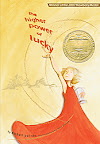
How can anyone resist such a story? I didn't have any books like this to read in 1950 when I was ten! It's a great book for children, but I also recommend The Higher Power of Lucky to moms and grandmothers, too, so we can remember what it's like to be ten years old. That's old enough to know all kinds of things, but not quite mature enough to understand them. And why is Lucky wearing a flowing red dress on the book's cover and carrying an urn?

Her friend Lincoln is a nerd and a word-person, as I have been since at least the age of two. Let me give you an example: Lincoln was so annoyed by a sign that said SLOW CHILDREN AT PLAY, that he had to "fix" it. He didn't want people to think that the children around there, including Lucky and himself, were SLOW, so........
Lincoln did something brilliant. Next to SLOW, he drew two neat perfect-size dots, one like a period and the other a little above it. Lucky knew it was a colon and it made the sign mean, "You must drive slow. There are children at play" (p. 24).
For readers who are as brilliant and "presidential" as Lincoln, the author adds a page at the end of the book showing which books are mentioned in Lucky's story, how to reach the website for the International Guild of Knot Tyers, and the little prayer Lucky hears at the twelve-step meetings:
God grant us the serenity to accept the things we cannot change,
Courage to change the things we can,
And the wisdom to know the difference.
Now THIS is a real booklover's kind of book! No wonder it won the John Newbery Medal. Rated: 9/10, an excellent book.

Introduction ~ Bonnie Jacobs

I'm excited about The Newbery Project and have already written a post about it on my Bonnie's Books blog. Although I've already read 21 of the books, I plan to read them again in order to write reviews of each one, except the 2007 book which I have recently reviewed. I'll post that review here, but you can also click on the title below, in the list of books I have read before:

2007
The Higher Power of Lucky, by Susan Patron
2001 A Year Down Yonder, by Richard Peck
2000 Bud, Not Buddy, by Christopher Paul Curtis
1999 Holes, by Louis Sachar
1997 The View from Saturday, by E. L. Konigsburg
1994 The Giver, by Lois Lowry
1992 Shiloh, by Phyllis Reynolds Naylor
1991 Maniac Magee, by Jerry Spinelli
1990 Number the Stars, by Lois Lowry
1986 Sarah, Plain and Tall, by Patricia MacLachlan
1983 Dicey’s Song, by Cynthia Voigt
1981 Jacob Have I Loved, by Katherine Paterson
1978 Bridge to Terabithia, by Katherine Paterson
1977 Roll of Thunder, Hear My Cry, by Mildred D. Taylor
1975 M. C. Higgins, the Great, by Virginia Hamilton
1970 Sounder, by William H. Armstrong
1968 From the Mixed-Up Files of Mrs. Basil E. Frankweiler, by E. L. Konigsburg
1964 It’s Like This, Cat, by Emily Neville
1963 A Wrinkle in Time, by Madeleine L’Engle
1944 Johnny Tremain, by Esther Forbes
1924 Invincible Louisa: The Story of the Author of Little Women, by Cornelia Meigs
1931 The Cat Who Went to Heaven, by Elizabeth Coatsworth

Holes 1999


With great care the scene is set and the characters are introduced. From the outset you are aware that all is not quite as simple as it may appear. A story, on the surface written in short economic sentences. We learn enough about our characters but, as with much else in this book – it is the bare minimum. As two of these characters launch out into an apparent barren wilderness the reader is compelled to turn the page and ‘just finish the chapter’!
I enjoyed the style of writing, the story within a story plus the message of the book ‘look carefully, things are not always what they appear to be’.

A read that would appeal to boys and well deserving of the Newbery Medal award

Monday, September 3, 2007

The Tale of Despereaux - 2004

Delightful writing from the pen of Kate Di Camillo tells an apparently simple fairy tale story of a small brave mouse who despite having the odds stacked against him enables light to triumph over darkness. The reader is challenged by the apparently simple questions posed by the author who writes in a simple but never condescending style.

In my opinion deep respect for her readers was evident. On the face of it this is a good over evil fairy story, light winning over the darkness. But behind the simplicity are laid the big questions of life. The short chapters lead from one unlikely scenario to the next but almost inevitably a puzzle or query arises from her writing. Themes of being different, standing up for what is right, forgiveness and challenging taken for granted assumptions are used to encourage thinking and reflection far from the soup, red cloth, needle and small ears that are never far from the narrative.

I would highly recommend this book, especially for reading aloud, just allow plenty of space for reflection and discussion.

Saturday, September 1, 2007

I, Juan de Pareja (1966)


I loved reading I, Juan de Pareja by Elizabeth Borton de Trevino. This novel is based on the life of Juan de Pareja, a slave that served a famous painter, Diego Rodríguez de Silva y Velázquez, in 17th century Spain. The main character is compelling and likable. We meet him as a child living in Seville. Since the book is written in first-person, from Juan de Pareja's point of view, we get to know him well; he confides his deepest secrets and feelings as he passes through a difficult childhood.

After the first few chapters, Juan is no longer a child. To me it seemed strange to read a children's book that violated a primary rule of writing for children – that the main character should be a child – and that's one reason I decided the book was more suitable for teenagers than for middle grade aged children (8 to 12). Another reason is that there are many tragic deaths of people around him, including his mother and a young girl. Through most of the book, we read about Juan de Pareja as an adult, living in Madrid, a slave to the painter. He is portrayed as a devoted servant who is happy with his slavery except for one detail: he wants to paint, which is forbidden by law to slaves.

The writing in this book flowed flawlessly so it was pleasant to read, and it took me only a few days to get through it. That's fast, as I'm normally a slow reader who gets through one chapter per night if I'm lucky. But I, Juan de Pareja fascinated me and at times I couldn't put it down despite being tired (I read right before sleeping, most nights).

One thing I liked about the book was the philosophy Velasquez expressed about painting. In one scene he compared the drawings of two apprentice artists, defacing the excellent work of one of the boys because he had embellished the truth in order to make a still-life of moldy cheese and dry bread look better. Velasquez said, "I would rather paint exactly what I see, even if it is ugly, perfectly, than indifferently paint something superficially lovely. . . . Art is Truth, and to serve Art, I will never deceive."

You can find photos of paintings by Velazquez on the internet. The painting included with this review is one Velasquez did in 1650 of his slave and friend, Juan de Pareja.

My book review blog: Linda Jo Martin.
My children's literature blog: Literature For Kids.