Thursday, February 12, 2009

The View from Saturday

I was predisposed to like The View from Saturday, by E.L. Konigsburg, because From the Mixed-Up Files of Mrs. Basil E. Frankweiler was one of my favorite childhood books, and remains a favorite today. And I like reading about smart misfits, having been one myself, especially in junior high school.

But the four kids' stories in The View from Saturday didn't really grab my interest. The kids' voices didn't seem quite right to me, and as soon as I got used to one character - bam, a new point of view appeared.

There were a few passages that made me laugh, or nod my head in agreement, like the ones below - but in general, I just couldn't seem to connect to the characters or their situations. They never seemed real to me - except when Nadia gets mad at everyone and stays home watching daytime tv and decides that everyone is either pathetic or disgusting - that I could see myself doing when I was 11 or 12 year old.

Here are a few passages that I liked, anyway:

There were times in school when a person had to do things fast, cheap and without character (pp. 9-10).
Such public displays of affection can be embarrassing to a prepubescent girl like me who is not accustomed to being in the company of two married people who like each other (p. 27).

I read a book a few years ago called Ballyhoo, Buckaroo, and Spuds, by Michael Quinion (entitled Port Out, Starboard Home: And Other Language Myths in the U.K.), which includes a rather lengthy discussion of the origins of the word posh. And as much as I liked the Grandpa's song in his flying "laboratory" in Chitty Chitty Bang Bang:
"O the posh posh traveling life, the traveling life for me
First cabin and captain's table regal company
Pardon the dust of the upper crust - fetch us a cup of tea
Port out, starboard home, posh with a capital P-O-S-H, posh...

...my inner word nerd didn't really approve of Julian's use of this folk etymology to score points in an academic contest (see Quinion's essay on the origins of tip here). Then again, it wasn't as easy to fact-check stuff like this in the pre-Google era, and I certainly didn't know all of the "Fifteen Questions with Thirty-Six Answers" that Konigsburg adds to the end of the story.

Fact: Mrs. Konigsburg is pretty perceptive when it comes to describing people's reactions to physical disability and to subtle bullying amongst 6th graders.

Further Fact: The slightly mystical part of the story - Epiphany, The Souls, the choice of the teammates, Mr. Singh's statements to Mrs. Olinski, all the little synchronicities, and (most unreal of all) - the kids coming together and not fighting at all - didn't work so well for me.

And like Aunt Sara, the whole use of the noose as a team symbol bothered me - though its use as a racist threat wasn't as prevalent in the 90's as it is today (see an interesting article on "The History of the Noose"), it still made me uncomfortable. It didn't jibe well with what I saw as the other symbols in the story - the cups of tea, or the calligraphy and fountain pen, for instance. Then again, symbolism is not really my cup of tea.

I can't help agreeing that kindness is something that 6th graders and teachers really need. So even though many of the disparate pieces of The View from Saturday just didn't work for me (and why the title? I don't like it when the reason for the title isn't explicit in the book), I can see why many others - especially adults who like to speculate about the decline of Western civilization - like this book.

Wednesday, February 4, 2009

The Graveyard Book by Neil Gaiman


The Graveyard Book by Neil Gaiman
Illustrated by Dave McKean

Pages: 309
First Published: Sept. 30, 2008
Genre: children, fantasy
Award: Newbery Medal 2009
Rating: 4.5/5

First sentence:

"There was a hand in the darkness, and it held a knife. "


Comments: After his family is killed a baby escapes by wandering out the open door and making his way to the graveyard. A married ghostly couple adopt him and name him Nobody Owens, Bod for short. Nobody then commences to grow up in the graveyard and can see and talk with all the ghosts of those buried there. In fact, he himself is not quite in the land of the living but somewhere between the life and death. He must stay here in the graveyard until he is old enough to look after himself on the outside as the man who killed his family is still looking for him and will continue until his job is completed.

I really enjoyed this book. Finally a 21st century Newbery winner I can rave about and recommend. The story and the characters are just wonderful. I really enjoyed the premise. It reminded me a bit, at first, of Terry Pratchett's Johnny and the Dead even though the plot's are completely different. Even though I don't believe in ghosts and my religion tells me differently what will happen in the afterlife, it still is so much fun to imagine a world of ghosts. To imagine graveyards are full of the people buried there talking to each other. The book is really well written, fun and exciting. I think this is the type of book that will appeal to pretty much anyone, even those who don't like fantasy as a rule. Finally a Newbery winner that *will* be enjoyed through the ages!

My only reason for not giving a full rating of 5 is that I really did not like the illustrations at all. They were dark, hard to see the details and I thought the faces were horrible. They definitely did not enhance the reading experience at all. From looking at covers at LibraryThing I see there is an edition with illustrations by Chris Riddell. Now that is someone whose art I appreciate and I'd love to have a look at those illustrations.

Sunday, February 1, 2009

The Graveyard Book

It's an unexpected pleasure, writing a review of The Graveyard Book by Neil Gaiman. As I said back in December, it was my favorite book out of the ones I read on the Mock Newbery's short list, but I didn't really think it would win. I thought it was too funny, too macabre, just too different from previous winners. I couldn't be happier to have been proved wrong.

There were a lot of things that I loved in this book. The story of Nobody's childhood is wonderfully clever, but it is Gaiman's writing that really stole my heart. Combine his way with words with the British references (airing cupboards, kettles of tea, pupils instead of students, etc.), fascinating history, his humor, and the delightful illustrations by Dave McKean, and you have.....well, you have a winner.

A few examples of Gaiman's winning (and winsome) storytelling:
The child had fallen asleep in Mrs. Owens's arms. She rocked it gently, sang to it an old song, one her mother had sung to her when she was a baby herself, back in the days when men had first started to wear powdered wigs. The song went,

Sleep my little babby-oh
Sleep until you waken
When you're grown you'll see the world
If I'm not mistaken
Kiss a lover,
Dance a measure,
Find your name
and buried treasure...

And Mrs. Owens sang all that before she discovered that she had forgotten how the song ended. She had a feeling that the final line was something in the way "and some hairy bacon," but that might have been another song altogether, so she stopped and instead she sang him the one about the Man in the Moon who came down too soon, and after that she sang, in her warm country voice, a more recent song about a lad who put in his thumb and pulled out a plum, and she had just started a long ballad about a young country gentleman whose girlfriend had, for no particular reason, poisoned him with a dish of spotted eels, when Silas came around the side of the chapel, carrying a cardboard box (p. 26).
Ah, I do love those weird old nursery rhymes. And powdered wigs! Hairy bacon! Not to mention the "dish of spotted eels". I can't really explain it, but Gaiman's descriptions just delight me. Even when he is talking about revolting European foods:
Miss Lupescu continued to bring Bod things she had cooked for him: dumplings swimming in lard; thick reddish-purple soup with a lump of sour cream in it; small, cold boiled potatoes; cold garlic-heavy sausages; hardboiled eggs in a grey unappetizing liquid (p. 71).
I've always loved old-fashioned names, and have kept a list of my favorites from the genealogy my grandmother drew in her spiky, shaky old lady handwriting (including Comfort Littlejohn, Mindwell Phelps, Squire Boone, Gad Noble, Sylvanus Crook, etc.). Gaiman clearly has a feel for historic names (and epitaphs) too, and has picked the best of both the graveyard and an English town for us. There's Mother Slaughter, Geo. and Dorcas Reeder, Thomes Pennyworth, Abanazer Bolger, Amabella, Portunia, and Roderick Persson, and a host of other memorable minor characters - not to mention the extraordinary Nobody Owens himself, who "could greet people politely over nine hundred years of changing manners" (p. 189).

I feel I should mention that I am not a fan of horror in general, and that reading about the first scary chapter of The Graveyard Book initially made me want to give the book a pass. And it was scary - every mother's worst nightmare, perhaps - although it was not particularly graphic. Parents might want to read the first couple of chapters (you can listen to Neil Gaiman reading it himself here), and think about their kids' particular sensitivities and fears before giving a child that is younger than say 10 or 11 years old a copy of this book.

I'm happy that my preconceptions about horror and scary stories didn't prevent me from reading The Graveyard Book, obviously, and I think that it's great that a lot of people who wouldn't think this book was right for them might give the book a chance now that it's won the Newbery.

I could go on, but I'm afraid I'm running out of words like delightful, wonderful, winsome, and the like. I will say that I first read The Graveyard Book last November, and enjoyed it just as much (if not more) upon re-reading it this week. And I still cried happy tears on the last few pages. This is one of those books that stand up to repeated re-readings - a classic, if you will. Which I guess makes it a pretty good choice for the Newbery Medal after all.

The Tale of Despereaux


The Tale of Despereaux, being the story of a mouse, a princess, some soup, and a spool of thread by Kate DiCamillo
Illustrated by Timothy Basil Ering

Pages: 270
First Published: 2003
Genre: children, fantasy, fairy tale
Award: Newbery Medal (2004)
Rating: 3.5/5

First sentence:

This story begins within the walls of a castle, with the birth of a mouse.


Comments: Written in a tradition fairy tale manner this is the story of four characters, two good and two evil (or shall we say mislead). They include a princess, a mouse, a serving girl and a rat. All good ingredients for a fairy tale. We learn the background lives of all four characters then we are told how they met up with each other and created this story which ultimately is about the mouse, being a knight in shining armour, and how he rescued the princess and helped the evil doers as well.

I know there are a million reviews of this book and many raves. It also won the Newbery in 2004. It is one of the better Newberys that have won in the 21st century but I wasn't that taken with it. Perhaps I am too grown up and cynical for this type of story but I found it very sickly sweet. Even though I am a great fan of fairy tales I found here that the good were too good and the evil were not all that evil, simply mislead. It is a very fast read so certainly worth the effort. I think girls in particular will enjoy the story but it's a bit too much "honey" for my tastes.

Friday, January 30, 2009

The Grey King

Sometime back when I was in grade school, I picked up my older brother's copies of The Hobbit and the Lord of the Rings trilogy, and got forever hooked on fantasy. This was right around the same time that Susan Cooper's The Dark Is Rising sequence of books was published, but unfortunately (because I'm sure I would have have loved them then) I was oblivious, and only became aware of these books in the last few years.

My recent reading and appreciation of The Grey King was hampered by a couple of things. First of all, I have not read the other books in the series, and I'm guessing that you really need to have read Over Sea, Under Stone, and then The Dark Is Rising, and Greenwitch (the three books preceding The Grey King) to really get into Will Stanton's story.

Secondly, I just finished a couple of other fantasy books that were so very, very good that other fantasy just pales in comparison (Lois McMaster's The Sharing Knife: Horizon, and a re-read of Neil Gaiman's The Graveyard Book, in case you were wondering). Do you ever have this happen? That what you read influences your views so much on the very next book you pick up? Maybe I should have read some non-fiction next, or something else that really couldn't be compared.

Finally, I was stuck in bed recovering from a stomach bug when I read The Grey King. I will say Cooper's book helped me forget my surroundings for a while. But overall, I was a little disappointed. I didn't think that the fantastic parts of The Grey King meshed particularly well with the details of everyday life on a farm in Wales (at first, at least, I think it got better as the story went on), and I was confused about the relationships of the "Old Ones", the Dark, the Sleepers (pictured in the cover above), Merriman, and the Grey King.

The main character, Will Stanton, was an appealing character, and I liked his aunt's family and his friend Bran and Bran's dog Cafall very much, and the use of Celtic myth and history. But I don't have a strong urge to read the rest of The Dark Is Rising series - which I guess tells you something about my feelings about The Grey King. I don't have any problems with recommending it for young readers who enjoy fantasy, but for whatever reasons (and probably at least partially for the ones given above), it's not a keeper for me.

Monday, January 26, 2009

Check Out Neil Gaiman's Blog Post

upon learning he won the Newbery Medal this morning: (Insert Amazed and Delighted Swearing Here). His labels on the post are pretty sweet, too.

Thursday, January 22, 2009

It's Like This, Cat

It's Like This, Cat is a the perfect title for this book. Because I think that what it does best is describe a time and a place - neighborhoods in New York City in the early 1960's. A lot of the Newbery winners do excel in capturing particular settings, come to think about it. Maybe I've come to expect that as a given, and that's why I didn't like this book more than I did, which was moderately.

It's interesting, too, because Neville gets the feel of it down (I think pretty well, though I don't know the setting myself) without mentioning current political events or too much of the pop culture of the time. It reminded me of Betsy Byars' Summer of the Swans in that way - except instead of a girl and her tennis shoes and backyards and Green Acres, Neville shows us a boy with his duck tail (which gets turned into a "butch" cut) and apartment buildings with stoops and cellars full of storage lockers, and record players with needles and Belafonte records. Young teenagers ride their bikes everywhere and explore the city by themselves, calling their parents (even if their parents are beatniks) at dinnertime if they're going to be late.

Apart from the setting, the story is a quiet coming-of-age story of a young teenaged boy (unnamed for a few chapters, but you finally learn he's called Dave) who befriends a number of different characters in his neighborhood. One of the more eccentric ones, whom the local kids call Crazy Kate the Cat Woman, gives Dave a young tomcat. Dave is a rather lonely kid - he has no siblings, and he fights with father - and his adventures with Cat lead him to some new perspectives on his family and new friends.

It was all very nice, and I enjoyed reading it, but it didn't really make the profound impression on me that I feel like a Newbery winner should make. Am I expecting too much? Do I really need more "issues" in a story? Is it weird that my main thought after finishing It's Like This, Cat is on the lack of drug use in the big city?

I did find the whole book, including illustrations, online at the University of Pennsylvania's digital library. Take a look at it and see what you think.

Friday, January 9, 2009

The Cat Who Went to Heaven

There were some things I liked very much in The Cat Who Went to Heaven, by Elizabeth Coatsworth, and some things that I was very dubious about.

I liked the descriptions of the cat, Good Fortune, as well as all of the deftly portrayed animals that the unnamed Japanese artist thought about for his painting of the Buddha's death scene. Coatsworth uses simple yet poetic words in her short story (is this the shortest of the Newbery winners? I think it must be, except perhaps for one of the poetry collections - it's only 74 pages!):
So the old woman put down the basket and opened the lid. Nothing happened for a moment. Then a round, pretty, white head came slowly above the bamboo, and two big yellow eyes looked about the room, and a little white paw appeared on the rim. Suddenly, without moving the basket at all, a little cat jumped out on the mats, and stood there as a person might stand who scarcely knew if she were welcome. Now that the cat was out of the basket, the artist saw she had yellow and black spots on her sides, a little tail like a rabbit's, and that she did everything daintily (p. 10).

She is like new snow dotted with gold pieces and lacquer; she is like a white flower on which butterflies of two kinds have alighted...(p. 11).
I did wonder why the cat had such a short tail. Was this some genetic thing, like a Manx cat, or was it cropped or lost in an accident? Frustratingly, my library book had a sticker over the rear end of the cat shown on the cover, but it did appear that the pencil illustrations by Lynd Ward and Jael inside this 1990 edition showed a short-tailed cat. When I went to look at what I think was the original cover art, this is what I saw:


Every single copy of this cover image that I can find on the internet has the Newbery medal stuck on the cat's tail! Is it a tiny nub or what? I think if the cat had a normal tail it would extend out beyond the medal.

Now for the things I didn't like about this quiet little story that a lot of people find so charming and inspirational.

I really wondered about its authenticity (ooh, big literary word alert), and question how much of Coatsworth's portrayal of Japanese culture and Buddhism is accurate. I did some Googling and didn't turn up a legend about cats spurning the Buddha's blessing on the first couple pages of hits. Does anyone know if Coatsworth made this story up out of whole cloth, or is it really a Japanese legend? The fact that schools and homeschoolers alike use this book to fulfill a reading or social studies requirement on world cultures and/or religions makes this question rather important, I think.

In a similar vein, the Newbery Book Discussion Group at the Allen County Public Library ranked The Cat Who Went to Heaven 81st out of 87 winners, noting that it was:
Blessedly short. Some of us were bothered by seeming cultural insensitivity in the title, since the book is a story about an artist and the Buddha...So, shouldn't it be "The Cat Who Went to Nirvana"?
Finally, I absolutely hated the book's ending. I don't want to spoil it for those who haven't read it, but if you want to read about the part that bothered me, highlight the following paragraph.

The cat dies because she's so happy? WTF? What kind of ending is that for a children's story? I don't demand "and they lived happily ever after" for all kid's books, but isn't it a little disturbing to suggest that "pure joy" will kill you?

Anyway, it was a mostly enjoyable story, but not one I'll probably ever re-read or recommend to anyone but hard-core cat lovers, who might enjoy the gentle creature that Coatsworth portrays as colorfully as the artist in the story.

Thursday, December 18, 2008

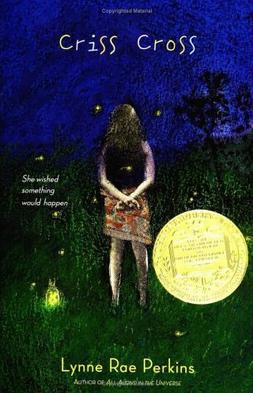
Criss Cross


Author: Lynne Rae Perkins
Narrator: Danielle Ferland
Published by: Harper Childrens Audio (2006)
Originally Published (2005)
Length: 5 hours, 8 minutes
Award: Newbery Medal
My Rating: 2/5
Amazon Rating: 3/5 (72 customer reviews)

This is a hard book to review--I've written something and erased it about ten times now. Can I just say that I didn't like it? The first disc was frustrating to listen to, because I didn't really know that there wasn't much of a plot, and I kept waiting for something to happen. The narrator's voice was completely wrong for the tone of the book. Once I accepted that this wasn't a plot-driven novel, it got a little better, but I have to admit that the only reason I continued to listen is because when I have an audio book in the car, I follow the path of least resisitance, which is to not take out the CD. There are moments when Perkins really captures the essence of adolescence, and looking back to when I was younger, I could identify with some of the feelings and agree that that is how things felt. I just am not sure that teens living in the midst of this time of transition in their lives would find as much meaning in it. It had more of a reminiscent feel, maybe because the setting is sometime around the 70's.
I assume this won the Newbery Medal because it was somewhat innovative. I think some of that quality was lost in the audio version (haikus, song lyrics, etc. that weren't so obvious listening to.) I much preferred Princess Academy by Shannon Hale that won the Newbery Honor for that year.
Bottom line: Writing about nothing may have worked for Seinfeld, but not for Criss Cross. If you've got the five hours it takes to listen to this audio book, watch about 10 Seinfeld reruns instead!

Tuesday, December 16, 2008

Hitty (aka Mehitabel)

I didn't expect to like Hitty: Her First Hundred Years, by Rachel Field. A story about a doll? A book that is commonly referred to as dated and "not politically correct"? It sounded both ho hum and distasteful.

I couldn't have been more wrong.

Although there definitely are some rather outdated parts in Hitty, as well as a few unfortunate stereotypes, these passages were not as bad as I feared. I thought that the rest of the story was an unusually charming, occasionally exciting, and truly interesting look at American history and "the good old days".

Hitty's story begins sometime before 1830 in the great "State of Maine" (as it is often referred to in Hitty), where she is carved out of mountain-ash wood by an Irish peddler. She is given to young Phoebe Preble (and fans can read more about the Preble family here), and accompanies Phoebe and her parents on a whaling expedition to the South Pacific, where mutiny, shipwreck, a desert island, "savages", an exciting rescue, and "a dirty old snake-charmer" of India (p. 92, also described as a heathen Hindoo) are encountered. And this is just in the first half of the book. That's a fair amount of action for a small wooden doll.

The not-so-PC passages are mostly from some of the parts described above, such as when the natives on the unnamed island are repeatedly described as childish, flamboyant, and possibly cannibals, who take Hitty to be an idol. When Hitty is lost in India, she describes a "babble of strange voices uttering heathenish gibberish" (p. 85). Later in the book, southern Black Americans are described as dirt poor but exceptionally musical, and then Hitty goes on meet "a noisy, unattractive lot of young men and women whose clothes shocked me by their tightness and lack of modesty" (p. 189).

Hitty's perspective is basically that of a rather old-fashioned, upper-middle-class white lady of the 1930's, so these comments are not particularly surprising. I think that the outdated passages are worth discussing*, especially with your kids, but I don't think it should lead readers to condemn the rest of the book when there is so much more to recommend it. Quakers, social class, the Civil War, theft, fashion, growing old, children's unthinking cruelty, and religion - all are touched upon, usually very graciously - in the second half of Hitty's memoir.

Plus, Rachel Field introduced me to the word "wadgetty", a regional term from Massachusetts and Nantucket (which means fidgety) that is used repeatedly and to great effect in Hitty. Although I was shocked to find that wadgetty isn't in the Oxford English Dictionary, it was fun to discover that H.L. Mencken defined it in 1948.

Dorothy P. Lathrop's gorgeous artwork adds a whole new dimension to the story. The original cover (shown above) isn't bad, but I have to admit that I like the new cover, a colored version of the illustration on pg. 13, even more.


Which leads me to the latest edition of Hitty: Her First Hundred Years (and no, it's not a sequel, though like Peter D. Sieruta, I wouldn't be surprised to read about the publication of Hitty: Her Second Hundred Years).

In 1999, a new book entitled Rachel Field's Hitty: Her First Hundred Years was written (or adapted, with substantial abridging and some entirely new adventures) by Rosemary Wells, and lavishly illustrated by Susan Jeffers. A discussion on goodreads.com led me to this interesting article in the New York Times Book section: Children's Books: The Name is the Same.

Boy, people are not happy when you mess with their beloved classics, and there are apparently a good number of Hitty fans out there - see Hitty Preble, presented by the Great Cranberry Island Historical Society; Hitty.org - The Hitty Research Pages; or HittyGirls, to begin with. I've never seen so much discussion of a character from a classic Newbery book, or one with as many related eBay auctions. I hope all of this encourages people (including kids) to read the original Hitty before passing it by as hopelessly outdated and politically incorrect.


*And not just the passages on race. For instance, when Phoebe's father, the captain of a whaling ship, says that if he strikes it lucky on his next voyage, he might "bring back six or seven hundred barrels of sperm" (p. 34), you probably want to explain to your children that Captain Dan'l is referring to oil made from sperm whale blubber.

Saturday, December 13, 2008

Mock Newbery Discussion

The Allen County Public Library's Mock Newbery blog is "the place to be if you enjoy reading and discussing quality, newly published, children's literature." They've just published their "short list" of some of the candidates for the 2009 Newbery Award. There are quite a few familiar names on the list: Linda Sue Park, Lois Lowry, Cynthia Kadohata, Karen Hesse, Sid Fleischman, Sharon Creech, and Avi are all previous winners.

There's also some fun discussion at Heavy Medal: A Mock Newbery Blog (great title!). They've been discussing 1953, when Secret of the Andes (which I haven't managed to read yet - checked it out and returned it to the library untouched) beat Charlotte's Web for the medal, which a lot of people think was one of the poorer choices the Committee has made. I haven't read Charlotte's Web since grade school, and I didn't love it then, so I'm ambivalent about the choice.

Anyway, I've read more of the ACPL's mock candidates this year than in previous years, probably because I've been enjoying YA literature a lot lately. I don't think my 12 year old is mature enough to handle Suzanne Collins' The Hunger Games, or Neil Gaiman's The Graveyard Book, but I loved both of them. He and I both read and enjoyed Kathi Appelt's The Underneath, and The Willoughbys, by Lois Lowry.

These four books are all rather dark. If I had to pick one out of just these four books, I'd select The Graveyard Book as my favorite, but I bet the Newbery Committee would pick The Underneath for it's poetic language, clever mix of myth and history, and its setting in an east Texas bayou.

I guess we'll see in a couple of months. Have you read any of the short listed mock Newbery selections? What do you think - last year's winner was set in medieval England, are we due for something contemporary? Something uniquely American? Something science fiction or fantasy-ish? All four of the books that I've read fall in that category!

Of course it's always possibly they'll pick something completely different.

...And Now Miguel

...And Now Miguel, by Joseph Krumgold, was not the most exciting Newbery winner I've read this year. It reminded me a lot of Shadow of a Bull - most of the story is about a boy becoming a man - and the rest is ethnographic detail on a way of life that is foreign to most readers.

I'd rather read about sheep herding in New Mexico than bullfighting in Spain, though, so despite becoming bored (and mentally re-naming the book Not Now, Miguel, for how many times I put it down and picked up another book - almost any book - that was more appealing), I did enjoy ...And Now, Miguel more than Shadow of a Bull.

Miguel, the twelve year old protagonist, yearns to go to the Sangre de Cristo mountains with the other adult men in his family, who take the sheep to graze in the high mountain valleys during the summer months. The mountains are beautiful and mystical, and it would be interesting to compare Miguel's ideas about the mountains with the unnamed narrator's view of the Himalayas in Gay-Neck. I'll spare you the compare and contrast essay, though.

I came to appreciate Miguel's story a bit more when it came to the last 40 or so pages (but what a long haul that was, considering the whole book is 245 pages), when Krumgold examines Miguel's growing maturity and how he questions his religion and how and why prayers to San Ysidro (pictured on the cover with his oxen) are answered. The questions are big ones, and the lessons learned are important, even if I don't always personally agree with the way his big questions are answered.

I did appreciate the fact that the moralizing isn't too heavy-handed, as it is in several other Newbery winners from the 50's, like The Door in the Wall, Carry On, Mr. Bowditch, and Amos Fortune (wow, they just didn't go in for subtlety then, did they), and I thought that this was the most interesting part of the book. It's too bad that a lot of kids (and adults) will probably give up on the story before they get to this part.

It's interesting how cover designs and illustrations influence my view of the Newbery winners - something I did not anticipate before starting this project. Anyway, there have been quite a few books that I didn't really like that I felt were at least somewhat redeemed by beautiful artwork (by the author, even, as in The White Stag and The Door in the Wall). And then there are others where the artwork just leaves me cold. Unfortunately, Jean Charlot's drawings in Miguel fell into this latter category. The "About the Illustrator" blurb at the back of the book says says Charlot's work was influenced by the Olmec statues in southern Mexico, and I can definitely see that. Sadly, I didn't think that the drawings particularly fit the tone of the story, and they made the whole thing even more ponderous than Miguel's thoughts and descriptions alone did.


I do think kids and adults that are particularly interested in New Mexico, sheep, or a quiet coming-of-age story might appreciate Miguel's story if they persevere with it. In retrospect, I like the story more now than I did while I was slogging through it, and a few of the beautiful and meaningful scenes from the book that are stuck in my head made it worth the effort.

Monday, December 8, 2008

Dicey's Song - 1983


Dicey's Song picks up right where Homecoming leaves off--the Tillerman children tentatively settled in with a brusque and independent grandmother who has cut herself off from the surrounding community. Gram warily (but deep inside lovingly) welcomes her grandchildren, who have come with their own experiences of being shunned by their peers in the past for having an unconventional family situation. Gram and the children come to meet a whole cast of characters in the novel who are likewise loners or unusual in some way. Obviously, this theme is woven throughout the book, and I egocentrically love it because I can identify with it. And I would imagine that most people have felt at sometime or other that they just didn't "fit in." I grew up in a loving home in which they query was often made, "Was she switched at birth?" I took an online personality test as an adult with these results: "People who know you can only desribe you as possibly being from a different planet or universe." My mother wholeheartedly agreed. I have come to neither love nor hate whatever it is that makes me different, but accepting that it just IS, and it is not an excuse or reason to be antisocial. I think this is one of the lessons Dicey learns as she gradually opens herself up to others, despite the very real fear of vulnerability. She also learns thetricky art of "give and take" in relationshipsIn attempts to reach out to others and receive in return, the results are rarely neat and tidy, but necessary all the same. As Gram has learned through her own mistakes:

"I got to thinking—when it was too late—you have to reach out to people. To your family, too. You can't just let them sit there, you should put your hand out. If they slap it back, well you reach out again if you care enough. If you don't care enough, you forget about them, if you can."

Saturday, November 15, 2008

Waterless Mountain

Waterless mountain by Laura Adams Armer, is the story of a young navaho boy Hayolkai aski but called younger brother. He wants to be a medecine man like his uncle and it tells the story from when he was a young boy to becoming a man.

Laura Adams Armer made friends with the navaho people and learned a lot about their beliefs, custums, and culture.

Younger brother decides he needs to go on a trip and search for the ancient turqoise woman and makes a long journey from his home in Arizona to the pacific ocean.
Younger brother has many experiences along the way and meets many friends and enemies.

There are a lot of old native american stories told throughout the book that are kind of interesting.

This book goes into the thoughts of younger brother and tells of the way many Navaho people think.

Saturday, November 8, 2008

Dear Mr. Henshaw

Dear Mr. Henshaw, by Beverly Cleary, was so much better (and shorter!) than I expected. Why didn't anyone tell me what a sweet book this is?

I'm not a huge Beverly Cleary fan, mainly because I'm not terribly familiar with her books. I somehow missed her stories as a child (my parents and grandmothers tended to give me classic books as gifts, and I never stumbled across Ramona or Henry Huggins on my own). When Dear Mr. Henshaw won the Newbery in 1984, I was in college, and not paying a whole lot of attention to children's books. But I'm trying to make up for lost time now. ;-)

The title didn't instantly draw me to this book, nor did the cover. The reviews and summaries didn't really grab my interest, either - an epistolary story (ho hum) about a boy whose parents divorce (sounds depressing). I don't usually like heavy-handed "serious topic affecting youth today" kinds of kid's books.

But I was wrong (except about the cover, I still don't like the cover, or the illustrations all that much). This book was funny, not at all heavy-handed, and the format - of letters to Mr. Henshaw and diary excerpts - was perfect. Both Leigh's and Mr. Henshaw's "voices" (although you only get Mr. Henshaw's words as they are reflected by Leigh, but that's enough) were wonderful. The portrayal of the divorced parents was so skilfully done that I wondered whom Cleary modeled it on.

Sometimes it's good to be so far off the mark when it comes to judging a book by its cover and blurbs. Now what I'd really like is another book by Beverly Cleary featuring Boyd Henshaw (with maybe a few reflected notes from a teenaged Leigh?). He just sounds like someone I'd like to hear more about.

Thursday, November 6, 2008

The Cat Who Went To Heaven

This very short book written by Elizabeth Coatsworth took me a little less than an hour to carefully read. The book is set in Japan and talks of an artist struggling to sell his paintings. One day his housekeeper brings him a cat. At first the artist is very angry at the housekeeper for bringing the cat because they are considered unlucky and even evil.
A priest comes to the artists house and tells him that he is the chosen one to paint a picture of the Buddha's death which if accepted would be hung in the temple. The artist spends the next several days living the life of buddha in his mind. He paints the buddha and then all the animals that visit him at his death. Each time he paints an animal the cat comes and looks at the painting with a longing to be in it.
The artist is torn between painting the cat or leaving it out of the picture because of their bad reputation. The ending was pretty neat when the cat was finally accepted.
I liked the brief description of the life of Siddhartha and the many animals he took the form of along with the short stories of them. There are also eight songs which the housekeeper sings that are kind of cool.
This book was probably not a favorite but it wasn't bad. I think it had a deeper meaning to it than I picked up on. I think children could be taught a little about the buddha by it.

Monday, November 3, 2008

Hitty Her First Hundred Years

Hitty Her first hundred years by Rachel field is a story about the world from a doll's prespective. This book did not sound very interesting to me when I looked over the cover but I have to say it surprised me. This was the first book I have ever read about a doll and I actually enjoyed it even thought I have seen many low reviews on it compared to the other newbery book winners.
Hitty was a very special doll of her time. She was slightly smaller and wooden unlike a lot of china dolls that were popular during the time. She was made of mountain ash wood which is said to bring good luck, and you can tell that it generally did throughout the story.
The book is set somewhere in the early nineteenth century and tells of the first hundred years of her life into the early twentieth century. Hitty has many adventures and travels from her native state of Maine to many parts of the world and the United States. She is a doll that many people come to love and she goes through many owners and occupations including a snake charmer in India, a doll of fashion, a model for photography and even a pincushion. She gets to see much of the natural world and is even worshipped as a heathen idol.
I like that the book talks a little bit about what was going on during the nineteenth century including slavery and what life was like in the northern and southern parts of the United States during the Civil War.
Hitty meets many interesting and a few famous people along the way in her adventures including Adelina Patti( who I had never heard of but was a famous opera singer at the time) and Charles Dickens. She has seen the perspective of the world from many different people with different views and opinions and has been with people who treat her very kindly to people who are very cruel to her. She is owned by many girls with a variety of ways of life. She learns to accept critisism and compliments being that she is a doll of experience.
I think that most girls would really like this book and maybe even a few boys if they gave it a chance. For me it was a fast read and really easy.

Wednesday, October 29, 2008

The Trumpeter Of Krakow

I found The Trumpeter of Krakow by Eric P Kelly a very interesting and creative book. The book is set in Poland in the fifteenth century. It is a story of a family on the run from the Ukraine to guard an ancient possession which is the ancient great tarnov crystal. This is very valuable and sought by many and the only person that the family would willingly give it up for is the king of Poland. The family settles in the town of Krakow and the father of the family takes on a job as the trumpeter for the church of Our Lady Mary to play a tune every hour, and to be the lookout for the town against fires and foreign invasions. Their secret is soon discovered about the whereabouts of the crystal and there are many attempts to steal it. The crystal is soon afterwards taken to the king for it's safety and protection.
I really liked the storyline. It goes from one adventure to another and leaves you wanting more. Not only does it have adventure but it describes somewhat how people acted and thought during that time (I'll have to admit that I had no idea what an alchemist was.) The author wrote also of what the town of Krakow is like and some geographical features of it. It only took me a couple of days to read this book because I could not put it down.
Along with the good story it also teaches of some great moral lessons and patriotism to ones country.
From its fast paced story to it's dramatic ending there is something to enjoy. I think that most children would really like reading this book because it is interesting and they could learn something from it. I don't know if this book is based on a true story or not but the way it was written kind of led me to believe it was, although I searched the king Kazimir Jagiello on the internet and in some books but did not come up with anything. If anyone has any information on this I would be really interested in knowing.

Tuesday, October 21, 2008

Gay-Neck The Story of a pigeon

Gay Neck The Story of a Pigeon by Dhan Gopal Mukerji, was not at all what I expected when I started this book. After reading it now it surprised me on how good it is and the deep meaning behind the story.
The book is set in the mid teens of the twentieth century during the first world war. The book starts out in India with the birth of a special pigeon ( gay neck) who is taught and trained by his parents and a sixteen year old boy( I am assuming it is the author, I do not recall the book ever saying his name) in the ways of flying and being a carrier pigeon.
Gay neck runs into many enemies of the sky like owls, hawks, and eagles and must learn how to outfly them or be killed. There are many adventures that gay neck and the boy go through and the descriptions of nature and the surroundings are absolutely magnificent. You actually feel peaceful reading this book.
The book is told by the sixteen year old boy but it also has parts where he has the pigeon tell his own story using, "the grammar of fancy and the dictionary of imagination." In these stories gay neck tells of the experiences he has while exploring and the many attacks on him by other birds. He talks of how cruel the world can be and asks, "Why is there so muich killing and inflicting of pain by birds and beasts on one another? I don't think all of you men hurt each other. Do you? But birds and beasts do. All that makes me so sad."
Gay Neck learns that men do go to war and hurt each other and I think that is one of the points the author was trying to make in that we humans can act just like beasts.
Gay neck goes with Ghond, a friend of his keeper to serve in the war as a carrier piegon and deliver messages from the front lines of battle to the commander in chief. Gay neck and Ghond sail from India to France and they go on a scouting trip to find a German ammunition dump. They see much killing and firing of men against men that both the pigeon and Ghond both have fear in their hearts. They go to a monestary to get healed by the wise lamas and they eventually find peace with themselves and overcome fear, suspicion, and hate.
I really liked this book even as much as I told myself that I wouldn't. I would recommend that any child read this book.

Sunday, October 19, 2008

Good Masters! Sweet Ladies! A Brief Review

I had read raving reviews about this, but skimming through it I had my doubts about whether I would like it. I just couldn't see what the fuss was about. But this collection of monologues and dialogues of various characters living on a manor in England in 1255 is truly exceptional. I think the strength is in how she taps into the emotions and desires of the characters in a way that we can relate to. It is moving in parts, as well as humorous and educational. I would love to see this performed by an actual class!