Friday, October 10, 2008

Sailing by Ash Breeze (a Review of Carry On, Mr. Bowditch)

Although Carry On, Mr. Bowditch, by Jean Lee Latham, started out rather slowly, I did enjoy it. I'm not sure that most kids (who haven't poured over all of Patrick O'Brian's seafaring works, like I have) would enjoy it so much. Unless they really, really like nautical metaphors.

The main character - Nat Bowditch - is an earnest, hardworking, exceptionally intelligent boy who comes of age during the story, which takes place from the late 1700's through the early 1800's.

Nathaniel has a difficult life in Salem, Massachusetts. His father, Habbakuk (!!), is a cooper who "lost his tuck" (i.e., his ambition; he became depressed) when his ship foundered on a lee shore (see where having read O'Brian comes in handy? I know all about the perils of losing your anchor to windward).

There are a lot of children in the Bowditch family and not much money, and Nat is forced to give up school, which he loves, and work for his father and then as an apprentice (indentured for nine years!) to a ship's chandlery, "where he kept books and sold marlinspikes, belaying pins, and hemp rope" (p. 66).

There are many family deaths (which really happened and was not uncommon in this period in history), but Nat's reaction to the tragedies is curiously flat. The narrative concerning the romances in Nat's life is similarly unemotional and frankly, rather tedious.

Latham makes the story much more interesting when she describes Nat's love of mathematics and his desire for knowledge, and his passion for teaching navigation to everyone on the fo'c'sle*. It is classic story of pulling yourself up by your bootstraps, or to use the nautical term (which Latham never fails to do**), sailing by ash breeze:
Sam said, "Bah! Only a weakling gives up when he's becalmed! A strong man sails by ash breeze!" (p. 47)

..."When a ship is becalmed - the wind died down - she can't move - sometimes the sailors break out their oars. They'll row a boat ahead of the ship and tow her....Oars are made of ash - white ash. So - when you get ahead by your own get-up-and-get - that's when you 'sail by ash breeze'." (p. 48)
I think that this book was written mainly for boys, but I'm afraid that its lack of action and the overt moralizing may turn many of them off today. Yes, it's laudable that Nat wants to be a Harvard man more than anything else, and that he can learn any language, including Latin, with just a dictionary, a grammar, and a New Testament, but I don't think this will lead a lot of kids to identify with Nat.

And there are parts of the story where there is action - how could there not be action, on a tall ship doubling the Horn at the turn of the 19th century? - but Latham doesn't make you feel the exhaustion of several days of "all hands on deck" with wet clothes, cold food, and foul air belowdecks the way some authors do (not just Patrick O'Brian! read Tony Horwitz's description of sailing in the beginning of Blue Latitudes). When I read about someplace so different, I don't want to see a dispassionate list of what Nat endured. I want to taste the hardtack, weevils and all. Paula Fox did a much better job of this in The Slave Dancer (the depressing 1974 winner).

I liked the classic illustrations by John O'Hara Cosgrave II, but I really wanted a map. A trip to the island of Bourbon was an important part of the story, but until they mentioned that it had been re-named Réunion, I had no idea where they were (near Nantucket? by Hawaii?). And frankly, I only knew where Réunion was because I'd read The Mauritius Command (yes, yes, O'Brian again). If kids are reading this (and I know it's a favorite for some homeschoolers), then a map with Réunion, Madeira, Cadiz, and Batavia is a really good idea.

This online biography of Nathaniel Bowditch by the Unitarian Universalist Historical Society filled in some of the questions I had after I finished the book. What happened to Nat's father? What did Nat do after his last voyage? How much of Carry On, Mr. Bowditch was true? (This last question only partially answered, of course). It was undeniably cool to read that a copy of Bowditch's The New American Practical Navigator is still carried on board every commissioned vessel in the United States Navy.


* fo'c'sle=forecastle, or the living quarters in the bow of a ship where the crew is housed. In the book, Nat is quietly egalitarian, teaching the entire crew the arcane arts and science of navigation. I have no idea if this is an invention of Latham's, or something that Mr. Bowditch was actually known for doing. It would be nice to know one way or the other; this is something I really don't like about these children's biographies.

**"You know an anchor won't hold if the cable's too short. A man always needs another shot in the locker" (p. 170). Then there's living by "log, lead, and lookout", always "having a good anchor to windward", "swallowing the anchor", "splicing the main brace", and a lot more. I have to say some of these were the best part of the book for me, but I think it's unlikely most other readers will agree.

Sunday, October 5, 2008

Shen Of The Sea

Shen Of the Sea by Arthur Bowie Chrisman is a collection of sixteen amusing and interesting chinese stories. The story Shen of the Sea is the second of the sixteen stories. Chrisman studied the ancient chinese culture and collected stories and folk tales and wrote them down in his own words.
The stories were fun to read. Some of the characters in the stories had really similar names so you had to pay attention so you knew what character the author was talking about. Most of the stories are really humorous and you can really enjoy reading them.
A lot of the stories are about how things were invented or came to be. It tells of the invention of printing, chopsticks, gunpowder, tea, kites, plates or china, and so on...
My personal favorite story in this book is one called As Hai Low Kept House, which is a comical story of a young brother watching the house for his older brother. Hai Low does everything that his older brother tells him to do but still gets in trouble for it. After doing everything wrong he eventually ends up being king.
I think children would enjoy reading these stories and I think they would get a good laugh out of this book. I really enjoyed it.

Saturday, October 4, 2008

More Controversy about the Newbery Award-Winners!

A friend just sent me these links - first, a recent article in the School Library Journal, by Anita Silvey: Has the Newbery Lost Its Way? (subtitled "Snubbed by Kids, Disappointing to Librarians, the Recent Winners Have Few Fans"), with the following response: The Best Book No Kid Wants to Read.

And this was also interesting - note that all three parts are worth reading: Newbery Report, Part 1 of 3.


Thursday, September 25, 2008

Tales From Silver Lands

I'll have to say I had quite a fun time reading Tales From Silver Lands by Charles J. Finger. This book is a compilation of tales that the author has collected from his travels in many countries of Central and South America. I find it really intersting reading a large diversity of old tales coming from this part of the world.
These are the kind of stories that would be fun to sit around the campfire and listen to. The tales are really short. Most are only seven or eight pages. I personally liked to read one or two at a time. I did not like the idea of reading all of the short stories at once. I wanted to just read a couple at a time so I could think about them and enjoy them more. I did like some more than others, but all of them were pretty easy to follow.
The stories talk about many different topics but I noticed some themes in the book among which are: that good triumphs over evil, men do not know what is best for them most of the time, and to be hard working and not remain idle.
I think my favorite tale in this book is one called El Enano. This book has an interesting viewpoint on how certain animals came to be: like monkeys, seals, armadillos, and huanacos. I thought that the stories were really entertaining hearing about giants, wizards, witches, evil birds, giant cats, magic spells, animal transformations and so on..
I think that these stories could be read and enjoyed by most teenagers and pre- teenagers but some of them might be a little bit graphic for a young child.
In all I think it was fun to read and is a good choice when you only have a few spare minutes.

Friday, September 19, 2008

The Dark Frigate

I was glad I picked up The Dark Frigate by Charles Boardman Hawes winner of the third Newbery Medal award. This book goes much deeper than just sea voyages and pirate tales. It talks of a young man (Philip Marsham) trying to figure out what he wants to become in life and the road he should take.
He is a runaway after an accident forces him to leave the alehouse he was living in due to an illness. He finds himself alone with very little money and no place to go. He meets up with two sailors and eventually finds himself leaving England on the Rose of Devon Frigate.
The frigate comes upon a shipwreck and saves half of their crew. This new crew takes control of the ship and murders the captain after being saved by him. Philip is forced to join them and become a pirate if he wishes to survive. They then set off on a new course robbing and murdering many people on the way. Philip escapes and eventually gets caught and sent back to England to await trial.
The language this book is written in is much different than today and at times can be a little tricky to follow. It uses many phrases that people don't say today but with careful reading you can figure out the meaning to most of the words.
This book teaches many themes among which are Loyalty, bravery, and Courage. Philip learns that not everyone is as honest and as good a person as himself. He loses almost everything he has come to know and everything that he has looked forward to having in the future. He eventually turns his back on England with much disgust and sails again as a captain in the same ship he once left before and vowed he would never return to.
I would definitely recommend reading this book. It has many adventures on the sea and teaches much about courage and loyalty.

Thursday, September 18, 2008

All Outdoors on Maple Hill


Miracles on Maple Hill, by Virginia Sorensen, was a beautiful, rather old-fashioned story that I didn't read for a long time because I didn't really like the cover (yes, all too often I do judge books by their covers) or the blurb on the back, which says:
Marly had been waiting a long time for this special moment. She sat alone in the car and stared at the lonely countryside and the small dilapidated house.

It had to be the right place. All outdoors. With miracles. Not crowded and people being cross and mean. Daddy not tired all the time. Mother not worried.....

She whispered, "Please let there be miracles." (pp. 22-23)
Maybe some kids who are religious or who long to move to snowy hillsides covered with bare trees would be compelled to read more, but I wasn't (and I couldn't entice my 11 year old son to read it, either). But I've been missing out on a wonderful story, a story about spring, and the best kind of neighbors, and flowers and gardens and all of the things you that find in the woods in the eastern part of the U.S. (bloodroot! trillium! foxes!), and a rural way of life that is both rather timeless and so very stuck in the 50's.

If you loved The Secret Garden (and I know lots of girls like me did - check out this nostalgic review of that classic), with its theme of a garden coming back to life along with the main character's health and mental and emotional well-being, then I think there's a good chance you'll like the quintessentially American Miracles on Maple Hill, with its miracles of life "pushing-up" and a father recovering from his experiences as a soldier and a prisoner of war. The whole idea of getting back to nature - which certainly isn't a simpler way of life, but definitely has its own rewards - and returning to the family's roots in rural Pennsylvania are deftly explored.

Also, it's not too often my former interests as an archaeologist (and more specifically and obscurely, as a paleoethnobotanist) collide with my current life, so imagine my excitement over Sorensen's description of the history and origins of maple syrup in Miracles on Maple Hill.*

Sorensen (perhaps unwittingly) does an excellent job of describing the strict gender roles of the 1950's, which often vex Marly, the 10 year old narrator, especially when it comes to things that Joe (her 12 year old brother) gets to do that Marly doesn't.
He [Joe] looked determined and she knew how he felt; after what happened before he absolutely had to see Maple Hill first. And she decided to let him. Boys were queer. They seemed afraid they'd stop being boys altogether if they couldn't be first at everything (p. 21).

Once in a while Fritz came by and said Daddy had worked long enough - and then they went fishing. Of course Joe went, too, and Mother and Marly had, as Mother said, "a fine female time." They didn't have to cook perfect pots of things every meal but ate up all the leftovers (pp. 90-91).
In the end, though, Marly gets to help make syrup and touch everyone's heart:
"We've decided the boys can take turns at it," Miss Annie said. "No one boy is going to suffer much loss of school if those runs last a solid month or more."

Marly stood by the telephone, poking Mother with her elbow. "Mother - ask her why the girls can't come. Why, I can carry as many buckets as Joe can!"

"You can't either!" said Joe.

"I can!"

"Ssssh!" Mother said.

There was a little silence on the other end of the phone. Then Miss Annie's voice came again. "I heard that," she said. "I didn't even think about the girls. I don't know why I didn't. Actually..." Another little silence. "I'll talk to them about it. If there are any girls who want to come and work, I don't see why they shouldn't."

"Maybe they won't want to, really," Mother said. "I'm afraid Marly's different. She's rather a tomboy - "

"Mother, I'm not!"

"You are too," said Joe.

"Just wait and see then!" Marly said (pp. 171-172).
The sibling interactions are rather realistic, don't you think? In the story, Marly and Joe clearly love each other, but can't help baiting each other at every chance.

Anyway, I unexpectedly loved Miracles on Maple Hill, and I'm looking forward to sharing it with my daughter (sadly, I don't think I will be able to convince my son to read it). Maybe by the time she can read it, the publisher will have produced a more appealing cover and blurb.


Gathering sap in Vermont in 1940; photograph by Marion Post Wolcott.
Library of Congress, Prints & Photographs Division, FSA-OWI Collection, [reproduction number, e.g., LC-USF35-1326]


*If anyone wants to read more about maple syrup vs. sugar vs. sap production in Native North America, check out A Sweet Small Something: Maple Sugaring in the New World by Carol I. Mason, which GoogleBooks provides as part of the complete text of The Invented Indian: Cultural Fictions and Government Policies, by James A. Clifton.

Sunday, September 14, 2008

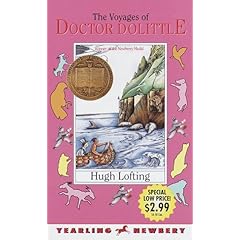
The Voyages of Doctor Dolittle

I had a very fun time reading The Voyages of Doctor Dolittle by Hugh Lofting, the second winner of the newbery medal. This book is full of adventure and you don't really have to think too hard to read it. It is a real page turner with really short chapters that allow you to stop and go whenever you please.
The book is set in the time frame of the late 1830's to the early 1840's and is told by an old man looking back in time to when he was nine years old. He tells the story of many of his amazing adventures he had as a boy and meeting the famous Doctor Dolittle.
One day while wandering the boy comes upon a squirrel that had been injured by a hawk. The boy rescues the squirrel but it is in very bad shape and is in need of serious attention. The boy hears of the famous Doctor Dolittle and eventually meets him and asks if he would look at the squirrel for him. The doctor agrees and treats the squirrel. The doctor has a great advantage over other naturalists in that he can talk to the animals and because of that he is able to solve many problems and hardships.
From here on out the doctor and the boy are great friends and the boy eventually becomes the doctors assistant and is allowed to live with the doctor and go on his voyages with him.
They decide to go on a voyage to the floating Spidermonkey Island to study natural history and there they rescue and meet one of the greatest naturalists of all time, Long Arrow.
While on the island the doctor helps the poor people considerably. He helped them overcome the cold. He showed them fire. He fought in battle with them and he eventually became a king against his will.
One of the greatest things in this book to me was the doctors ability to talk with the animals and his views on them.
One of the points people sometimes make about this book is the racism. It is true that in the older version there are some refrences to it. I don't think that is one of the major points that Lofting was trying to make while writing the book though. The new version of this book has been edited and I was surprised to find that quite a considerable amount of writing had been taken away from the older version which is really disappointing because much of it did not have any racism at all. There is an afterward in the new book by his son explaining why the old version was edited.
I'm glad I read both the new and the old version so I did not miss anything. I would recommend this book for children because of its adventure and it's lessons towards kindness and respect towards animals.

Saturday, September 13, 2008

Holes by Louis Sachar


This was such a great read that I feel I could recommend it to anybody. Children, teenagers, adults, men or women. It’s a very quick read, but unlike some other short novels I read, it left quite a big impression on me. It’s probably because it can’t be categorised into anything I’ve read before and because it was so beautifully crafted. Its theme is unusual and it would be hard to convince someone to read it by simply telling them what it is about:

A clumsy and unlucky boy gets sent to a detention camp by mistake, where everyday, together with other “troubled” boys, he is made to dig a hole in the hard ground. Five feet deep, five feet across. Apparently this exercise is supposed to build their character and make them better boys, but there's something their warden is not telling them…

The truth is this is not just Stanley’s story at Camp Green Lake. It’s about Stanley’s ancestors, and about Stanley’s camp-mates. It’s about the weird connections that life lays ahead of us and how they affect our destiny one way or the other. It’s about lethal lizards and about onions. There’s also a hearth-breaking love story and a gypsy curse. And there’s friendship. Powerful and selfless friendship. That’s all I can say about it. More would spoil the plot, which is far more interesting than it sounds.

What I loved about it was the rewarding feeling that it gave me when all the threads came together in the end. All the different layers and the details in the story became one neat pattern of a jigsaw, which felt so satisfying. I love when the authors know exactly where they’re going and how they’re going to get there, even though it’s intimidating from an aspiring writer’s perspective.
I’m sure I will re-read it one day, which is saying a lot, since I don’t usually reread books.
Besides being a great piece of storytelling, it triggered many emotions. It was humorous, tragic and even heroic at some point. It was pure comfort reading. A book to keep for those reading slump sometimes people fall into. I can guarantee a speedy recovery!

Tuesday, September 9, 2008

Shiloh

I've had this book on my shelves for over a year, but I just wasn't sure that I wanted to read a dog story - and especially not one where I was afraid that the dog might die (I'm more than a bit like the kid in Gordon Korman's No More Dead Dogs, I guess). We had to put our very elderly and much loved dog to sleep this summer and reading Marley and Me for my book club last year already made me a sobbing mess. I really didn't want another Old Yeller experience.

But Amanda's recent post finally convinced me to pick up Shiloh when I didn't feel like reading anything else in my "to read" stack. I've noticed that good kids' or YA books really help me get out of a reading slump.

Anyway, I enjoyed Shiloh, in a quiet way. I thought that Phyllis Reynolds Naylor really captured many of the joys of having a dog, as well as a thoughtful 11 year old's perspective on some weighty moral questions. I liked how the story unfolded, the ending was entirely satisfying, and I saw lots of great possibilities for discussion (if I could ever convince my own 11 year old to read it. But at least he's reading another Gordon Korman book recommended by his teacher right now).

But somehow the book just didn't transport me or totally engage me like my favorite Newbery winners (or some children's books in general) have. I didn't have any problems setting it down at night, it didn't make me cry (spoiler alert - highlight to read: no dogs died, thankfully!) or laugh out loud, and I thought the book was perceptive but not incredibly insightful.

Maybe my standards are just really, really high. I think some of the other books I've read for this project have blown them sky high, actually. Anyway, I would recommend Shiloh, especially to 9-12 year olds, and I am glad to have read it, but I'm not going to push it towards random friends and family members insisting that they read this incredible work that will change the way they feel about kids' books or dogs or life in West Virginia.

Here's one my favorite passages about dogs from Shiloh, though, and one that struck me as very true (especially since I'm still missing my dog):
We stand out in the meadow flying the kite, and I watch the blue-and-yellow-and-green tail whipping around in the breeze, and I'm thinking about Shiloh's tail, the way it wags. You get a dog on your mind, it seems to fill up the whole space. Everything you do reminds you of that dog (p. 92).

Monday, September 8, 2008

The Story of Mankind

When I picked up the first newbery medal book, The Story of Mankind by Hendrik Willem Van Loon it was not what I expected. My first thought was how huge the book was and how it could possibly be written for a childrens audience. After sitting down and reading the first few chapters I began to understand it's writing style and unique way of representing history.

He did a good job covering what he did in the very large timeframe he had to work with, which was the time from which man (or a creature more or less resembling man) has been on this earth. I imagine it must have taken a lot of time and patience to cover all of this material, not to mention the numerous hand drawn illustrations and maps.

In the foreward the author talks of a visit to the tower of Old St. Lawrence in Rotterdam that he took in his younger years. After climbing to the top of the tower he looks down and remembers all the history making moments that happened in the busy streets below where people were going about their business in their normal fashion. He finds this trip very rewarding and returns many more times. He then gives us the "key" that will open the door of history for us.

The first half of this book is a lot easier to read than the second half. It made me remember a lot of history stories I had learned from school and I also learned many other facts and stories I did not know before.

This book reads more like a story than a history book. The book does not try to give an account of everything that has happend in the history of mankind. It tries to explains certain significant events, that without them the world would not be how it is today. The books talks about how we have become who we are today, from being men and women concerned only about finding food and shelter to using our brain to make tools. It talks about the origin of writing and the importance of being able to write down thoughts and ideas. This book focuses on how and and most importantly why things happened the way they did.

I enjoyed reading how man has evolved into the present day. I particularly enjoyed the chapters about the revolutions and how people over came the rich and corrupt governments to become independent people and nations.

Most of the chapters read just like a story. There are others however, like National Independence and Colonial Expansion and War, that are very confusing and you have to be very focused on reading them so you don't miss anything. When I say confusing I mean that there are too many people, dates, and countries to remember and this makes it difficult (even as an adult) to follow.

The goal of this book is to try to give you a taste of history and I believe the author has done just that. He really tries not to let his own views and perspectives bias the book, and he does a good job of making history fun for the most part. Overall it's a good read but I really doubt many children would pick it up and read it.

Friday, August 15, 2008

The Story of Mankind by Hendrik Willem Van Loon


“Why should I ever read fairy stories, when the truth of history is so much more interesting and entertaining?”

Imagine my surprise when I first went in search of Hendrik Willem Van Loon’s The Story of Mankind, the first winner of the Newbery Award, and stumbled onto a history tome of 500+ pages (in its “updated” state). I was not prepared for this. My brief dalliance with the Newbery Award has always been with fiction and considering the seeming shortage of children’s nonfiction I never appreciated the idea that the Newbery list may be more expansive.

First published in 1921, The Story of Mankind is a children’s history beginning with the first cells that would contribute to the initial plants and animals on Earth through the beginning of the United Nations. The Story of this work is that it’s largely written in a narrative style that reads very much as verbatim classroom lecture or simply as an adult explaining aspects of history to a child. Nearly every page is decorated with a map, illustrated timeline, or simple sketch to further enlighten the passages. Perhaps this doesn’t appear too impressive compared to modern children’s history texts, but I’m sure it was quite a staggering accomplishment for the period.

Seth Lerer describes The Story of Mankind as “rich with engaging anecdotes, clear judgments, and precise chronology” and “It gives us history that is accurate, clear, and organized.” And all of these things are true but it is the “clear judgments” that I find most troubling. Though I am only up to the chapter on the English revolution, it’s blatant that The Story of Mankind is not the most objective work of nonfiction and threads of racism and intolerance trickle throughout the texts. (Admittedly Van Loon passed prior to post-colonial studies developing into a force to be reckoned with.)

It’s ironic though that within the book Van Loon dedicates space to the idea of intolerance, “For tolerance (and please remember this when you grow older), is of very recent origin and even the people of our own so-called ‘modern world’ are apt to be tolerant only upon such matters a do not interest them very much.” I would still give Van Loon a great deal of credit on writing a children’s history that during the time must have very much complimented other historical and nonfiction writings. It’s an idealist book that focuses exclusively on the events that leads the reader unquestioningly to the development of the modern United States. Throughout the text the reader is not often required to consider the “rightness” or “wrongness” of situations as Van Loon provides a “clear judgment” of events.


Of all the books appearing on the Newbery list, The Story of Mankind (using completely unscientific statistics) seems like the least read or most unfinished book. Van Loon’s portrayal of human history and heritage seems quite foreign to more modern Newbery winners and even stands apart from the early winners of this literary award. Perhaps the most obvious distinguishing feature is that The Story of Mankind is more or less a work of nonfiction while the vast majority (if not all of the rest) of other winners are works of fiction.

This book is problematic for the modern reader in part because it was originally published in 1921 and, like every other book attempting an all-encompassing view of history, it promises more than it can ever possibly deliver. Van Loon is a subjective writer and certain racist, hegemonic, and imperialist attitudes crop up throughout the book. And as other authors writing such a vast history, it just doesn’t work. The Story of Mankind is the story of historical events that led to the formation of the modern United Nations and doesn’t spend a great deal of time outside of Europe and the United States of America (unless other countries were briefly useful in colonization that led to the formation of the United Nations).

The Story of Mankind does work in its narrative features to deliver history and what in 1921 would have been the rather progressive look at using illustrations to instruct and enliven history for children. I was asked by Julie regarding current (if any) usage of The Story of Mankind, and while I would never argue for sole usage of this text a comparative look between this and a more recent study of history would certainly have some validity.

I must say that I am still intrigued by the presence of The Story of Mankind on the Newbery list and particularly as it was the first book to win the award. Returning to Children’s Literature, Seth Lerer describes some of the books attributes for the Newbery category: “rich with engaging anecdotes, clear judgments, and precise chrononology,” a “history that is accurate, clear, and organized,” it “is history as a social lesson,” it’s a vivid book written with clarity and optimism that from “hard work and struggle” leads to “a good feeling of success.” And I suppose that it is these categorizes that continue to filter down through the years when selecting the Newbery titles.

Originally published in two parts at Adventures in Reading.

Saturday, August 2, 2008

Walk Two Moons by Sharon Creech


Stars: ****

Walk Two Moons won the 1995 Newbery Medal.

Summary: “As Sal entertains her grandparents with Phoebe’s outrageous story, her own story begins to unfold – the story of a thirteen-year-old girl whose only wish is to be reunited with her missing mother.”

I must admit that the summary at the back did not sound all the interesting to me. However the book was very well put together. The summary just doesn’t explain enough. Sal is on the road with her Grandparents and is telling them the story of her friend Phoebe and her life, which at times seems to be very similar to Sal’s. The book switches back and forth from what is happening with Sal and her grandparents to what happened with Phoebe. It does not always alternate every other chapter, which makes it more interesting since you don’t know whose story will be continued next until you start reading.

The story has good lessons in it and would make a good school read I think.

Friday, August 1, 2008

The Giver by Lois Lowry


I don't know about "Brave new world" or the film "Pleasentville" and I've never read "1984" by George Orwell, only excerpts in school. But as far as children's literature is concerned this is an extraordinary book. It kept me glued to it for hours. I had to know how this world worked, what were its secrets, what would happen to its protagonist. It was a real page-turner. It wasn't a simple read though, like others have said. It was quick, but it made me think about it for days. It was scary in a deep, subtle way. It raised strong, elementary emotions, and it made me shiver trying to imagine how a world like that would be possible.
The story is set in an indefinite far future, where society is organised in small communities, all designed with the same scheme: everything and everyone have to be up to the standards of the community. Everything is regulated by fixed and almost unchangeable laws. Individuality is not an option and neither is free will. This is the price that humanity have chosen to pay to avoid hunger and violence and war.
Families, called family units, are not decided by love or anything else but a Community Council which finds the right match for every person, thus creating the perfect harmony in the unit. Children are also regulated by a scheme: one boy and one girl, born by a group of birth-mothers, are allocated to one family who requests them.
At first this system seems to be the most organised way of living. There's no struggle for survival because everything is provided, everyone is kind and equal, though some "assignments"( not jobs) are less honourable than others. Everything is tidy, and quiet and peaceful. But there's something eerie is this peacefulness.
You can feel that something is not quite right. Hints are given here and there: people being mysteriously "released" (and you can guess pretty quickly what that means), an impersonal Voice that speaks through a microphone and gives orders and warnings. Even a rule that might sound positive and open-minded, the sharing of dreams in the morning and of feelings in the evening, has something mechanical and disturbing about it.
And then you start asking questions: where are the books, the writers, the artists? Will there be an assignment specifically for them? Because certainly they can't live without them.
"Stories are the most important thing in the world. Without stories, we wouldn't be human beings at all.” said Philip Pullman and so I kept reminding myself.
But it's not till Jonas, the boy who's the main character, has his first wet dream, or the Stirrings, as his parents would call it, that you realise how controlling and de-humanising this society is.
Shortly after Jonas' life changes completely when he is selected as the new Receiver of Memory. And here I stop. I've already said too much. I'll leave it to you to find out what that means. If you've never heard of it, like me before, then you shouldn't be spoiled with more informations. If you've read it, I'll like to discuss it with you in the comments!

Thursday, July 31, 2008

Miracles on Maple Hill


Miracles on Maple Hill, by Virginia Sorensen, was selected as the Newbery Award winner in 1957. While some of the older Newbery winners seem to be outdated in today’s world, this book is filled with relevant historical and emotional topics.

As I read the book, I was struck by the imagery and sense of place which was strongly developed by Sorensen. I have never been to visit the northern United States, but I feel like I have been there – visited four times in a year and caught a glimpse of each season.

The story revolves around a family. The father has returned from the war (which is unnamed) and is having difficulty returning to the civilian life. How appropriate is that in the lives of children today? The mother and two children are concerned about the father and wish that he would return to his old self. To help with this process, the family visits the grandmother’s old place in rural Pennsylvania – a place called Maple Hill, where miracles happen!

The story is told from the perspective of the daughter, Marly, who immediately falls in love with the mountain and the wonder of the rural life. The father stays on fulltime at Maple Hill, while the family visits every weekend. The strength of the novel is the descriptions of the flora and fauna in the area and especially the gathering and processing of the maple syrup.

Other reviewers have talked at length about this spirit of the place, and I invite you to read them here!

TITLE: Miracles on Maple Hill
AUTHOR: Virginia Sorensen
COPYRIGHT: 1956
PAGES: 180
TYPE: fiction, Newbery Award Wimmer
RECOMMEND: I loved this book.
Flusi the LibrarysCat

Tuesday, July 29, 2008

Dr. Dolittle by Hugh Lofting

From Adventures in Reading:

Preparing to read Seth Lerer’s Children’s Literature, I decided to first delve back into my own childhood and reread Hugh Lofting’s The Voyages of Doctor Dolittle and by incident this also kicks off my first book for the Newbery Project. Recently at work, various aged co-workers and I were discussing the excitement surrounding the fast-growing young adult section and reflecting on our own young adulthoods which had far less reading fodder. When I was a young adult literature was certainly available, but I often found myself searching for something to read and one of these conquests led me to Lofting.

It’s difficult to not be familiar with some aspect of Doctor Dolittle even if it’s only that he was a character who could speak with animals. This 1923 Newbery Award winner is told in hindsight from the somewhat fatalistic viewpoint of young Tommy Stubbins. After becoming more or less apprenticed to the good Doctor, the two and their human and animals friends begin a voyage to Spider Monkey Island off the coast of Brazil. Various adventures ensue including stowaways, bull fighting, floating islands, and a shipwreck.

Central ideas in the book are fairly representative of the time; particularly Dolittle’s interest in natural history (the popular scientific study of animals or plants) and the Dawin-esque feel of exploration stealthily lodges Doctor Dolittle into a bubble of historical consciousness. Lofting’s sketches illustrate the quite diminutive Tommy exploring Dolittle’s world. The back story is also quite interesting, as apparently Lofting wrote these tales out as letters to his children when he was a soldier during the World War.

The Voyages of Doctor Dolittle is problematic however in its representation of race, indigenous culture, and colonialism. Two characters in particular stand out: Bumpo an African prince being educated at Oxford who incorrectly uses lengthy words and prefers going about barefoot and Long Arrow a stoic South American indian who venerates Dolittle. So imagine my surprise when I finished the book and learned in Christopher Lofting’s afterword that the Yearling edition is actually an edited version from the original text and that some socially questionable illustrations had also been removed. I confess my interest is peaked more than ever to reread this book in its original format.

Wednesday, July 23, 2008

The Voyages of Doctor Dolittle - 1923


The Voyages of Doctor Dolittle by Hugh Lofting
Illustrated by Sonja Lumat
Doctor Dolittle, Book 2

Pages: 276
First Published: 1922
Genre: children's animal fantasy, adventure
Awards: Newbery Medal 1923
Rating: 5/5


First sentence:

All that I have written so far about Doctor Dolittle I heard long after it happened from those who had known him -- indeed a great deal of it took place
before I was born.


Comments: In this second book of the series we meet Tommy Stubbins, the boy who becomes Dolittle's assistant. Once again Dolittle sets off on a voyage this time to meet the great botanist Long Arrow, son of Golden Arrow and along the way they meet many side adventures. Dolittle becomes set on learning the shellfish language, meeting the Great Glass Sea Snail, ends up on Spidermonkey Island, saves the island from floating into the Antarctic and helps the natives build a thriving city and society.

Both the 8yo and I thoroughly enjoyed every word of this book. Everything a child could want in a book is here: adventure, fantasy, science and animals all rolled into one. The action starts in the first chapter and is non-stop right to the very end which comes to a heart warming ending that leaves the reader with the feeling that there most certainly must be a sequel.

The edition I have is unaltered from the original text. At least I can find no indication that it has been altered, though the spelling has been Americanized. This edition is part of the Grosset & Dunlap Illustrated junior Library which has been in publication since the 1950s so I am fairly confident the text has not been edited. Since these books are often cited as being racist by PC fanatics I will note that I found absolutely nothing offensive in the book at all. The original illustrations have been omitted and replaced by a handful of full-colour plates illustrated in a cute fashion which I am not fond of. I will look for an original edition with Lofting's illustrations to replace this one someday.

Having read the first two together I can say for certain we will continue on with the series. The 8yo thought it was one of the best books we've read together and we both agree it is even better than the first book. Having read this as a child myself it is great to see that it lived up to my expectations and then some. Recommended!

Monday, July 21, 2008

Rabbit Hill

Rabbit Hill by Robert Lawson is another classic children's book that I never read as a child. And I thought I was well-read!

I think I would have really enjoyed Rabbit Hill, since one of my favorite children's books was another talking animal one - the original Bambi, by Felix Salten. And a few years after that, I also loved Watership Down. I wonder if Richard Adams read Rabbit Hill as well as The Tale of Peter Rabbit as a child or young man?

Anyway, Rabbit Hill is definitely an old-fashioned story, and rather slow-paced, as Alicia noted. As an adult, I didn't mind the wordiness and lack of action so much (especially since the story is only 128 pages long). But the things that I really enjoyed in this book as an adult are probably things that a lot of kids would not be interested in or wouldn't even notice.

I loved the comparisons between the different people that lived on Rabbit Hill (which was also the name of Lawson's country home in Connecticut, I gathered), especially the difference between "planting folks" (gardeners) and others:
Then evil days had fallen upon the Hill. The good Folks had moved away and their successors had been mean, shiftless, inconsiderate. Sumac, baybery, and poison ivy had taken over the fields, the lawns had gone to crab grass and weeds, and there was no garden (p. 14).
I spent a little time wondering if the animals were really better off with people living on the hill and actively managing the land. I know that many of the animals in the story (like rabbits, groundhogs, moles, and fieldmice) do benefit from human agriculture, and especially like to eat some of the species in lawns and gardens, but is there really that much of a gain? What if the new folks didn't plant a vegetable garden? And what about today's suburban enclaves of asphalt, golf-course grass, and gravel with a few yew bushes or yuccas and day lilies? These landscapes must produce a huge net loss when it comes to biodiversity and small creature population. Though I have heard that vegetable gardening is getting more popular again.

I really enjoyed all of the descriptions of ecological succession, with wars and economic changes and people and farms, factories, and gardens coming and going, and the rabbits continuing on, adapting to the Black Roads and various folks' dogs and cats.

Although Father Rabbit's verbosity did occasionally get on my nerves, in general I really liked the language and the tone of the story. The "free garbidge" that the skunk loved was a nice touch, and I squealed when Phewie the skunk goes on to mention that Deer was "not above a mess of garden sass* now and then" (p. 24). The discussion of "Reading rots the mind" was fun, and I thought it was cute that the woodchuck (i.e., groundhog) was named Porkey. I did think the story got more exciting as it concluded.

I wonder if Rabbit Hill won the Newbery in 1945 because Americans really needed comforting stories of home at that point in time. It is a comfortable book, with its vision of little creatures living in harmony with (at least a couple of well-read) humans on a picture-perfect farm. I want to go spend a quiet weekend there, eating garden sass and watching the animals come out at dusk.

______________

*garden sass = garden sauce, an old-fashioned term for vegetables that I blogged about a few years ago. A little more research on the term shows that "garden sass" (instead of sauce) was already being used by 1856, as in this Lea & Perrins ad for Worcestershire sauce:
Lexicographers tell us there are various kinds of sauce, some of which are exceedingly appetizing, while others are difficult of digestion. The old Colonists, and even modern Yankees and Virginians, speak in their quaint rustical way of “garden sass,” under which term they include all culinary vegetables.
In 1947, in the Secrets of New England Cooking, Ella Shannon Bowles and Dorothy Siemering Towle noted that:
Garden sauce and green sauce were old English terms dating from the time of Beaumont and Fletcher and perhaps before. Corrupted in New England to garden sass, it included all the vegetables raised in the garden. At one time some of the vegetables were classified as short sauce, others as long sauce, but these finer distinctions have been lost, and in northern New Hampshire and Maine, even today, garden sass is the accepted term for all garden vegetables.
I think this sentence in Lawson (and Bowles and Towle a few years later) are around the last print references I've found to "garden sass," except for the recent works that refer to it as an antiquated or no-longer-used term.

Monday, July 14, 2008

1980 - A Gathering of Days

A Gathering of Days: A New England Girl's Journal, 1830-32 by Joan W. Blos won the Newbery Medal in 1980. As you might guess, the book is written in the form of a diary which was kept by thirteen year old Catherine Hall who tells about her life in rural New Hampshire in the early 19th century.

I liked the opening of the book which was a letter from Catherine to her great-granddaughter who was turning fourteen. She writes, "Once I might have wished for that: never to grow old. But now I know that to stay young always is also not to change. And that is what life's all about - changes going on every minute, and you never know when something begins where it's going to take you. So one thing I want to say about life is don't be scared and don't hang back, and most of all, don't waste it."

The beauty of this small book is in the descriptions, both of the physical places and the emotions of the young girl who loses her mother and her best friend to fevers. Until her father remarries, she must take care of her younger sister. Young children (we have it with a recommended reading level of grades 4-8) might appreciate Catherine's emotions as her new "mother" moves in with them and brings many changes to their home!

In addition to winning the Newbery Medal, this book also won the American Book Award (Children's Fiction) in 1980.

TITLE: A Gathering of Days
AUTHOR: Joan W. Blos
COPYRIGHT: 1979
PAGES: 144
TYPE: Fiction
RECOMMEND: I really liked this book and would recommend it to children who are interested in New England history or how young people lived in the past.

LibrarysCat

The Witch of Blackbird Pond by Elizabeth George Speare

7 of 12 for the 2008 Young Adult Challenge
2 of 3 for the tl;dr challenge
1 of 6 for the Classics Challenge
5 of 11 for the Summer Reading Challenge

This is a breathtaking book. It takes us to Puritan New England, in the colony of Connecticut. Sixteen year old Katherine (Kit) arrives in America after having been brought up by her grandfather in Barbados. Her liberal Shakespeare-reading, ocean-swimming, silk-dress wearing upbringing did nothing to prepare her for the inflexibility and piousness of her aunt’s family that takes her in. In fact, Kit’s free thinking and outspoken ways create suspicion and irrational fear.

Speare’s characters are fleshed out and conflicted and it is a pleasure to watch them learn and grow throughout the book. Kit’s constant impulsive decision making and the inadvertent consequences never felt contrived. The time period and its rigid culture played a huge part in the plot of this novel – where seemingly harmless gestures and friendships can somehow make a person seem like a Satan-worshipper and be put on trial for witchcraft. It was a tremulous and frightening time, where politics were a constant topic of conversation as the colonists were just beginning to decide that they no longer wanted a king.

Kit’s indecision about what and who she loves, and where she belongs, rang so true to me. The descriptions of New England itself and of the traditions and chores of the time were expertly woven into the prose. The sprinkling of romance throughout the story fit just right and I loved the ending. If you are a lover of young adult historical fiction, this Newberry Award winner is a must-read.

Thursday, July 3, 2008

Lincoln: A Photobiography

The 1988 Newbery winner Lincoln: A Photobiography by Russell Freedman is an excellent and informative book about the life of our 16th president. What makes this book amazing is not only the pictures, but the writings of Lincoln which are provided and the small details of his life which perhaps are not as well known.


One amusing detail of his writing is from his home-made arithmetic book. In his own writing, Lincoln says:


"Abraham Lincoln

his hand and pen

he will be good but

god knows when" (p. 13)


Freedman provides many stories about Lincoln's childhood and family. The details of the day Lincoln was killed are very touching. The war was over and Lincoln and his wife, Mary, were trying to come to terms with the death of their second child. During a carriage ride early in the day, Lincoln told Mary, "We must both be more cheerful in the future. Between the war and the loss of our darling Willie, we have been very miserable." (p. 121)


I would recommend this book to anyone interested in one of our most honored presidents.


FlusiCat

Tuesday, July 1, 2008

Author Comments upon Winning the Medal

This is a nice collection of author responses following the phone call informing them that they'd won the prestigious Newbery award (from 1996, so don't expect more recent authors' comments): Newbery Authors

I found the site Googling "getting your kids to read Newbery", wondering if there was a trick to convincing my son to read something that I recommend. His friends, even the school librarian, random advertisements - they all carry more weight than my opinion. :(

We still do a little "read aloud" to wind up the day, so I've been picking Newbery winners that I want to read for that. He does admit that some of these are pretty good. But except for The Twenty-One Balloons, I've only been doing books that I've already read that I really know he'll like. I'm good at picking out books that people will enjoy, why won't he believe me when I say it's something he'll like? It must be a tween thing.

On a related topic, I have a whole stack of "girl books" that I can't wait until my daughter is old enough to read. It's interesting dividing the Newbery winners up into "girl vs. boy vs. either gender will enjoy" categories.

Sunday, June 29, 2008

Rabbit Hill

This story was a slow starter for me as an adult; I wonder if my kids would have any patience for it. That would be too bad because the ending is really very sweet.

The illustrations are a delightful compliment, as is the map on the inside cover. That the author was also the illustrator is a nice touch. I noticed (with more interest than I had in the book itself) that Robert Lawson was also the illustrator of a favorite story of mine, Ferdinand. Last week I discovered that Lawson is also the author/illustrator of Ben and Me, which I unsuccessfully tried reading to my son when he was seven or eight. The stuffy prose, well represented in Rabbit Hill by father rabbit's dialogue, turned him off.

For the short read, I didn't mind Rabbit Hill. However, I wouldn't expect my kids to like it and am surprised it merited a Newbery Medal.

Friday, June 27, 2008

The Twenty-One Balloons

I was surprised by how much I liked The Twenty-One Balloons, by William Pène du Bois - an older Newbery winner (1948 winner) - especially since I'd never even heard of it before this project.

I'm pretty sure I would have liked this as a child, too - I loved Jules Verne (especially Twenty Thousand Leagues Under the Sea), and this reminded me a lot of that, though The Twenty-One Balloons was a lot more light-hearted. Also, my eleven year old son enjoyed The Twenty-One Balloons as much as I did, and our tastes don't overlap that much. So I'm going to go out on a limb and say that this book should appeal to a pretty broad audience. In fact, I think it is definitely an under-appreciated, underrated classic.

William Pène du Bois' quirky, rambling writing style appealed to me as much as the story did. Who wouldn't like "a balloon in which I could float around out of everybody's reach....to be where no one would bother me for perhaps one full year" (p. 40), at least on some days?

This story of 66-year-old retired mathematics teacher Professor William Waterman Sherman, who stumbles on a secret society on the supposedly uninhabited Pacific island of Krakatoa just before its 1883 explosion, is definitely one of the most whimsical Newbery winners I've read. There's a lot about balloons; their construction and their lifting power and the mechanics of rigging a basket, a couch, a house, and a huge platform up to them. There's economy, government, and exotic restaurants, and kids who get to invent incredible things. It's a great mix of science and fantasy, appropriate for all ages. Why isn't this book better known?

Funnily enough, my family just watched a Mythbusters episode (Larry's Lawn-Chair Balloon- myth confirmed) about a guy who attached a lawn chair to a bunch of weather balloons. And tonight we're going to check out Heliosphere, an "enchanting outdoor spectacle of aerialist performers suspended from a larger-than-life helium balloon" at Ann Arbor's Top of the Park festival, just to continue the theme.

Tuesday, June 17, 2008

The Story of Mankind Online


No, I'm not talking about a history of the internet. Here are a couple of links to online editions of the first Newbery winner - The Story of Mankind, by Hendrik Willem van Loon, which won the medal in 1922 - at this Prize-Winning Books Online page produced by a University of Pennsylvania librarian. The Voyages of Doctor Dolittle, by Hugh Lofting (1923 winner) and several early Newbery Honors books can also be found through this link, along with lots of early Pulitzer and Nobel prize winners.

Friday, June 13, 2008

Carry on, Mr. Bowditch

My initial impression of this -- that is, the impression as I read it -- was not favorable. Its main character was one-dimensional. The plot turns could be seen coming pages in advance. It had improbable coincidences (happening to be at Harvard the day he was awarded his degree). It seemed odd that it addressed much of the adult life of Nat Bowditch rather than just his youth (after all, Harry Potter's adult life is summarized in a few-page epilogue).

Yet after I read it, it grew on me. It was a classic by-the-bootstraps tale. It had adventure, history and, pleasantly, science. In hindsight, I was glad to have read it.

Then, THEN, (only today!) I learned that Nat Bowditch was not a fictional character. This was a fictionalization of a real person. Mr. Bowditch really did get indentured, develop a new way of calculating lunars and create a sailing manual that is still a classic.

I wish I had known this going in. The book's sense of inevitability would have been much easier to understand.

I don't expect either of my sons would enjoy this book, now or ever. But I am glad to have read it.

Saturday, June 7, 2008

The Door in the Wall

The Door in the Wall, by Marguerite de Angeli, was the fifth Newbery winner set in 13th or 14th century England that I've read this year (see here for a discussion of the medieval settings of the different winners). De Angeli doesn't ever say exactly what year this story takes place, but since it is during the reign of Edward III, during and after outbreaks of the plague, and at the end of the Scottish wars, I think it has to be between 1350-1365.

Unlike the other reviewers - so far, anyway - I didn't like this book a great deal. I couldn't help comparing it (unfavorably) to the other medieval Newbery winners - Good Masters! Sweet Ladies!, Crispin, The Midwife's Apprentice, and even Adam of the Road (which won the award in 1943, just seven years before The Door in the Wall won).

The Door in the Wall was a just little too heavy-handed for me. The idea that God always provides "a door in the wall" when bad things happen doesn't appeal to me much. I've always really hated it when people tell me that "when God closes a door, he always opens a window." Part of this can undoubtedly be chalked up to my lack of faith. I do think that many Christians might find this story meaningful, and de Angeli did an excellent job of describing medieval church rituals (including many feast days and daily bells and prayers, like Nones and Vespers), and of showing how the Church was such an integral part of everyday life in the 14th century.

Perseverance and courage are definitely important qualities, but I'd rather see them demonstrated, and not have characters preaching about this to Robin (the ten year old crippled protagonist) and the reader. The story bored me until I was near the end, when the castle where Robin is being fostered comes under siege. I did really like the details about the castle (boiling oil to pour on invaders' heads! a keep, a Great Hall!), and de Angeli's pencil illustrations are quite charming, and added a lot to the story. I wanted a few maps, too, though (how far was it from the castle at Lindsay on the Welsh border to London?). Here's a photo I took of the illustration of the Great Hall, since I couldn't find any of her illustrations from the book online:


I just read The Willoughbys by Lois Lowry a few weeks ago (reading The Giver started me on all of her works, and I grow ever more impressed with her versatility and skill). Anyway, The Door in the Wall fits so very perfectly in Lowry's bibliography of "old-fashioned children's books" in the back of The Willoughbys (I wish Lowry had included all the older Newbery books in there!), which include stories of "piteous but appealing orphans....magnanimous benefactors, and transformations wrought by winsome children." Granted, Robin isn't an orphan, but his parents are absent for most of the story. And the book is definitely quite old-fashioned (and I think quite unlikely to interest my son or many of his soon-to-be-entering 6th grade friends).

Finally, it's a very minor, nit-picky point, but I thought it was a little weird that there was a horse named Bayard in The Door in the Wall, when there was also a horse named Bayard in Adam of the Road (would de Angeli have read Adam of the Road? How widely known were Newbery winners of the 1940's?). Was every other horse called Bayard in the Middle Ages?

Friday, June 6, 2008

The Witch of Blackbird Pond


My Newbery Challenge is an audio experience. I listen to the books as I drive from place to place this is a unique way to enjoy books. The Witch of Blackbird Pond was a tale of discovery. The main character Kit bravely sets off to meet her Aunt Rachel in America. She is a proud, spoiled girl who had spent her whole life in Barbados with her grandfather. Upon meeting her relatives and seeing their way of life, she begins to question the decision to come to this new land. Their strict religion and hard work made her long for the freedom and lavish life she once had. Finally, Kit does befriend the local "witch". This leads her down a dangerous path that endangers her life.
I liked the suspense of the many relationship in the book. People had to act a certain proper way. Often times they could not be honest and forthright with feelings and thoughts. Although Kit struggled with this concept, as I would have. I wished the author had included more from the character Mercy. As the lame cousin, she is everyone's comfort. She was stuck in the home alone many times. She probably had a unique perspective on many of the character conflicts.
"'The answer is in thy heart,' she said softly. 'Thee can always hear it if thee listens for it.'" This is great advice for most situations. Listening to your heart can be a difficult thing to do. Hannah, the Quaker, who the townspeople label as a witch seems to be the wisest character. She guides Kit throughout her struggles in the new harsh town. Hannah has suffered a hard life of prison, branding, the death of her husband and isolation, yet as seen in this quote she i still remarkably optimistic.
The ending was predictable, but I wanted it to end as it did. This added warm to the character relationships that seemed so cold throughout the book. I enjoyed this audiobook.

Monday, June 2, 2008

Quick Link, Lots of Reading

Peter at Collecting Children's Books writes about Newbery sequels, lots of sequels and related books.

The Giver by Lois Lowry

My first thoughts upon closing the cover of this prize-winning young adult novel: what a wonderful, powerful story and what a horrible, confusing and disappointing ending! I'm not opposed to ambiguity, but be warned if you haven't read it that the ending is beyond ambiguous. I'm not sure how I would have wanted the novel to end, but I'm not the author, only the reader. I immediately looked to see if there was a sequel, and there are not sequels, but rather "companion books." So perhaps my questions will be answered and my angst over the fate of certain key characters resolved.

The Giver is a great novel, worthy of the Newbery Award it received. It brings up the issues of freedom vs. order and security, emotion vs. intellect, and the utility and purpose of memory and history. At first, Jonas, the narrator of the story, seems to live in a utopian community. No hunger, no sickness, very little pain, a society of stability, order and contentment. However, as the story progresses, the reader begins to see hints that Jonas's world might not be as perfect as it looks. His mother, who holds a prominent position at the "Ministry of Justice", is disturbed about a repeat offender who has broken the rules for a second time. The third offense means release from the community. Jonas's father is a bit concerned about a baby at the Nurturing Center where he works who is not thriving and cries at night. Jonas himself is apprehensive about his Twelve Year ceremony, coming up in about a week, in which he will receive his apprenticeship assignment, the job assigned to him for his life's contribution to his community. Then, there's the airplane that flew over the community in direct contradiction to The Rules. All in all, it's an unsettling time for Jonas and for the community.

The Giver goes from unsettling to chilling in a little under 200 pages. Short but memorable. However, I'm not the only one who found the ending less than satisfying.

Saturday, May 24, 2008

Bud, Not Buddy

I read Bud Not Buddy after reading The Watsons Go to Birmingham with my 6th grade class. I loved this story. It took the reader on a journey along with a young foster boy, Bud, in Michigan. He leaves the home where he has many friends and is sent to an abusive foster home. After he escapes the horrible back shed in which he is locked over night, and attacked by door guarding fish heads and vampire bats, he sets out to find his father. 
Along the way Bud makes many friends. The struggle of common people during the Depression is shown along with compassion people seem to naturally show towards children in tough situations.  
The defining part of this audiobook for me was the epilogue. Curtis explains that many of these characters were inspired by his own family members. He encourages us all to learn our family history from our elders while they are alive. It is so exciting...I can't wait to have my students read this.

Friday, May 16, 2008

Crispin: The Cross of Lead

I'm going to give you two reviews for the price of one here: mine, and my 11 year old son's. He loved this book - he liked the action, the characters appealed to him, and the whole idea of being a "wolf's head" (a medieval outlaw) was fascinating to him.

I was a little more critical. I thought Crispin was certainly worth reading, but I found it a little dark. I kept expecting someone to get killed horribly (and it didn't help that I already knew a little medieval history and had heard of John Ball and the Peasants' Revolt of 1381). The medieval history in Crispin was very interesting, and well-presented, and intertwined nicely into the story of Asta's son - but again, it was all a little depressing for me, starting right off the bat with Asta's death.

I couldn't help comparing Crispin with the other medieval Newbery winners I've read recently (The Midwife's Apprentice, Good Masters! Sweet Ladies!, and Adam of the Road) - and quite frankly, I enjoyed all them a lot more than Crispin: The Cross of Lead. Crispin did make a very nice boys' counterpart to The Midwife's Apprentice, I grant you, but I didn't find the ending quite as inspiring or satisfying. In fact, I didn't like the ending of Crispin at all. I felt like it left too many questions unanswered. And both Adam of the Road and Good Masters! Sweet Ladies! had a certain story-telling charm and joy that I just didn't find nestled in Crispin alongside all of the drama and the history.

However, I know my son would disagree. He hasn't read the other Newbery winners set in medieval England, and given his taste in books right now, I think it is unlikely I could convince him to read them anytime soon. I should also note that although I didn't really love Crispin: The Cross of Lead, I did get well enough hooked that I'm going to read Crispin: At the Edge of the World as soon as my son is done with it.

Thursday, May 15, 2008

Good Masters! Sweet Ladies!


Good Masters! Sweet Ladies! Voices from a Medieval Village by Laura Amy Schlitz
Illustrated by Robert Byrd

Pages: 81
Finished: May 14, 2008
First Published: 2007
Genre: historical fiction, non-fiction, play, children
Rating: 2/5

First sentence:

The Feast of All Souls, I ran from my tutor -
Latin and grammar - no wonder!


Comments: A collection of monologues/soliloquies written to be performed by middle grade students. Each monologue tells the tale of an individual child from the middle ages. Footnotes are presented in sidebars and a few non-fiction factual pieces explain various medieval customs and history. The book is gorgeously illustrated with medieval-type illustrations in ink and watercolour. The design of the book is also very visually pleasing with coloured ribbon sidebars on every page.

While I found this book very pretty, the text did nothing for me. The majority of the monologues are written in verse (some even rhyming) which was very tedious to read and frankly, boring. I can't imagine watching a play that consists of a bunch of monologues to be very entertaining either. I enjoy both historical fiction and books that take place in the middle ages but this book was just not my thing.

Monday, May 12, 2008

Kira-Kira

I didn't think I was going to like Kira-Kira, the 2005 Newbery winner. Part of it was the cover - lots of people seem to love it, but it seemed a little stark to me, and on top of this, I knew that a main character dies in the story. I just didn't feel like reading one of those Reader's Digest type child death tearjerkers.

The writing on the very first page changed my reluctance to read it, though I still had some reservations about the death later in the story. The cover, I actually like now (after reading the book) - go figure. Though I still think it could use a little more color.
My sister, Lynn, taught me my first word: kira-kira....Kira-kira means "glittering" in Japanese. Lynn told me that when I was a baby, she used to take me onto our empty road at night, where we would lie on our backs and look at the stars while she said over and over, "Katie say 'kira-kira, kira-kira.' " I loved that word! When I grew older, I used kira-kira to describe everything I liked: the beautiful blue sky, puppies, kittens, butterflies, colored Kleenex (pg. 1).
Kira-Kira is the story of a Japanese-American family in the U.S. heartland in the 50's and 60's. The Takeshima family lives in rural Iowa, but moves to small town Georgia, where Katie and Lynn's father gets a job as a chicken-sexer (identifying the sex of newly hatched chicks), and her mother works in a chicken-processing plant. As you might expect, racism, the experience of second generation immigrant kids, and brutally hard work play important roles in the story. All of this really takes second stage to the characters and Kadohata's writing, though. Her descriptions never failed to surprise me. Take this description of the girls' strange Uncle Katsuhisa, who attempts to distract his nieces from crying about moving to Georgia (and not being able to find their favorite things in storage during the ride), by teaching them to spit like he does:
Lynn and I tried to rumble our throats like him.

"Hocka-hocka-hocka!" he said.

Lynn and I copied him: "Hocka-hocka-hocka!"

"Geh-geh-geh!"

"Geh-geh-geh!"

He turned to his open window, and an amazing wad of brown juice flew from his mouth. The brown juice was like a bat bursting out of a cave. We turned around to watch it speed away. A part of me hoped it would hit the car behind us, but it didn't. I leaned over Lynn and out the passenger window. "Hyaaahhhh!" I said, and a little trickle of saliva fell down my chin (p. 22).
The intimate, often funny portrayals of the Takeshima family reminded me (very favorably!) of The Watsons Go to Birmingham - 1963, by Christopher Paul Curtis (the 1996 Newbery Honors book), which also deals with the banality and ubiquity of racism in a totally matter-of-fact manner.

And it turns out that Kadohata's account of Lynn's death was sad, but it was not trite or Reader's Digest-like at all. The ending was beautiful, in fact, and very satisfying:
Now and then I thought I heard Lynn's lively voice. The cricket sang "Chirp! Chirp!" but I heard "Kira-kira!" ....My sister had taught me to look at the world that way, as a place that glitters, as a place where the calls of the crickets and the crows and the wind are everyday occurrences that also happen to be magic (p. 243-4).
There are a lot of rather adult references in Kira-Kira, and the lack of action and a meandering storyline in much of the book will not endear it to younger readers, anyway. But I think it's a wonderful choice for teens, especially girls. Adult readers who like this may also want to check out Bento Box in the Heartland, by Linda Furiya - a memoir (with recipes!) set a few years later than Kira-Kira, by the daughter of another chicken-sexer.

Tuesday, May 6, 2008

I Know It's Not as Pretty

but the site will be a lot more navigable using the latest version of Blogger. I hope to add some of the prettiness back soon, as well as a sidebar list that automatically takes you to all the reviews of a given title.

Monday, May 5, 2008

Still No Reviews at All

for Smoky, the Cowhorse (by Will James) and Waterless Mountain (by Laura Adams Armer).

And many, many other books have very short reviews, or reviews from just one person - wouldn't you like to add your input? We could all learn something from your perspective on these classics.

Sunday, May 4, 2008

Jacob Have I Loved

I have to admit that kept putting off reading Jacob Have I Loved because the cover on the copy I got from my library was so horrendous.

It's like something from a horror novel from the 1970's, isn't it? Caroline (the main character's twin sister) looks like a ghost.

However, even really bad covers can only keep me from reading something I've heard so much good about (check out this review*) for a while.

As soon as I started Paterson's book, I just wanted to keep reading it (though maybe with one of those stretchy cloth covers pulled over it). There was so much in this book: gorgeous descriptions of life in a small town and on an island, sibling rivalry, a demented grandmother, first love, the value of hard work, an examination of how we make choices about our lives, and judging other people's (especially your mother's) choices, gender roles, WWII....have I left anything out? Hmm, maybe a lot about crabs and oysters. Reading those parts was a bit like watching an episode of Dirty Jobs. Fun, and you learn a lot about a totally different way of life pretty painlessly.

Like Flusi, I did want more at the end of the book. Or a sequel, even, filling in Sara Louise's college years and her introduction to adult life in Appalachia. And I agree with Corinne, this book is definitely for older Newbery readers - say 13 and up. There are some pretty adult themes in Jacob, including a loss of faith (oops, forgot to add that in the list of things included above) and sexual awakening. A lot of the "gave it one star" reviewers on amazon hated both of those parts; I thought Paterson's description of the first stirrings of physical attraction were amongst the most beautiful, the most realistic, and conversely the most subtly portrayed and unique that I've ever read.

And is she right about February, or what?
I used to try to decide which was the worst month of the year. In the winter I would choose February. I had it figured out that the reason God made February short a few days was because he knew that by the time people came to the end of it they would die if they had to stand one more blasted day. December and January are cold and wet, but, somehow, that's their right. February is just plain malicious. It knows your defenses are down. Christmas is over and spring seems years away. So February sneaks in a couple of beautiful days early on, and just when you're stretching out like a cat waking up, bang! February hits you right in the stomach. And not with a lightning strike like a September hurricane, but punch after punch after punch. February is a mean bully (p. 79).
I also really enjoyed Jacob I Have Loved a huge amount in comparison to Up a Road Slowly, the last book I read. Both are coming of age stories about teen girls. It would be interesting to look at just how many of these Newbery winners fall into that genre - out of just the ones I've read, The Witch of Blackbird Pond, Out of the Dust, The Midwife's Apprentice, Missing May, The Hero and the Crown, and Julie of the Wolves (and maybe Island of the Blue Dolphins?) all seem especially calculated to appeal to teenage girls. It seems that this is becoming more common in the past few decades, perhaps as children's literature becomes more specialized. Maybe there should be an award just for that? Something like the "Judy Blume award for capturing the anguish of adolescence" medal?

Anyway, Jacob Have I Loved would win that award, hands down.

When I was googling for the hideous cover above, I ran across Chesapeake Bay links for this book on the Library of Congress website. Very cool. And I was also very happy to see that recent covers are much less off-putting.

*Note how much better that early 80's cover is - though I think it is pretty inaccurate, in terms of what the girls wore in the 40's, and the clothes they describe in the book. Those look like 70's sundresses to me.