Friday, October 5, 2007

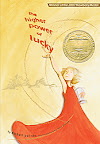
The Higher Power of Lucky: Dewey's Review

Cross-posted at my blog.

I read The Higher Power of Lucky by Susan Patron and Matt Phelan for the Newbery Challenge and the Book Awards Reading Challenge. I really enjoyed this novel, which is intended for an audience of children from ages nine to eleven.

Lucky is a spirited ten year old girl who lives in an impoverished small town in the Mojave desert. The conflict she faces was a bit simplistic for me; like a bad TV sitcom conflict, it arises out of a misunderstanding that could easily be cleared up with some simple communication. But I'm not ten years old, and maybe kids of this age could use a book that teaches them to just ask when they're confused.

SPOILER WARNING: Lucky's dad has never been a part of her life, and her mother died two years ago. When that happened, her dad, whom she didn't even recognize, convinced his ex-wife from before his marriage to Lucky's mom to come and take care of Lucky. Lucky believes that this is a temporary arrangement until she can be put in a foster home, but she's grown attached to her guardian, Brigitte, and understandably isn't ready to face losing another adult she cares about. She sees Brigitte's passport out and assumes Brigitte is going home to France without her. So Lucky runs away from home, hoping that Brigitte will miss her so much that she realizes she should stay with Lucky. As it turns out, Brigitte only has her passport out as a form of ID for a hearing to adopt Lucky permanently.

Many children's books present a false view of the world in which children have no contact with difficult situations, or with the adult world. I think that this sort of approach in children's literature gives children a strange sense that the rest of the world is safer and saner and simpler, more ethical and straightforward than their own life experiences. This gives them a feeling that there's something wrong with them and the people they know in real life.

In this book, however, Lucky eavesdrops on AA meetings and hears a lot of confusing things she doesn't understand. She has to try to come to terms with the fact that her father has simply never wanted kids and isn't about to start wanting kids now just because she has no other parent to take care of her. She wrestles with the cultural differences between her and her French guardian. She's also entirely aware that everyone in her town is poor, and that the free government food they get is of a low quality.

I think that many children reading this book will feel relief to know that even kids in books face challenges they don't really understand. I also think many children will miss some of the references to adult situations (such as twelve step programs) but they will recognize that Lucky doesn't understand either, and that will reassure them that it's natural for kids to encounter aspects of the adult world they can't make sense of.

The fact that Lucky's mother has died will be especially reassuring to kids who have had enormous losses in their own lives and are tired of reading about kids in perfect little worlds where everything is always just fine.

There was a big hullabaloo about the fact that this book contains the word "scrotum." This word, which Lucky overhears but doesn't know the meaning of, is just one more thing Lucky doesn't understand. Personally, I'm surprised that people could worry that the word scrotum might traumatize children while it's more likely a child reading this book would be shocked by the idea that hey, their mom could die in an electrocution accident, too, just any old time, right out of the blue.

One prude objector said: “You won’t find men’s genitalia in quality literature.”

Um, it's a dog's genitals mentioned in the book this objector so obviously didn't read. Every kid who has a dog sees their dog's scrotum all the time. Maybe we should start requiring dogs to wear pants in public. And they should keep their tails tucked into their dogpants, because tails are also a dog body part mentioned in this book.

But as for men's genitalia, half the kids reading this book carry around scrota attached to their bodies every day. They've probably noticed such things exist by now. As for the girls, maybe this book will initiate a birds-and-bees discussion with their parents when they go ask what "scrotum" means like Lucky did. They are theoretically nine to eleven, definitely of an age to wonder how babies are made. Or even be menstruating themselves. I would prefer that menstruating pre-teen girls know what scrota are for, so they can avoid them, but maybe that's just me.

All in all, I highly recommend this book, but don't take my word for it; take the American Library Association's recommendation. They awarded the 2007 Newbery Medal to this book.

Tuesday, October 2, 2007

Bud, Not Buddy


When I read an interview with Christopher Paul Curtis in the free BookPage magazine that I always pick up at the library (promoting his new kids' book, Elijah of Buxton), it prompted me to finally pluck Bud, Not Buddy off the bookshelf. It seemed fitting to read about Michigan during the Great Depression over this past weekend, when the governor was going to shut down the state until a new budget fixing the $1.75 billion deficit was agreed upon, and when Michigan leads all other states in the US in unemployment.

I was fascinated to learn that Christopher Paul Curtis not only grew up in Flint, but spent over a decade working at a GM Assembly plant there (I think one of many that has been shut down in the past twenty years) before he began writing and became successful with The Watsons Go to Birmingham: 1963 (a Newbery Honor winner).

Bud, Not Buddy was a fun read - like Holes, it deals with injustice and racism, but Curtis has such a light touch that the story, the characters, and the humor in his writing just send the serious issues in the book creeping noiselessly into your brain. And as with Jerry Spinelli (in Maniac Magee), the writing and the description really blew me away. I honestly think it is on a par with the wonderful passages in the award-winning book that I just read for my adult book club - The Shadow of the Wind, by Carlos Ruiz Zafón. And like Zafón, Curtis's description of books and libraries was beyond wonderful:
The next thing about the air in the library is that no other place smells anything like it. If you close your eyes and try to pick out what it is that you're sniffing you're only going to get confused, because all the smells have blended together and turned themselves into a different one.

As soon as I got into the library I closed my eyes and took a deep breath. I got a whiff of the leather on all the old books, a smell that got real strong if you picked one of them up and stuck your nose real close to it when you turned the pages. Then there was the smell of the cloth that covered the brand-new books, the books that made a splitting sound when you opened them. Then I could sniff the paper, that soft, powdery, drowsy smell that comes off the pages in little puffs when you're reading something or looking at some pictures, a kind of hypnotizing smell. (pp. 53-4)
Another passage that I loved describes Bud's first experience in a restaurant:
It was like someone took a old pot and poured about a hundred gallons of hot apple cider and a hundred gallons of hot coffee into it, then stirred eight or nine sweet potato pies, crusts and all, into that, then let six big steamy meat loafs float on top of all that, then threw in a couple of handfuls of smashed potatoes, then boiled the whole thing on high. This must be exactly how heaven smells! (p. 161-2)
This is exactly the kind of book that I want to share with kids (including both of mine) - it's got fantastic writing, suspense, clever but not condescending looks at the fears of childhood, and a wonderful coming of age story, coupled with historical and racial experiences that may as well be in Outer Mongolia for many American kids today. I can't recommend it highly enough.

Some web sites that were interesting while reading Bud, Not Buddy:

- Michigan Historical Museum Depression News
- Christopher Paul Curtis's website (check out his books for younger kids!)
- Photos from the 1930s and 1940s: Resources for Karen Hesse's Out of the Dust and Christopher Paul Curtis's Bud, Not Buddy

Sunday, September 30, 2007

The Higher Power of Lucky by Susan Patron – 2007


In my opinion this is a profound book as themes and threads are intertwined at many levels. On the surface there is adventure, detail and day to day life from a child’s point of view. Look further and we find a myriad of issues such as the loss of a parent, friendships, finding the ‘higher power’, coping with a desolate and dusty life style not to mention that the characters are each grappling with growing up. Through the story we witness the children supporting one another and we are often reminded of the challenges children face.

What is so delightful is the very way in which the author reasons like a child and gives voice to the fears and anxieties that we may well recognise from our own childhoods. For those of us who work with children it is very true to life - their fears, their sometimes simplistic views, uncluttered, reasoning that sounds quite straight forward. The characters are life like and well painted and provide humour. I especially liked Brigitte as she clearly attempts to speak English, despite her French nationality. Then there is Lincoln who ties knots incessantly. People think he is clueless but as Lucky tells him ‘..but you’re really not’. One such knot, a Ten Strand Round Knot was a gift to her. From that knot she wishes that she too could bring together all the complicated strands in her life and so weave it all into a beautiful neat ten strand knot. This is a delightful image of learning from someone whom others see as ‘clueless’. This is a very short read but it prompted many reflective moments that would be a joy to share with a young reader.

Wednesday, September 26, 2007

And Another Thing About A Wrinkle in Time....

...that I had forgotten, but remembered when starting A Wind in the Door (the sequel) with my son tonight.

I don't know if it shows how long ago the book was written, or how just how very different the Murry family is - but they eat liverwurst and cream cheese sandwiches.

Liverwurst and cream cheese sandwiches?
That's almost as scary as the Black Thing.

Monday, September 24, 2007

Number the Stars (1990)


Stars: ****1/2
Review cross-posted to SMS Book Reviews
It's the story of a little girl named AnneMarie in Denmark during the war with the Nazis. Her best friend is Jewish and the Nazis are cracking down.

It's a very moving story, it does a good job of pulling me in and making me think I'm there. It's a good way to learn about history without the monotony of school work. (hint for homeschooling families) It succeeded in showing that times then were scary but is not too scary for most children 10 and over to handle.
This is the second book by Lois Lowry I've read and so far they've rated 5 and 4 1/2 stars so I look forward to reading more.

A Wrinkle in Time

I first read A Wrinkle in Time sometime around the time I was 11 or 12, and I remember loving it so much that I went on to read all of its sequels and many of L'Engle's other books, including the adult ones. I think this prompted me to read a lot of other science fiction (and The Tempest), too, which led to an interest in science and other cultures that remains with me today. There's not too many books that I read as a child that I can point to as so influential, even affecting what I do and read today - which still includes lots of science and science fiction.

Despite my love for L'Engle, however, I never went back and re-read her books after my teen years. I'm not sure why. As my kids have gotten older, however, I've picked up many of L'Engle's books when I've seen them at library book sales, anticipating the day that they'll be old enough to read them. My son is finally old enough - but perhaps because of the somewhat girly 70's cover of the copy we have (see right), he didn't ever start it, despite (or because of?) my enthusiastic recommendation. Since we still read aloud at bedtime, though, and we're taking turns picking the books, I picked A Wrinkle in Time for the most recent story. And he likes it after all. Really, how could he not like it?

And how could I have forgotten this story for so long? It's very strange, reading about the oxygenating flowers, and creepy Camazotz, and the lovely fur-covered, tentacled Aunt Beast again. It's almost like reading it for the first time, but there's a familiarity, too - and I have to say, A Wrinkle in Time (like a few other Newbery winners - especially The Mixed Up Files of Mrs. Basil E. Frankweiler) really stands the test of time. There's just one part in the beginning, where Calvin and Charles Wallace and Meg are talking about people assuming that Charles Wallace is a moron that strikes me as rather painfully dated.

The descriptions of Camazotz were especially chilling:
Below them the town was laid out in harsh angular patterns. The houses in the outskirts were all exactly alike, small square boxes painted gray. Each had a small, rectangular plot of lawn in front, with a straight line of dull-looking flowers edging the path to the door. Meg had a feeling that if she could count the flowers there would be exactly the same number for each house. In front of all the houses children were playing. Some were skipping rope, some were bouncing balls. Meg felt vaguely that something was wrong with their play...

Then the doors of all the houses opened simultaneously, and out came women like a row of paper dolls. The print of their dresses was different, but they all gave the appearance of being the same. Each woman stood on the steps of her house. Each clapped. Each child with the ball caught the ball. Each child with the skipping rope folded the rope. Each child turned and walked into the house. The doors clicked shut behind them (p. 103-4).

And Meg? How could I forget a character like Meg, with her stubborn anger, her loyalty, and her love?

Now I just want to go and read all the rest of L'Engle's books again. If you don't hear from me for a while, that's probably where I'll be.

Sunday, September 23, 2007

Bridge to Terabithia (1978)


I read this book in almost one sitting. Snuggled up in bed it was started before I turned off the light and finished the next morning. As an adult I really related to this book. As far as our children are concerned we may need to reflect upon the purpose of education. In my view it is about forming people who, however academically and technically skilful, are not reduced to inarticulate embarrassment by the great questions of life and death, meaning and truth. This book addresses the ‘big
questions of life and death, meaning and truth’ in the context of a childhood friendship. Yes, it is soul achingly sad …. yet few of us are untouched from grief in life ... I would highly recommend this book to be read and shared by children and caring adults everywhere.


A Single Shard (2002)

This is an apparently simple story as an orphan dreams of becoming a potter one day. Tree ear grows up in a very difficult world which is carefully yet simply portrayed. The characters are life like and richly developed. Throughout Tree ear has to make choices – who knows if they are right or wrong. At the start of the book his motives are fairly self centred, he wants to become a potter. By the end he undertakes a challenge for someone else and en route – becomes lost in his work as he makes a clay monkey for his friend ‘Crane – man’.

This friend is the one who imparts the words ‘My friend, the same wind that blows one door shut often blows another open.’ These resonated with me as I remembered how often have I used this saying to children as they move on from one school to another.

In her author’s note Linda Sue Park tells us that “Every piece described in the book actually exists in a museum or private collection somewhere in the world”. To see pictures of some of the pottery, including the Thousand Cranes Vase, she tells you to go to her web site. Unfortunately I found that the picture was not in fact on her web site. Please let me know if you know differently.

Tree-ear is a fictional character, the fictional merges with fact as Park suggests that perhaps such a vase, depicting the crane as a tribute to his beloved Crane-man, might have been made by a young potter like Tree-ear. One of the points I think Park is trying to make is that Tree-ear’s art may exist over 800 years after its creation; it might be on display in a museum; it might even be the impetus for the writing of a young adult novel.

In the author’s note we find that Tree ear’s achievements have not only brought a sense of satisfaction and self-understanding to Tree-ear but that his efforts may have touched generations of people who came after him. Perhaps the same is true of our work ….

I would recommend this book at many levels and will do so to a friend of mine who loves turning!

Saturday, September 22, 2007

Crispin Presents a Peasant Boy's Grand Quest for the Truth


Set in Medieval England, Crispin: Cross of Lead tells the story of a 13-year-old peasant boy - called Asta's Son - who becomes orphaned when his mother dies. He has no kin and few friends in his village, where he and his mother were always treated as outsiders. Distraught, he hides in the woods, where he overhears a disturbing conversation between his cruel feudal master Lord Aycliffe and a stranger. Although the words exchanged make little sense to Asta's Son, he senses the men are discussing his own situation. When the feudal lord spies the boy, a chase ensues, and Asta's Son narrowly escapes. After spending a night in the forest, the boy creeps back to his hut, only to see soldiers burning it to the ground. Stunned, Asta's Boy cannot understand what is happening. At nightfall, he creeps to the town church to seek help from the only friend he has left - Father Quinlen. The priest presents Asta's Boy with a leaden cross, which belonged to his mother. On the cross is printed words the boy can't read - Father Quinlen promises to read to decipher the writing later. The priest also gives the boy another gift, the name with which he was christened - Crispin. Father Quinlen further explains to Crispin that he has been declared a "wolf's head" - a wanted criminal, who is to be shot on sight - by Lord Aycliffe. The charge is thievery, although Crispin has done nothing. Mystified, Crispin creeps back into the woods, promising to meet Father Quinlen the next night, when the priest will help him escape the village. Crispin keeps the appointment, only to find his friend dead. In abject terror, Crispin flees, heeding the priest's warnings to run for his life. Lost and hungry, the boy wanders into a deserted village where he encounters a huge, red-headed juggler named Bear. The man commands Crispin to be his servant, but the boy soon realizes that he is freer with Bear than he has ever been. Still, Lord Aycliffe pursues the boy, and Crispin cannot be wholly certain Bear will not betray him for a reward. As Bear and Crispin travel to Great Wexley for a grand festival, they attempt to make sense of Crispin's mystifying situation. The solution appears to be connected to the writing on Crispin's lead cross, writing which remains undeciphered. Once in Great Wexley, Bear and Crispin find themselves in more danger than they could have possibly imagined. As they close in on the truth, they must risk their necks to save their lives. Although I won't give away the ending, I will say that Crispin survives to continue his adventures in Crispin at The Edge of the World (which I haven't read yet).

This Newbery Award winner gives the reader a fascinating glimpse into the bleak world of 14th Century England; its old-fashioned, formal tone just adds to the period detail. I think younger readers may be put off by the tone of the novel, but they will certainly be pulled in by the non-stop action. It's truly a grand adventure with a brave and admirable hero on a quest to find the most important thing in the world - his true identity.


This post also appears on my blog, Bloggin' 'Bout Books.

Thursday, September 20, 2007

Sounder 1970

Stars: ****

Here's a little synopsis:

"A landmark in children's literature, winner of the 1970 Newbery Medal, and the basis of an acclaimed film, Sounder traces the keen sorrow and the abiding faith of a poor African-American boy in the 19th-century South. The boy's father is a sharecropper, struggling to feed his family in hard times. Night after night, he and his great coon dog, Sounder, return to the cabin empty-handed. Then, one morning, almost like a miracle, a sweet-smelling ham is cooking in the family's kitchen. At last the family will have a good meal. But that night, an angry sheriff and his deputies come, and the boy's life will never be the same."


I enjoyed this book. I had a hard time getting into it at the beginning but I quickly got into it after that. My only regret is that the book is really short, only 116 small pages and I wish the story had been longer. It was really interesting to read about what life was like for African-Americans in the south at this time. It was also interesting to see how they talked. Words like follard instead of followed. The story was well written and I could see an 19th-century southern boy telling the story as it is written.

By far my favourite quote is this:

"The boy had once heard that some people had so many books they only read each
book once. But the boy was sure there were not that many books in the world."

Tuesday, September 18, 2007

The Grey King 1976

‘For a moment he seemed no more than an uncomplicated small boy, caught up in bubbling wonder by a marvellous sight’

Set in the mysterious Welsh countryside this is a story woven with myth and Arthurian legend. Will, recuperating from hepatitis and staying with his Welsh uncle and aunt overcomes the Dark evil with the help of Bran, a young boy whose origins are clouded in mystery. As we learn more of his story themes of separation, roots and belonging emerge. For Bran the boundaries surrounding ‘his story’ have been tightly controlled by his father. Finally he is able to ask and face those questions that were previously unspeakable. This was a poignant and tense part of the book for me that somehow does not often get mention – I liked the way in which Susan Cooper brings together the longing question of humanity ‘where do I come from’ to the legend aspect of her saga.
This fourth book in the Dark is Rising sequence was the first book in the series that I have read and had it not been for the Newbery Award it would not have been my choice. Having said that it was compelling, magical and certainly full of mystery!

Saturday, September 15, 2007

Adam of the Road (1943)


The 1943 winner of the Newbery Medal, Adam of the Road, a 23-chapter book by Elizabeth Janet Gray (Elizabeth Gray Vining), is a juvenile romp down primitive roads surrounding London during the Middle Age years of 1294-1295. The title character, Adam Quartermayne, is the eleven-year-old son of a minstrel. Adam starts his adventure with a harp, and ends it with a bagpipe. He also has a steady repertoire of songs, including at least one he wrote himself. And Adam has the road.

According to Adam's father, Roger, the road is home to a minstrel:
"A road is a kind of holy thing," Roger went on. "That's why it's a good work to keep a road in repair, like giving alms to the poor or tending the sick. It's open to the sun and wind and rain. It brings all kinds of people and all parts of England together. And it's home to a minstrel, even though he may happen to be sleeping in a castle."
I found this particularly interesting because my first big writing project, my seventh grade term paper, was about minstrels. I wish I'd known about this novel back then.

There's some beautiful description in this book:
"Between the high, windswept fields the road stretched muddy and rutted toward bare purple woods. Here and there a swollen brook flooding the road reflected the cold cherry-colored light of the setting sun."
The book contains plenty of action to keep a child interested as Adam leaves his school to follow his father down the road to harmonious minstrelsy. His adorable red setter, Nick, goes along.

Things happen in a fairly ordinary way until page 126 when Adam's dog, Nick, is kidnapped. I wondered if this might have been a better beginning for the story, since at this point the story grabs the heart and emotions and won't let go. As if that wasn't bad enough, Adam soon loses track of his father as well. You just have to keep reading to find out what happens next!

Adam's story is one of suffering and hardship. On the road he meets wonderful people who want to help him as well as evil people who want only to harm and destroy. The contrast of Adam's experience with the lives of children in modern times is going to be an eye-opener for every child who reads this moving novel. Despite all conflict, Adam maintains a sense of gratitude for the experiences life gives him:
"Last night at Guildford Castle, the night before at the Ferryman's house, tonight at Farnham Inn under the merchant's care! Adam thought he knew now why Roger said the road was home to the minstrel. It was because people were kind."
Some of those people were so kind they tried to convert Adam to their styles of living. He was offered opportunities in several different trades, but it was minstrelsy he had his heart set on.

I found a lot of dated expressions in this book. How quickly our language changes! I won't ruin the experience for you by pointing them all out, but expect a 1940s book, because that's what you're going to get when you read Adam of the Road. Quaint in places, but still an excellent children's primer on the life of minstrels in the Middle Ages in England.

My book review blog: Linda Jo Martin. My children's literature blog: Literature For Kids.

1963 ~ A Wrinkle in Time ~ by Madeleine L'Engle

Title, author, date of book, and genre?
A Wrinkle in Time, by Madeleine L'Engle, 1962, YA speculative fiction

What made you want to read this book?
After posting the story of Madeleine L'Engle's death, I got A Wrinkle in Time from the library and read it that same evening. But then I couldn't write the review. I guess I'm in mourning. This morning I decided I really MUST do this so I can move on to the other books I should have already reviewed. Okay, so I've gotten started, thanks to my handy-dandy book review outline.

Did it live up to your expectations?
My first reaction: Well, of course it did, since I've read it before! On second thought: I was surprised this time by what seemed to be missing, things like cell phones and computers which, of course, were not yet the ubiquitous items they are today. But I was also overwhelmingly pleased with what WAS in the book.

Summarize the book without giving away the ending.
The article below, that I posted from AP, does that quite nicely:
Wrinkle tells the story of adolescent Meg Murry, her genius little brother Charles Wallace, and their battle against evil as they search across the universe for their missing father, a scientist. The brother and sister, helped by a young neighbor, Calvin, and some supernatural spirits, must pass through a time travel corridor (the "wrinkle in time") and overcome the ruling powers on a planet with a totalitarian government reminiscent of George Orwell's 1984.
Meg is 12, the twins Sandy and Dennys are 10, and Charles Wallace is 5. Calvin O'Keefe, 14, goes with Meg and Charles Wallace to find their father.

Which character could you relate to best, and why?
Meg and I are both the oldest of our siblings, so I relate best to her. However, I find Charles Wallace to be the most interesting, though he's so young he does things I didn't want him to do. Well, Meg didn't want him to do those things, either. On the other hand, in some ways I relate best to Calvin O'Keefe (see the quote below).

Were there any other especially interesting characters?
Oh, yeah! Three of them: Mrs. Whatsit was the comforter, an interesting allusion to the Holy Spirit, in my opinion. A Wrinkle in Time exposes readers to the words of great thinkers, as Mrs. Who quotes Pascal, Seneca, Shakespeare, the Bible, Euripides, Dante, and others. Mrs. Which is so ephemeral she shimmers ... and doesn't quite appear.

What did you like most about the book?
I like the fact that Madeleine L'Engle never, ever talks down to children. She assumes children know a lot more than most adults seem to think.

Share a quote from the book.
Calvin: "I'm not alone any more! Do you realize what that means to me?"

"But you're good at basketball and things," Meg protested. "You're good in school. Everybody likes you."

"For all the most unimportant reasons," Calvin said. "There hasn't been anybody, anybody in the world I could talk to. Sure, I can function on the same level as everybody else, I can hold myself down, but it isn't me."
No wonder I have always liked Madeleine L'Engle! She understands! See what I wrote in March.

Share a favorite scene from the book.
Meg is talking with her mother (pp. 46-47 of a paperback copy):
"I like to understand things," Meg said.

"We all do. But it isn't always possible."

"Charles Wallace understands more than the rest of us, doesn't he?

"Yes."

"Why?"

"I suppose because he's -- well, because he's different, Meg."

"Different how?"

"I'm not quite sure. You know yourself he's not like anybody else."

"No. And I wouldn't want him to be," Meg said defensively.

"Wanting doesn't have anything to do with it. Charles Wallace is what he is. Different. New."

"New?"

"Yes. That's what your father and I feel."

Meg twisted her pencil so hard that it broke. She laughed. "I'm sorry. I'm really not being destructive. I'm just trying to get things straight."

"I know."

"But Charles Wallace doesn't look different from anybody else."

"No, Meg, but people are more than just the way they look. Charles Wallace's difference isn't physical. It's in essence."

Meg sighed heavily, took off her glasses and twirled them, put them back on again. "Well, I know Charles Wallace is different, and I know he's something more. I guess I'll just have to accept it without understanding it."

Mrs. Murry smiled at her. "Maybe that's really the point I was trying to put across."

"Yah," Meg said dubiously.

Her mother smiled again. "Maybe that's why our visitor last night didn't surprise me. Maybe that's why I'm able to have a -- a willing suspension of disbelief. Because of Charles Wallace."

"Are you like Charles?" Meg asked.

"I? Heavens no. I'm blessed with more brains and opportunities than many people, but there's nothing about me that breaks out of the ordinary mold."
How would you rate the book?
Rated: 10/10, a book I couldn't put down.

Read Madeleine L'Engle's Newbery Award Acceptance Speech

and her Acceptance Speech upon receiving the Margaret Edwards Award from the ALA.

Now read what her former neighbor says about her!

This review was also posted on my book blog:
Bonnie's Books.

Thursday, September 13, 2007

Mrs. Frisby and the Rats of NIMH- 1972

Mrs. Frisby was a mouse whose husband, Jonathan, was dead. And so, when she had a serious problem, she had no one to turn to for help. That is she had no one until a friendly crow took her to a wise old owl, a frightening creature for a mouse to visit. Then at the owl’s suggestion, she went to visit the rats who lived under the rosebush. This, too, was a daring undertaking. The rats were an odd and unknown lot. Everyone on Mr. Fitzgibbon’s farm knew the rats did strange things.

Yet nothing Mrs. Frisby had heard of the rats was as strange as the truths she discovered about them, and also about her dead husband. Neither these rats nor her husband were ordinary creatures. All had been imprisoned for several years in a laboratory known as NIMH, where various injections had made them wise, long-lived, and inventive. The rats were indeed able to help Mrs. Frisby. And she in turn rendered them a great service.

As to the end of the story: Mrs. Frisby had her problem solved. But the rats, well that’s something else again.


In 1972, a John Newbery Medal (prestigious award for children’s books) winner was chosen and it was Mrs. Frisby and the Rats of NIMH written by Robert C. O’Brien and illustrated by Zena Bernstein. I’ve never had an affinity for rats or mice (hamsters are another story) but O’Brien makes you look past the fact that you’re reading about some of the most hated and feared creatures on our planet. Maybe because they are anthropomorphized or maybe just because they are animals, either way, I still enjoyed the book and its amazing little characters.

This fabulous children’s book went on to be made into the animated feature The Secret of NIMH which; although a spectacular movie in its own right, only vaguely follows the basic storyline. For example: in the movie Jennar is an evil, conniving rat who doesn’t want to move to Thorn Valley but in the book he is Nicodemus’ childhood friend who refuses to move to Thorn Valley and sets off with his own followers. The reader never even meets him except through others memories.

~ After Mr. O’Brien died, his daughter
Jane Leslie Conly continued the Rats of NIMH series with Rasco and the Rats of NIMH & R-T, Margaret, and the Rats of NIMH.

Articles on Mrs. Frisby and the Rats of NIMH (including Robert O’ Brien’s Newbery acceptance speech)
Wikipedia Entry
See original post on my blog

Wednesday, September 12, 2007

Walk Two Moons Sharon Creech 1995


A journey with your grandparents, a missing mother, a best friend Phoebe and a lunatic or two are all ingredients in this story of love, growing up separation and loss. Grandparents add a lighter streak of comedy as Salamanca Tree Hiddle journeys from Ohio to Idaho. The love of these two is deep and born of a great tenderness. The book is at times amusing, poignant and full of emotion as the young Sal strives to bring her Mum home.

As Sal learns more of herself the thought provoking nature of the tale becomes more apparent. It is a many layered story with the moral being never judge a man till you have walked two moons in his moccasins. Truly deserving of the 1995 Newbery award I would highly recommend this book.


Tuesday, September 11, 2007

1996 The Midwife’s Apprentice

The Midwife's Apprentice

This winner is set in 14th century mediaeval England. In a sense that fact is immaterial in terms of the story. What the setting does offer is a wonderful reason for using delightful, varied and unusual vocabulary. I marked many passages of beautiful writing reminiscent of the period setting yet deeply adding to the depth of the story. The Author’s note at the end was just what I wanted as I completed the book as it answered many of my puzzles as I read.


The central character Beetle is ‘needed by no one’ at one point. Gradually, glimmerings of self belief appear in response to the actions of other characters. At one point she is given a comb that she has much coveted. However it was given with a wink and a compliment and although ‘she did not know it, they were also gifts, and they nestled in Beetle’s heart and stayed there’. Wondrously, Beetle then begins to share what she learns along her journey and others begin to value her. She is painted as a kind and humble character and the fruit of those traits becomes increasingly evident. Beetle continues to learn from her experiences and in doing so is able to give increasingly of herself. Naturally she comes up against events that mean she loses faith in herself, yet even then the reader learns that the friendship and loyalty she has shown is repaid and proffers great comfort.

The main question the story poses is found towards the end when she is asked by Magister Reese ‘And what, inn girl, do you want of life?’ By the end she discovers for herself the great truth of life and through her actions she gives Edward (a small waif) the self confidence and skills he had previously lacked – and so the circle is continued.

An excellent and very satisfying read with themes ranging from success to failure, perseverance, life long learning, hope and compassion. This was well deserving of the Newbery Medal award and would be delightful to read aloud.

William Blake’s Inn 1982


This was one of the first Newbery winners I wanted to get hold of. I loved the idea of reading this book but was disappointed. It seems to me that it is a book written with a view to adults enjoying it. I wondered if there is an element of the time in which it was written. I am certain my young children would not have been at all captivated by this book in the 1980s. The illustrations were interesting but again not, in my opinion aimed at young readers. I worked hard to re read the rhymes and look more carefully at the illustrations but sadly came to the conclusion that this is not a book I would recommend.

Friday, September 7, 2007

Madeleine L'Engle (November 29, 1918 - September 6, 2007)

I'm sure you've heard the news of Madeleine L'Engle's death. I just didn't feel like we should let this moment pass without acknowledging the life of such a gifted author.

I'll end this with a couple of quotes:

"You have to write the book that wants to be written. And if the book will be too difficult for grown-ups, then you write it for children."

"In the evening of life we shall be judged on love, and not one of us is going to come off very well, and were it not for my absolute faith in the loving forgiveness of my Lord I could not call on him to come."
-Madeleine L'Engle

2007 ~ The Higher Power of Lucky ~ by Susan Patron

I frequently read YA and children's books, but I haven't reviewed any here. It changes with this one, which I discovered when I read 3M's review of this 134-page book for children 9 to 12. From the dustjacket:
Lucky, age ten, can't wait another day. The meanness gland in her heart and the crevices full of questions in her brain make running away from Hard Pan, California (population 43), the rock-bottom only choice she has.

It's all Brigitte's fault -- for wanting to go back to France. Guardians are supposed to stay put and look after girls in their care! Instead Lucky is sure that she'll be abandoned to some orphanage in Los Angeles where her beloved dog, HMS Beagle, won't be allowed. She'll have to lose her friends Miles, who lives on cookies, and Lincoln, future U.S. president (maybe) and member of the International Guild of Knot Tyers. Just as bad, she'll have to give up eavesdropping on twelve-step anonymous programs where the interesting talk is all about Higher Powers. Lucky needs her own -- and quick.

But she hadn't planned on a dust storm, Or needing to lug the world's heaviest survival-kit backpack into the desert.
How can anyone resist such a story? I didn't have any books like this to read in 1950 when I was ten! It's a great book for children, but I also recommend The Higher Power of Lucky to moms and grandmothers, too, so we can remember what it's like to be ten years old. That's old enough to know all kinds of things, but not quite mature enough to understand them. And why is Lucky wearing a flowing red dress on the book's cover and carrying an urn?

Her friend Lincoln is a nerd and a word-person, as I have been since at least the age of two. Let me give you an example: Lincoln was so annoyed by a sign that said SLOW CHILDREN AT PLAY, that he had to "fix" it. He didn't want people to think that the children around there, including Lucky and himself, were SLOW, so........
Lincoln did something brilliant. Next to SLOW, he drew two neat perfect-size dots, one like a period and the other a little above it. Lucky knew it was a colon and it made the sign mean, "You must drive slow. There are children at play" (p. 24).
For readers who are as brilliant and "presidential" as Lincoln, the author adds a page at the end of the book showing which books are mentioned in Lucky's story, how to reach the website for the International Guild of Knot Tyers, and the little prayer Lucky hears at the twelve-step meetings:
God grant us the serenity to accept the things we cannot change,
Courage to change the things we can,
And the wisdom to know the difference.
Now THIS is a real booklover's kind of book! No wonder it won the John Newbery Medal. Rated: 9/10, an excellent book.

Introduction ~ Bonnie Jacobs

I'm excited about The Newbery Project and have already written a post about it on my Bonnie's Books blog. Although I've already read 21 of the books, I plan to read them again in order to write reviews of each one, except the 2007 book which I have recently reviewed. I'll post that review here, but you can also click on the title below, in the list of books I have read before:

2007
The Higher Power of Lucky, by Susan Patron
2001 A Year Down Yonder, by Richard Peck
2000 Bud, Not Buddy, by Christopher Paul Curtis
1999 Holes, by Louis Sachar
1997 The View from Saturday, by E. L. Konigsburg
1994 The Giver, by Lois Lowry
1992 Shiloh, by Phyllis Reynolds Naylor
1991 Maniac Magee, by Jerry Spinelli
1990 Number the Stars, by Lois Lowry
1986 Sarah, Plain and Tall, by Patricia MacLachlan
1983 Dicey’s Song, by Cynthia Voigt
1981 Jacob Have I Loved, by Katherine Paterson
1978 Bridge to Terabithia, by Katherine Paterson
1977 Roll of Thunder, Hear My Cry, by Mildred D. Taylor
1975 M. C. Higgins, the Great, by Virginia Hamilton
1970 Sounder, by William H. Armstrong
1968 From the Mixed-Up Files of Mrs. Basil E. Frankweiler, by E. L. Konigsburg
1964 It’s Like This, Cat, by Emily Neville
1963 A Wrinkle in Time, by Madeleine L’Engle
1944 Johnny Tremain, by Esther Forbes
1924 Invincible Louisa: The Story of the Author of Little Women, by Cornelia Meigs
1931 The Cat Who Went to Heaven, by Elizabeth Coatsworth

Holes 1999


With great care the scene is set and the characters are introduced. From the outset you are aware that all is not quite as simple as it may appear. A story, on the surface written in short economic sentences. We learn enough about our characters but, as with much else in this book – it is the bare minimum. As two of these characters launch out into an apparent barren wilderness the reader is compelled to turn the page and ‘just finish the chapter’!
I enjoyed the style of writing, the story within a story plus the message of the book ‘look carefully, things are not always what they appear to be’.

A read that would appeal to boys and well deserving of the Newbery Medal award

Monday, September 3, 2007

The Tale of Despereaux - 2004

Delightful writing from the pen of Kate Di Camillo tells an apparently simple fairy tale story of a small brave mouse who despite having the odds stacked against him enables light to triumph over darkness. The reader is challenged by the apparently simple questions posed by the author who writes in a simple but never condescending style.

In my opinion deep respect for her readers was evident. On the face of it this is a good over evil fairy story, light winning over the darkness. But behind the simplicity are laid the big questions of life. The short chapters lead from one unlikely scenario to the next but almost inevitably a puzzle or query arises from her writing. Themes of being different, standing up for what is right, forgiveness and challenging taken for granted assumptions are used to encourage thinking and reflection far from the soup, red cloth, needle and small ears that are never far from the narrative.

I would highly recommend this book, especially for reading aloud, just allow plenty of space for reflection and discussion.

Saturday, September 1, 2007

I, Juan de Pareja (1966)


I loved reading I, Juan de Pareja by Elizabeth Borton de Trevino. This novel is based on the life of Juan de Pareja, a slave that served a famous painter, Diego Rodríguez de Silva y Velázquez, in 17th century Spain. The main character is compelling and likable. We meet him as a child living in Seville. Since the book is written in first-person, from Juan de Pareja's point of view, we get to know him well; he confides his deepest secrets and feelings as he passes through a difficult childhood.

After the first few chapters, Juan is no longer a child. To me it seemed strange to read a children's book that violated a primary rule of writing for children – that the main character should be a child – and that's one reason I decided the book was more suitable for teenagers than for middle grade aged children (8 to 12). Another reason is that there are many tragic deaths of people around him, including his mother and a young girl. Through most of the book, we read about Juan de Pareja as an adult, living in Madrid, a slave to the painter. He is portrayed as a devoted servant who is happy with his slavery except for one detail: he wants to paint, which is forbidden by law to slaves.

The writing in this book flowed flawlessly so it was pleasant to read, and it took me only a few days to get through it. That's fast, as I'm normally a slow reader who gets through one chapter per night if I'm lucky. But I, Juan de Pareja fascinated me and at times I couldn't put it down despite being tired (I read right before sleeping, most nights).

One thing I liked about the book was the philosophy Velasquez expressed about painting. In one scene he compared the drawings of two apprentice artists, defacing the excellent work of one of the boys because he had embellished the truth in order to make a still-life of moldy cheese and dry bread look better. Velasquez said, "I would rather paint exactly what I see, even if it is ugly, perfectly, than indifferently paint something superficially lovely. . . . Art is Truth, and to serve Art, I will never deceive."

You can find photos of paintings by Velazquez on the internet. The painting included with this review is one Velasquez did in 1650 of his slave and friend, Juan de Pareja.

My book review blog: Linda Jo Martin.
My children's literature blog: Literature For Kids.

Friday, August 31, 2007

An Introduction from Juliette

Hello all! Julie from Oxfordshire, England here.
I see there is already a Julie so I will use my 'real' name Juliette on this challenge! I have just come back from my holiday in France having signed up for this challenge. Visited both library and book shop with list-looks like getting hold of some of them will be a challenge for me. Anyway I am going to begin with Holes 1999, followed by Despereaux, Midwife's Apprentice and The Grey King.

I am really pleased to be taking part in this project and will try and post some reviews as soon as possible! I am also in three challenges, The Book Awards, Book Around the World and 50 book challenge. Happy reading!

Thursday, August 23, 2007

Secret of the Andes (1953)


Cusi, a precocious child of the ancient Inca culture, had a strange upbringing. His guardian, an old man named Chuto, was a llama herder living in the Andes mountain range near Cuzco, Peru. At the beginning of the novel Cusi has no memory of ever seeing anyone except Chuto, so when an Incan family moves into the valley below, Cusi is fascinated. He spends a lot of time watching them, wishing he had a family of his own. He has no idea who his parents were, or how he came to be living with Chuto. There are too many mysteries in Cusi's life, and he's desperately in search of answers. During the course of this unusual coming-of-age novel Cusi meets many other people and makes two trips off the mountain to visit the civilization below.

From the quality of the writing it was clear to me that the author, Ann Nolan Clark, was intimately familiar with Incan and Peruvian cultures. I did some research to see if she'd been to Peru. Sure enough, she had.

Ann Nolan Clark spent twenty-five years teaching school – most of that time at the New Mexico Tesuque school for Native American children. During her teaching career she wrote fifteen children's books that were published by the Bureau of Indian Affairs.

As Longfellow wrote, “Into each life some rain must fall.”

Tragedy hit Ann Nolan Clark's life when her only child, a son, was killed during World War II. After the war the Institute for Inter-American Affairs funded this author's travels in Central and South America. For five years she journeyed through Mexico, Guatemala, Costa Rica, Ecuador, Peru, and Brazil. Her travels inspired more novels for children, one of which was Secret of the Andes. This novel was published in 1952 and won the Newbery Medal for 1953.

For the most part, I enjoyed reading the book. There were no glaring grammatical flaws that interfered with my reading, and the words flowed well, which is the mark of an experienced writer. However there were a few passages that went into travelogue mode, and that brought me out of the novel experience long enough to be sorry the author had not edited them out. After this happened several times, I took note of this passage to share with you:
“Chuto brought the yarn he had carried down the mountain to barter. While they ate parched corn and dried meat, Chuto bargained. The other men examined the yarn, noting its quality and the evenness of its spinning. ‘The women of your village spin good yarn,’ one man told him. Chuto did not answer. He did not say there were no women in his village. He did not say that he had spun the yarn and under his patient teaching Cusi had spun some of it. Although spinning is chiefly women’s work, men and boys know how to spin. Occasionally they can be seen spinning yarn as they walk along the highland trails.” - pg. 46
This is a great scene until the last two sentences when the author stepped out of the character's point of view and started explaining the culture.

In the second half of the book I noticed other things that bothered me even more. I don't want to write any spoilers, so I can't tell everything I had trouble believing. In her effort to teach about the mysterious Incan culture, the author gave the Incas the ability to know and do things in super-human, mysterious ways. These unrealistic plot twists didn't go over well with me, but even worse were the psychic powers given to Misti, Cusi's favorite llama. Misti gained the power to lead Cusi on incredible journeys. I would rather have seen Cusi figure out things on his own.

For me, the most annoying thing in the book had to do with a landslide. This landslide was totally unnecessary to the plot of the book. There I was, enjoying a pleasant evening with a children's novel when suddenly I'm informed of a landslide that takes a heart-rending toll in human life. My heart starts aching, but to my surprise, Cusi doesn't react much. I don't have too much tolerance for tragedy and trauma in children's literature so I found that totally unnecessary landslide to be superfluous to the plot of the novel, and therefore, annoying.

Ann Nolan Clark came through for her readers in the end. She complimented her lovely descriptions of Peruvian landscape with a final chapter that satisfied me 100%. By the time I got done reading, I was excited about knowing what the secret of the Andes was.

It seems that a lot of Newbery Medal winners are chosen because they illuminate various world or historic cultures. This book is an excellent introduction to Andean culture for young readers. I was surprised, however, at the frequent mention of Coca leaf use by Cusi and his guardian, Chuto. I always considered Coca leaves to be the natural form of cocaine. I did some research on this and discovered that Coca leaves are for sale on the internet, and it is not illegal for Americans to buy them. Coca leaf tea is said to energize, brighten moods, help digestion, regulate the metabolism of carbohydrates, and alleviate fatigue and altitude sickness. It is an important part of Incan culture that Ann Nolan Clark wanted people to know about.

There were other parts of the book I liked, for example, the relationship of the humans and llamas, a scary bridge scene, and Chuto's early morning greeting to the sun. I could go on telling you more, but perhaps I've said enough and you will soon read and enjoy this short novel for yourself.

My book review blog: Linda Jo Martin.
My children's literature blog: Literature For Kids.

Wednesday, August 22, 2007

The Cat Who Went to Heaven (1931)

The most interesting thing about this slender book might be its author. Born in 1893, Elizabeth Coatsworth's family loved to travel, so she had the opportunity to venture through Europe and Egypt extensively before the age of 18. In her early 20s, she went on an 18-month journey through Asia on her own. Her travels inspired much of her writing. Of the 90 children's books that she wrote (between her 30s and her 80s), The Cat Who Went to Heaven, which won the Newbery in 1931, is apparently one of the few that remains in print.

Written in the style of a Japanese folk tale, the only character in the book with a proper name is a cat called Good Fortune. Adopted by the housekeeper of an impoverished artist, the cat's presence in their home begins to, of course, change their fortune. As they sacrifice to feed the cat as a member of the family, the artist wins a commission to paint a group of animals receiving the Buddha's blessing for a temple. The conundrum is that house cats are considered unlucky, even malicious, creatures. So the artist must wrestle with either creating a painting of animals without a cat (when it seems to him that the cat has saved his life), or including a cat in the painting, thus risking being ostracized.

This is an interesting take on Buddhist teaching, but a very Western one, if you know anything about the religion. A quick 74 pages with several illustrations and a few poems, it's possible to read aloud and might be preferable to kids that way because some of the antiquated and high-handed language the characters use. The morals just sound too much like morals, and many contemporary writers are much better at being clever and discreet.

Friday, August 17, 2007

A Visit to William Blake's Inn (1982)

I love letting my visits to the library be dictated by stream of consciousness. Last weekend I took my boys to the main library branch. While they were occupied with the fish tank, checkers game, puzzle table and other distractions, I pursued my own interests.

On a recent car trip, I checked out the audio CD of "Judy Moody Declares Independence." The book is about a girl's family trip to Boston and includes a few lines from "The Midnight Ride of Paul Revere." I went to the library's poetry section to see if I could get a copy of the entire poem to read to the boys.

While in the poetry section, I browsed other titles. Because I'd recently read Sandy D.'s post about the book, "A Visit to William Blake's Inn" caught my eye. I checked it out, read it twice and have this to report:

It grew on me.

The first time through I thought the illustrations far outshone the writing. I was irritated with the author's presumption that the reader would be familiar with William Blake's poetry (I wasn't). I'm guessing the poems' various styles (?) were tribute to Blake's verses but without side to side comparisons, who's to know?

Then I read it a second time. Maybe it was being more comfortable with the rhyme schemes this time around, but I better saw how they interrelate to tell an overarching, albeit weird, story. I even liked a few of the poems (in particular, Blake Leads a Walk on the Milky Way").

I agree with Sandy that this is not a children's book. Or at least it's not a book I'd expect children to spend any time with.

As for me, especially for the low investment of time it required, I'm glad to have read it.

Wednesday, August 15, 2007

Criss-Cross

Here's my 12 year old daughter's opinion of Criss-Cross by Lynne Rae Perkins:

I started this book, didn't think I'd like it, and put it down. Then, in about a month, I started it again. And, of course, I liked it. Because my first impressions of books are usually completely wrong.

I suppose you might say there are two main characters in this story. First, there's Debra (Debbie), an imaginative, wishful and thoughtful girl. Some of her favorite pastimes are helping elderly Mrs. Bruning around the house (and consequently meeting and falling for Mrs. Bruning's handsome grandson, Peter Bruning, later in the book), hanging out with her neighbourhood friends, and speculating over things (usually nothing at all).

Then, there's Hector, a slightly pudgy adolescent boy who sees a guitarist and is inspired to learn how to play. Taking lessons from a Presbyterian minister with a few others is how he meets a young girl named Meadow and develops a hopeless crush on her, hopeless because the striking, football-playing Dan Persik is interested in her as well.

Debbie loses her necklace, which is found by a few different people, all of whom make an effort to get it back to her, but in the end of the story...

Well, now you'll have to read it.

I really enjoyed this because of the different perspectives of all the different characters. The author didn't just stick to following Debbie and Hector around, but decided to bring their friends more into the story. Just the way the book was written was intriguing.

I liked this book, and I hope anyone who reads this review will want to read it as well.

Saturday, August 11, 2007

Maniac Magee

Maniac Magee, by Jerry Spinelli won the Newbery award in 1991. This book is really timeless, though - it could have taken place anytime from WW II to the present. Spinelli's writing is just fantastic (in several senses of the word!); I'm so happy that this project introduced it to me.

In Maniac Magee, Spinelli writes in a "playground folklore" style that is very appealing. Even when reading about something I don't care much about (like baseball), the magical realism made the story interesting and entertaining. I think this would be true for most kids, too (and I'm thinking of the "child appeal" of the different Newbery books here).

The setting and sense of place is very important in Maniac Magee (and hasn't that been very true for many of these winners?) - urban southeastern Pennsylvania is not someplace that I know, but it (and its inhabitants) are portrayed in both a loving and rather brutal manner. It makes me want to go to Norristown (Spinelli's hometown, said to be the model for Two Mills in the story) and look for a corner store and buy Tastykake butterscotch krimpets.

There is a lot for both kids and adults to ponder in this book: the importance of family, homelessness, reading, and race, but what really kept me hooked were the characters and Spinelli's incredible gift for spinning a story and description. Take the McNab house, delightful in its disgusting-ness:
Maniac had seen some amazing things in his life-time, but nothing as amazing as that house. From the smell of it, he knew this wasn't the first time an animal had relieved itself on the rugless floor.

Cans and bottles lay all over, along with crusts, peelings, cores, scraps, rinds, wrappers - everything you would normally find in a garbage can. And everywhere there were raisins.

Nothing could be worse than the living and dining rooms, yet the kitchen was. A jar of peanut butter had crashed to the floor; someone had gotten a running start, jumped into it, and skied a brown, one-footed track to the stove. On the table were what appeared to be the remains of an autopsy performed upon a large bird, possibly a crow. The refrigerator contained two food groups: mustard and beer. The raisins here were even more abundant. He spotted several of them moving. They weren't raisins; they were roaches. (p. 131-132)*
This book was among my favorite Newbery winners so far, and one that I think would appeal to boys more than many that we've already read. Incidentally, it is also one that I didn't think I'd like in the least - so much for judging a book on its cover and dustjacket blurb.

*Suggested musical accompaniment: Warren Zevon's (2003) "Disorder in the House".

Friday, August 10, 2007

Bridge to Terabithia

Bridge to Terabithia is one of those books that gets into your soul and sticks there for a while. It's also one of those books that means different things as you grow older, and as you grow into the lessons that it has to teach.

It's about friendship, and family, and the death of loved ones, and the ongoing death of being unseen by the people that you need most to see you. Paterson manages to capture all of these things both at the depth of adult commentary and at the depth of childlike experience, resulting in a book that is wonderful no matter how old you are.

The recent movie was both wonderful and disappointing. Imagination and the escape to a fantasy place is a major part of the book, but by making it so explicit in the movie, much of the power of imagination is stolen from the viewer. If you see the movie before you read the book, you're dong yourself a great disservice. Of course, that's true of any book. :-)

As usual, I have a word of advice for parents. This book is very, very sad, but it's also all about redemption. Read it before you read it to your kids, but do read it to your kids. It's worth the effort, and it deals with the issue of death of a friend in a very redemptive way.

Wednesday, August 1, 2007

About the Award

The other day, when it was too hot to go outside with the kids, I decided to read up a little on the Newbery Award - how exactly is it selected? The winners are so diverse. Anyway, I found this article in Open Spaces Quarterly online by Elizabeth Cosgriff, and pulled a few interesting bits out of it:
The award brings fortune (or what passes for it in the children's book world) as well as fame. Although the award itself does not include a monetary payment, it can double the sales of the book, as well as increase sales of the author's other books. It will also keep the book alive. The average shelf life (time in print) of a children's book today is eighteen months. But of the seventy-seven Newbery medal books, seventy-two are still in print today, including the second recipient, The Voyages of Doctor Dolittle, published in 1922.

The Newbery winner is selected by a committee of fifteen members of the Association for Library Service to Children. Competition to get onto the committee is fierce. Seven members and the committee chair are elected from a ballot of twice that many candidates, and the President of the Association appoints the remaining seven, with an eye to achieving ethnic, gender, professional and geographic balance. Although the ALSC is itself a division of the American Library Association, membership is not restricted to librarians. Parents, authors, booksellers and publishers are members and have participated on the awards committees, barring conflict of interest.

E.L. Konigsburg, Joseph Krumgold, Lois Lowry, Katherine Paterson, and Elizabeth George Speare have all received the medal twice.

What does it take for a book to win? The official criteria state that it must have "conspicuous excellence" and be "individually distinct." It must be age appropriate as well. A good book for a fourth grader dealing with, say, racial prejudice, will be very different in style and presentation from a book on the same subject intended for eighth graders. The majority of winners have been novels, but other genres have been represented as well.

The award criteria declare that the award "is not for didactic intent." But to receive a Newbery, it helps to have a serious theme. Death, loss, injustice, and hard decisions have figured in winners throughout the history of the awards. There have been lighter books, including a recent winner, The Whipping Boy, a romp in which an appropriately nicknamed Prince Brat, accompanied by his whipping boy, discovers what life is like outside the castle. But, although it is difficult to generalize among so many books, it seems that many of the more recent winners display a decidedly more serious tone than the majority of the earlier books.

The award criteria also state that the award is not for popularity, and Ellen Fader acknowledges that a well-written book could be a serious contender for the award even if it didn't have a lot of "child appeal."....Which raises the question of the role of children in the Newbery awards, and in the world of children's books generally. Children's books are an anomaly -- they are for children, but they are written by adults, purchased (generally) by adults, and judged by adults.
What do you think?

Between this article and Flusi's recent post, I'm picking up The Whipping Boy soon!

Tuesday, July 31, 2007

Missing May -1993 Winner

I finished reading this book quite some time ago - ummm, about two months ago. At the time, I was reading Torey Hayden's book One Child as well. Strangely, the books both revolve around a child who for one reason or another had been moved from one home to another after the loss of their mother. In Hayden's book, which is a true story, the young six year old girl was abused by her family and showed her distaste for the world by setting a neighborhood toddler on fire. The story told by Hayden, the little girl's teacher, is heartbreaking and uplifting at the same time. Slowly, Hayden was able to break through the barriers the little girl had surrounding herself to protect from all the horribleness in the world. She did not know love until she met this teacher.

Missing May by Cynthia Rylant is nothing like One Child because the young child in this story was able to pull from the inner love she remembered from her own mother (who died) while she was passed from family to family. Then, a miracle happened, and Summer went to live with May and Ob. The story unfolds after May has died and both Summer and Ob are trying to come to terms with May's absence. Like so many children in stressful situations, young Summer is worried that she has to put her grief on hold to help Ob cope with his. With the assitance Summer's quirky classmate Cletus, Summer and Ob find peace without May - knowing that she remains a part of their lives. Seen through the eyes of the young girl, the author helps us to realize that love does not have to come in shiny big boxes or cost any money - it can be in the form of an old trailer filled with whirlygigs and whatnots!

After finishing both books, I wondered what in the world made me think they were related at all. So I reread Missing May and found myself weeping at the fictional comments of young Summer, who had everything that Hayden's real-life child did not. Here are two paragraphs that show you what I mean:

I know I must have been loved like that, even if I can't remember it. I must have; otherwise, how could I even recognize love when I saw it that night between Ob and May? Before she dies, I know my mother must have loved to comb my shiny hair and rub that Johnson's baby lotion up and down my arms and wrap me up and hold me all night long. She must have know she wasn't going to live and she must have held me longer than any other mother might, so I'd have enough love in me to know what love was when I saw it or felt it again.
When she died and all her brothers and sisters passed me from house to house, nobody ever wanting to take care of me for long, I still had that lesson in love deep inside me and I didn't grow mean or hateful when nobody cared enough to make me their own little girl. My poor mother had left me enough love to go on until somebody did come along who'd want me. (p. 4)

Torey Hayden's child must not have had that reserve - or maybe when awful, awful things happen to you it is difficult to remember the good. At any rate, these books made me want to thank everyone who loves and cares for children who might not otherwise have love in their lives.

Also, just to set this post straight - this book was not depressing in the least - it was really very uplifting and funny.

Flusi Cat

Dobry (1935 Winner)

When I issued the July challenge, I was already several tens of pages into this book. I did not know I would be cutting it so close (July 31) in trying to finish before the end of the month. I read the final words this morning on the bus heading in to work.

I chose this book more or less randomly. When one is planning to read all Newbery books sooner or later, there is no wrong selection. They all "count" toward the end goal (and I am nothing if not goal oriented).

Yet the two things that drew me to the book once it was in my hands were the title and the cover illustration. The book had no jacket-cover preview. I was left to discern what I could from its appearance.

To this former student of the Russian Language, Dobry meant "Good." That word, above the amateurishly drawn domestic scene promised a sweet tale about what is good in peasant life. In that regard, the book did not disappoint. It was, in fact, about the simple yet satisfying work and rites of the people in a Bulgarian village.

[spoilers below]

Surprisingly, Dobry turns out to be the protagonist's name. I don't know Bulgarian to know if it is also the word for "good," or if it is simply a name. The book gives us two years in Dobry's life. The first is when he's a boy of maybe 7-10 years. He helps around the house, relishes the outdoors, and displays a talent for art.

The second section of the book takes place when Dobry is an adolescent. His artistic skills have blossomed into a rare gift the whole village recognizes.

What I found rewarding about the book were its accounts of everyday life in a mountain village before electricity or modern culture. Each chapter revealed something about how seasons were celebrated, traditions observed and relationships maintained.

Beyond that charming and no doubt rosified view, the book was not very good. It reminded me of the one Lois Lensky book I read, where very little happens and one is not given a reason to care about the characters. And ironically, the illustrations in this story about a budding artist, are bad. I can only guess they were supposed to look like folk art and have that unpolished composition. On more than one occasion, however, I could not tell what was happening in a photo until after I finished the chapter to which it corresponded.

Reading this book was like looking through a viewmaster. Each chapter was a different snapshot, and it didn't really matter where one began.

Hitty: Her First Hundred Years

This is a charming story in which a doll shares her adventures, which over the span of a hundred years have taken her around the globe. She starts life as a small, carved gift from a snowed-in peddler in Maine to the daughter of a whaler. Through circumstance, the family ends up on a whaling ship together and quite a long time passes before Hitty returns to America.

While the story is certainly dated by certain expressions and references to world religions and ethnicities, the point is very strongly made that worth cannot be gauged merely through appearances. Young and old, rich and poor alike are united in the desire to love and nurture little Hitty.

The Whipping Boy

The Whipping Boy by Sid Fleischman was illustrated by Peter Sis. This was a very quick read and full of mini-adventures that would probably entertain most children. The illustrations were in black and white and quite the match to the story. We have all probably heard the phrase "whipping boy" and while we knew what was meant by the words, I know I was not really sure how the terms came into use. The Phrase Finder provides some history of the term and traces it to the 15th and 16th centuries in England. It is interesting to note that the practice was NOT to use street urchins, but to select one of near-noble birth...this is contradicted by the story by Fleishhman.

So, on to the story: Jemmy was the orphaned son of a rat-catcher who lived in the sewers of the city before he was brought to the castle to serve as the whipping boy for Prince Brat, as he was not so lovingly referred to by his subjects. Each time the Prince did something wrong, Jemmy was whipped. Because the Prince was bored, he decided to run away and Jemmy was to go with him to serve as his man-servant. The two soon run into trouble and many fabulous characters as they navigate around the city hiding from the king's men who were searching for the Prince. As the two boys overcome many obstacles, they slowly become friends. They eventually make their way back to the palace where all is forgiven and the two boys remain friends and companions - with no more whippings!

In the author's note at the end of the book, Fleishman says, "History is alive with lunacies and injustices." I suppose that is why I spent six years of my life studying history with all of its insanity!

Flusi

PS. If you are a librarian (or even if you aren't I suppose), check out the YouTube post at my work related blog, LibrarysCat. It is a wonderful affirmation of what we, as librarians, should be doing to move the field into the 21st century! Also, this book post will be posted at my book blog Now that my required work blogging is done, I can concentrate more on reading!

Monday, July 30, 2007

A Visit to William Blake's Inn

is subtitled Poems for Innocent and Experienced Travelers, was written by Nancy Willard, illustrated by Alice and Martin Provensen, and won the Newbery Medal in 1982.

I felt like I was on a roll with children's poetry - I absolutely loved Out of the Dust, and I liked Joyful Noise very much. Last week I picked up my son's copy of A Pizza the Size of the Sun (by Jack Prelutsky) and read it without even meaning to do so before re-shelving it. And I have always liked "Tyger, Tyger, burning bright, In the forests of the night" (the only William Blake poem I can remember), so I thought that A Visit to William Blake's Inn was a good bet for my next read.

I was a little disappointed. It's a short book, shelved with the younger kids' picture books in our library (it won Caldecott honors in addition to the Newbery award), and I just didn't find the the sixteen poems and the accompanying illustrations about an imaginary inn run by William Blake terribly compelling. I like reading about (and watching video re-creations of) Regency period England, too. I just moved Pride & Prejudice (both recent versions) up on my Netflix queue. Again. Not just so I can see Colin Firth swimming, either.

The poems and the illustrations do have a certain charm reminiscent of old nursery rhymes, and they suit each other very well. But I would be very surprised if this were a favorite of many kids. I can see that some adults would enjoy it (especially if you have a fondness for early 19th century England) - but this is supposed to be an award for children's literature, not children's literature written for adults, and that's how this book struck me.

The Wise Cow Enjoys a Cloud

"Where did you sleep last night, Wise Cow?
Where did you lay your head?"

"I caught my horns on a rolling cloud
and made myself a bed,

and in the morning ate it raw
on freshly buttered bread." (p. 26)

Saturday, July 28, 2007

Feeling Pensieve about The Giver

In her blog, Bookworm recently posed a question about how one might differentiate between a literary homage and a literary rip-off. As I read The Giver (published in 1993), I was fascinated to see myself staring into Dumbledore’s pensieve (first revealed in Harry Potter and the Goblet of Fire, published in 2000) as the bearded, elderly mentor chose memories (magically presented from an omniscient point of view) to share with his youthful pupil. Receipt of the memories is a bittersweet experience for the student. In Harry Potter, the pensieve is a useful tool for a privileged few to access. In The Giver, memories are forbidden for most people. In each case, the pupil had been pre-ordained to bear a great burden on behalf of the community, and needed to be fortified with knowledge from the past in order to free loved ones from unpleasantness that would otherwise befall them.

In her June post about The Giver, Alicia asked: Is it possible to create a compelling story (about regimented eu/dys-topias) in which the protagonist is persuaded by the merits of and chooses to remain and support the society despite knowledge of its shortfalls? The wizarding world doesn’t nearly reach the level of regimentation of the society described by Lois Lowry (others have pointed out The Giver’s similarities to the planet in A Wrinkle in Time, and I also recall a Star Trek: Next Generation episode, in which Wesley Crusher had a close call after falling into a flowerbed). Taking gifted children away from their families to be schooled at Hogwarts, a sorting hat and a room full of prophecies are the main things I can think of where Rowling approaches regimentation.

Homage? I loved both books, but it is interesting to see how one author (perhaps) draws inspiration from another and uses it in a new way. J.K. Rowling and Lois Lowry both explore memory, using similar devices, and reach somewhat similar conclusions about the value of love, loyalty and innocence. I’ve got no problem with reinforcing those lessons. I’ll vote for homage.

Tuesday, July 24, 2007

More Love for the Hero and the Crown

Like Melissa, I read The Hero and The Crown a long time ago. I was an adult, but I've always liked fantasy, and when this was publicized as award-winning YA fantasy, I eagerly picked it up and wasn't disappointed. I went on to read everything that Robin McKinley published (which has not been nearly enough over the years!), most recently Sunshine - a post-apocalyptic vampire story - and I've loved them all. So I'm hardly an objective reviewer either.

I never re-read The Hero and the Crown after I discovered it in the late 80's, though, so when I picked it up last week I really couldn't remember why I loved it so much, nor many of the details of the story.

It didn't take me long to realize that (again, like Melissa) it was the writing and the characters - especially Aerin, the main character - that really got to me. Like J.R.R. Tolkien (sorry, but that's what got me hooked so hard on fantasy as a child), McKinley combines the mythical and the down-to-earth perfectly. And furthermore, she writes about a young girl, the rescue of a beautiful and intelligent horse, dragons, and secret powers - I would have read this and re-read it countless times if it had been out when I was an adolescent. Now, I noticed how cleverly that McKinley portrayed Aerin as a likable, irreverant, smart outsider - much like Rae in Sunshine, come to think of it.

There are a few things that bothered me a bit this time around. McKinley does an incredible job of world-building, but the Damarian names for things jarred sometimes. I didn't mind sol and sola (princes and princesses) so much, but hafor (for "folk of the household") and yerig and folstza and a few other terms interrupted the narrative unnecessarily.

There are two love stories in the book - I liked them both, and the more than "happily ever after" ending was a refreshing change. Funny how I completely forgot about Luthe (and pretty much Tor, too) since the first time I read The Hero and the Crown. Mostly I remembered Aerin, her horse, and the dragon. But although there's nothing particularly explicit about Aerin's relationship with Luthe, I think that it makes the book more appropriate for older Newbery readers. Plus, the writing (though exquisite), can be rather intense. Take this excerpt about despair:
A blast of grief, of the deaths of children, of crippling diseases that took beauty at once but withheld death; of unconsummated love, of love lost or twisted and grown to hate; of noble deeds that proved useless, that broke the hearts of their doers; of betrayal without reason, of guilt without penance, of all the human miseries that have ever occurred; all this struck them, like the breath of a slaughterhouse, or the blow of a murderer. (p. 208).
Have you ever read a more poetic description of despair and depression? Luckily, it is overcome, and the story ends happily with puppies and kittens and love. For a while, anyway, and isn't that the case in real life, too?